
PAYING TOLL - YESTERDAY - TODAY & TOMORROW
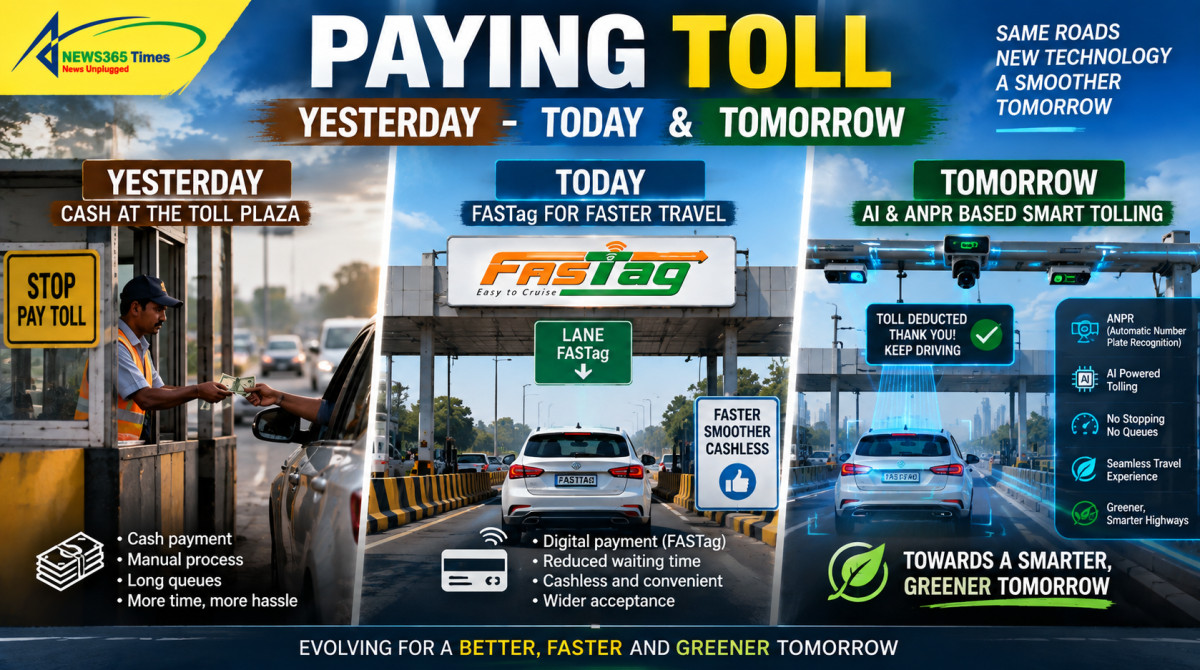
India’s highway payment systems have evolved across three distinct generations, moving progressively from human-dependent choke points to completely invisible, barrier-free infrastructure.
Why the New Barrierless System Is Required Most
While FASTag digitized money handling, it preserved the physical bottleneck. The new barrier-free architecture combining Multi-Lane Free Flow (MLFF) overhead gantries, Automatic Number Plate Recognition (ANPR), and Global Navigation Satellite System (GNSS) tracking solves four fundamental limitations of the older models:
- Eliminating Structural Bottlenecks: A 6-lane expressway squeezed into physical toll lanes forces high-speed traffic to decelerate, queue, and weave. Removing physical plazas prevents recurring highway shockwaves and eliminates idling emissions, saving thousands of crores in wasted fuel annually.
- True Distance-Based Equity: Under traditional regimes, a motorist traveling 5 km often pays the same fee as someone using the full 60 km segment. Satellite and entry/exit gantry tracking compute charges strictly for the kilometers driven, removing public friction over unfair flat-fee tolls.
- Real Estate & Maintenance Overhead: Garrisoned booths require extensive land acquisition, lighting, security, cash management logistics, and mechanical boom barrier maintenance. A wireless gantry or virtual satellite geofence drastically reduces highway footprint and operating costs.
- Zero Barrier-Level Failures: Optical or scanner alignment glitches, unreadable tags, low-balance disputes, and lane tailgating cause cascading delays at FASTag gates. High-speed ANPR combined with GNSS logs the vehicle via multi-sensor fusion, debiting the linked account or issuing an automated digital invoice in the background without halting the trip
The transition to barrier-free, Multi-Lane Free Flow (MLFF) and satellite (GNSS) tolling addresses edge cases from non-payment enforcement to extreme weather and vehicle categorization through automated digital rules rather than physical barricades.
How Penalties Work Without Barriers (Zero-Balance Vehicles)
Without boom barriers, evasion is prevented by shifting enforcement from physical gates to the VAHAN civil database and national digital notice systems:
- Digital E-Notice: If a vehicle passes an overhead gantry or geofenced highway stretch with zero balance, an unpaid user fee e-notice is generated via SMS, WhatsApp, and email with photographic proof.
- Grace Period vs. Double Toll: Motorists receive a 72-hour grace window to pay the original toll via the portal without any penalty. After 72 hours, the fee doubles automatically.
- VAHAN Blacklisting & Service Block: If unpaid after 15 days, the dues are permanently attached to the vehicles registration profile in the Ministry's central VAHAN registry. The owner is blocked from vehicle fitness renewal, ownership transfer (NOC), insurance claims, and pollution certificate (PUCC) re-issuance until the balance and penalties are cleared.
Weather Fail-Safes: Dense Fog, Smog, and Pollution
Delhi-NCR's winter inversion layers, extreme Air Quality Index (AQI) spikes, and zero-visibility radiation fog make purely visual cameras unreliable. The barrier-free architecture uses multi-sensor redundancy:
- GNSS/Satellite Priority: Unlike roadside cameras, satellite signals (using GPS and India's NavIC penetrate atmospheric particulate matter, smog, and fog without signal attenuation. The primary billing calculation comes from coordinate geofencing via the onboard unit (OBU) or smartphone telemetry, not optical line-of-sight.
- Infrared & High-Power Illuminator Gantries: ANPR cameras at highway gantries do not rely on visible light. They operate on narrow-band active 850nm / 940nm Near-Infrared (NIR) strobes and retro-reflective optical filters designed to penetrate heavy particulate fog and read high-contrast High Security Registration Plates (HSRP).
- Sensor Fusion Reconciliation: If a camera read is blurred by dense smog, the overhead short-range DSRC / RFID transceiver cross-verifies the physical tag on the glass while the GNSS logs the entry coordinates.
Commuter Passes and Local Subsidies
Under manual toll regimes, residents near had to present physical electricity bills and RC copies to obtain monthly discount passes. The wireless system automates this:
- Zero-Fee Distance Cushion: MoRTH regulations provide a statutory 20 km toll-free daily buffer in each direction for non-national permit personal vehicles on national corridors. If a local resident only drives 12 km on the expressway to reach an interchange, the system logs zero charge.
- Automated Geofenced Pass Schemes: Daily office commuters (e.g., Gurgaon to Delhi or Noida to Greater Noida) have digital monthly passes linked directly to their vehicle ID. The system matches daily trip counts and caps charges automatically without requiring physical stickers or renewal queues.
- The VAHAN Single Source of Truth: A camera or GNSS beacon maps the registration mark against VAHAN. The database dictates whether the plate belongs to a private car (white plate), commercial cab/Uber (yellow plate), state transport bus, or multi-axle freight carrier.
- Axle & Profile Verification: To prevent fraud (such as affixing a private car's tag to a 6-axle trailer), gantries incorporate overhead 3D LiDAR profilers and piezoelectric high-speed weigh-in-motion (WIM) sensors embedded in the tarmac. The profiler counts vehicle height, length, and axle configuration at full speed, instantly flagging class mismatches.
- Exempted Vehicles (2-Wheelers & 3-Wheelers): Two-wheelers and autos are toll-exempt on national expressways. Optical sensors ignore them for billing, but gantry enforcement cameras log them automatically for entry violations if the highway is strictly access-controlled.
What It Satisfies and Who Wins
- For the Daily Commuter: Zero slowdowns, zero fuel wasted idling in 500-meter queues, and fair billing (a 6 km short hop costs a fraction of the full-stretch toll instead of the full flat-rate fee).
- For Logistics & Fleet Operators: Indian commercial trucks previously averaged under 300 km/day due to checkpoints and toll plazas. Eliminating stopping cycles cuts delivery turnarounds, brake wear, and fleet fuel consumption.
- For Highway Authorities & Concessionaires: Toll evasion and physical plaza cash pilferage drop near zero. Real-time digital ledger integration provides predictable audit trails and lowers toll-plaza staff overhead.
What's Your Reaction?
 Like
0
Like
0
 Dislike
0
Dislike
0
 Love
0
Love
0
 Funny
0
Funny
0
 Wow
0
Wow
0
 Sad
0
Sad
0
 Angry
0
Angry
0

English Daily News Platform #News #Latestupdates #Tech #Business #Politics #Indianews #India. Regd No : JMAGC/HR/00072 (JMAGC ), MIB ,Govt of India









Comments (0)