
Towards Fast Disposal of Court Cases in India and Making Judiciary Accountable
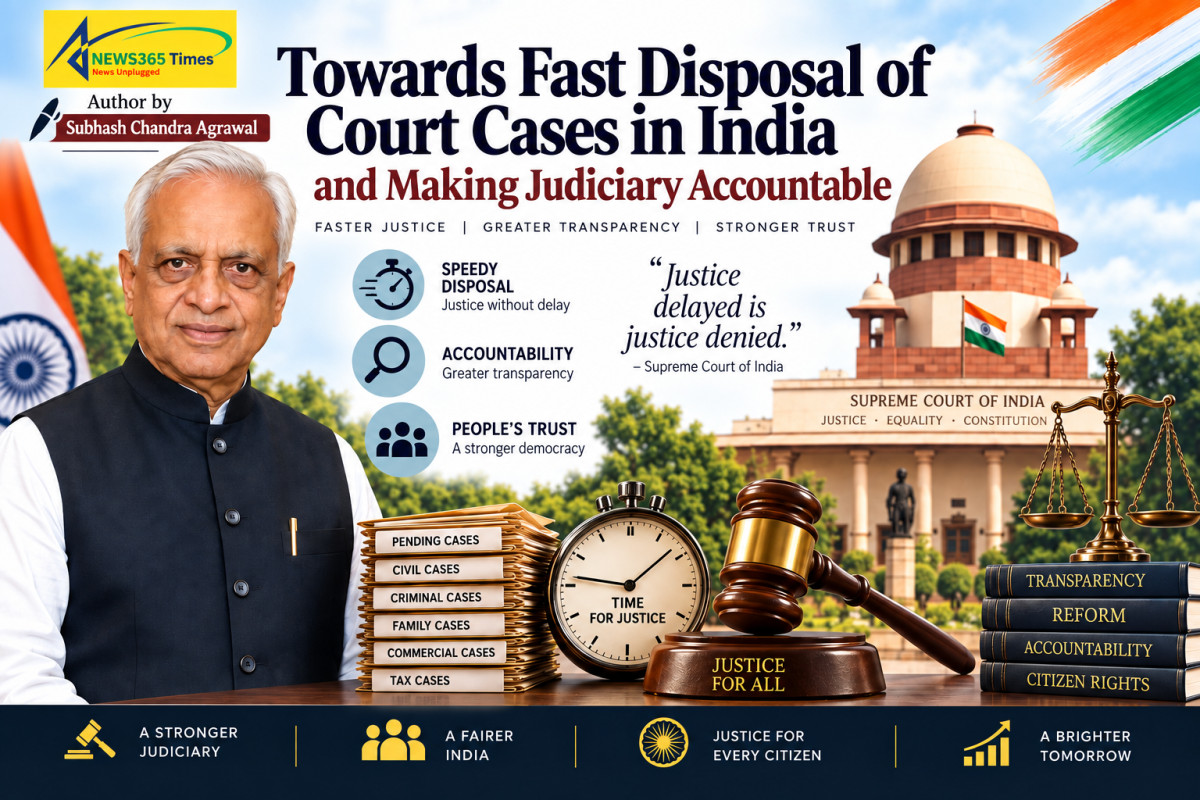
with about five crore cases pending in courts and tribunals of this country, India perhaps may be on top in cases in courts and tribunals both in respect of total number of cases and even according to court-cases proportionate to population thus making a much larger number of families and individuals always involved in tense-filled costly litigations paving way for judicial corruption at all levels with even Madras High Court Confessing- None can deny there is corruption in judiciary, judges are not holy cows- with India ranking poorly at 86th place out of 143 countries in WJP Rule of Law Index. Corruption in Indian Judicial System is also a factor for India ranking poorly at 96th place out of 180 countries in Corruption Perception Index While ranking at 118th place out of total 147 countries in World Happiness Report
Fast disposal of cases in Indian courts and tribunals on lines of developed countries can to some extent can overcome the problem as highlighted here-above. Much of time in Indian courts is spent on long adjournments where petitioners go on seeking adjournment after adjournment after managing an ex-party stay-order on first day of hearing. Division Bench of Supreme Court comprising of Justices RV Ravindran and JM Panchal in January 2009 observed and rightly too of the bitter reality that at times those having taken ex-party stay-orders seeking frequent adjournments in most cases ultimately lose the cases. Adjournments may be given only in exceptional cases. Court-cases should be contested mainly on basis of written arguments rather than on basis of oral arguments so that no law-point may be missing from records while there are every chances that oral arguments may not be fully become part of court-verdicts. System will again avoid adjournment-culture where at many times adjournments are sought on basis of non-appearance of arguing lawyers due to various reasons. Such a system will make litigations less costly because of less need of costly senior-designated lawyers required for oral arguments. Rather system of having senior-designated lawyers should be abolished altogether.Modern technology can further add to reduction of court-cases. Cheque-bouncing cases filed under section 138 of Negotiable Instrument Act can be drastically reduced by inserting a QR-code on every cheque where decoding of QR code may reveal complete details of cheques bounced from the bank-account/s may be available.
Another reason for such large number of court-cases is Perjury where it has become a usual tradition to speak lie in Indian courts and to file false affidavits with extremely low conviction-rate making wrong-doers worriless with no fear of law leading to a high crime-rate. Rajasthan High Court had to once direct action against two Oath Commissionershaving attested an affidavit while the applicant was out of the country. Such an illegal practice is quite common when usually Oath Commissioners and Notary Public fulfill formality of attesting documents without verifying the person or signature whose signatures are to be attested. Phenomenon of Oath-Commissioners and Notary Public where they usually charge fees much in excess than fixed by the government should be totally abolished. Instead power of attestation should be given to every registered lawyer. This will induce at least some accountability on lawyers too when they will be attesting for their clients. Power of attestation can also be given chartered-accountants, medical-practitioners, officers of government and public-sector-undertakings. Station-House-Officers (SHOs) of police-stations who presently do not have such powers, may be authorized and duty-bound to free-of-cost attest documents of those who do not have easy access to authorities mentioned above.
India is perhaps the only country where judges recommend to appoint judges in higher judiciary resulting in a constant tussle between legislature and judiciary. Collegium-system at Supreme Court for recommending appointments and transfers at Supreme Court and High Courts is also at times under criticism for some selected families observed as dominating Indian judiciary. It may also not be advisable to hand over appointment in higher judiciary solely in hands of political hands of legislature. A balanced approach can be achieved by instituting a high-powered National Judicial Commission having retired Supreme Court judges as member-nominees of President, Prime Minister, Leader of largest Opposition Party in Lok Sabha, Chief Justice of India (CJI) and Bar Council of India with Chief Vigilance Commissioner as ex-officio member of the Commission with Union Law Secretary as ex-officio member-secretary of such a Commission. CJI may head such a high-powered Commission. Recommendations of such a Commission should be final, and sent directly to President of India for a formal endorsement. Retirement-age of High Court judges should be raised to 65 years to be at par with that of Supreme Court judges to avoid any chances of lobbying for promotion as Supreme Court judges only because to be in system for three extra years. Reforms for future may be there to establish Indian Judicial Service (IJS) on lines of Indian Administrative Service (IAS) where those passing the tough competition may be appointed first at District Courts and ultimately to be elevated first to High Courts and then to Supreme Court.
To prevent chances of influencing locally appointed High Court judges either through their former bar-colleagues or local relations, all High Court judges should be compulsorily appointed outside from their home-states. To eliminate political bias in judiciary, it should be ensured that no person may be appointed as judge with an active political background. Even after retirement if any judge joins politics, he must lose all his post-retirement benefits. No judge should be given any post-retirement job anywhere after two years of retirement. It should be ensured that any person seated as CJI must get at least one year to be on post before he attains retirement-age of 65 years. Indian system is witness of contrast cases with Justice Kamal Narain Singh having been CJI for just 18 days (25.11.1991 to 12.12.1991) while Justice Yeshwant Vishnu Chandrachud having been CJI for more than seven years (22.02.1978 to 11.07.1985).
Suggested National Judicial Commission should also be empowered to probe all complaints against judges including Chief Justices of Supreme Court and High Courts, abolishing cumbersome and impractical system of removal of tainted judges through impeachment. It is noteworthy that in present system, there is no disciplinary authority for Chief Justice of India. Findings of the Commission and punishment suggested for such guilty-found judges should be endorsed for action with all post-retirement benefits of such tainted judges abolished. Even nothing could be done in the first-ever impeachment-case of Justice V Ramaswamy where the motion fell because of north-south divide of legislature. Tax-payers’ hard-earned money was wasted in paying a judge of a High Court for no work while on post and after retirement after the Supreme Court Collegium decided to recommend his impeachment. Judges are also human-beings picked up from the same society which has both honest and dishonest persons. Chairs of judges are not made from some divine material which can turn some undesirable one found entry as judge to turn fair.
Status of Chief Justice of India should be made at par with that of Union Cabinet Secretary, and of all other Judges of Supreme Court and High Courts at par with that Secretary in the Government in all respects of monetary and other benefits while on post and after retirement. However, for protocol purposes, Chief Justice of India and other Judges of Supreme Court and High Courts, existing position may be maintained. No extra-ordinary privileges should be provided to retired judges which presently also include life-time domestic help for them and their spouses after deaths of retired judges. Since pensions to government-employees has been done away, same system should be there for those in judiciary (and even in legislature).
All judges from Supreme Court to trial-courts must compulsorily record reason for recusal from the case on the file. Moreover, any such recusal should be informed immediately so that a new bench may be there for hearing without requiring any postponement of the hearing. A judge of Delhi High Court once recused herself from hearing a case where she herself issued notice to former President Pranab Mukerji after admitting a writ filed by some individual urging some contents of the book authored by the former President to be deleted. At times judges of higher courts have written to sitting Chief Justice of India about pressure and influence especially also from politicians. Making it compulsory to give reasons for recusal will prevent pressure and influence on judges.
Long summer vacations in courts were designed by erstwhile British rulers to save British judges in India from severe hot weather of this country, and also to facilitate them to visit their homeland. Unfortunately system continues in free India even after about eight long decades of independence, that too with long pendency of court-cases. Long-pending recommendation of Law Commission for scrapping long court-vacations should be implemented. Courts should adopt normal government-calendars for holidays abolishing system of week-long vacations for religious festivals apart from long winter and summer vacations.
Whole system of continuing naming High Courts is confusing where some High Courts are still named after cities where these are situated. Indian cities Bombay, Madras, Allahabad have since been renamed as Mumbai, Chennai and Prayag respectively long time back. But High Courts located in these cities are still officially named after old names of these cities. System should be that names of High Courts may get auto-changed with change in names of cities. Best is to end the British legacy by naming all High Courts after names of states rather than on cities. Proposed legislation should incorporate feature that names of High Courts may be automatically changed with change in name of states without needing any separate legislation.
What's Your Reaction?
 Like
0
Like
0
 Dislike
0
Dislike
0
 Love
0
Love
0
 Funny
0
Funny
0
 Wow
0
Wow
0
 Sad
0
Sad
0
 Angry
0
Angry
0

English Daily News Platform #News #Latestupdates #Tech #Business #Politics #Indianews #India. Regd No : JMAGC/HR/00072 (JMAGC ), MIB ,Govt of India






Comments (0)