
Matter of NCLT verdict dated 25.08.2026 quashing rupees 22000 crores of Subhash Chandra and his companies at 6.5 crores reaches NHRC
NCLT Verdict on Subhash Chandra’s Insolvency Case Draws Wider Scrutiny, Matter Reaches NHRC
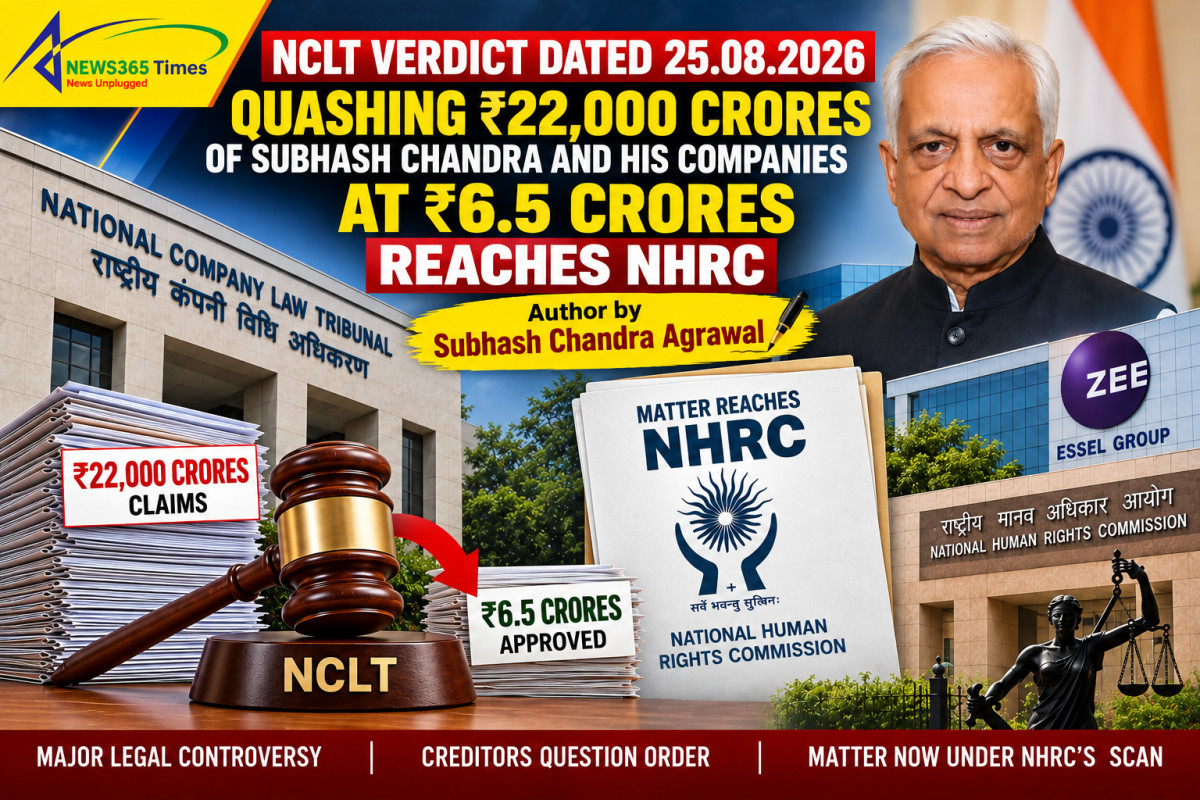
New Delhi: The controversy surrounding the National Company Law Tribunal (NCLT) order dated August 25, 2026, relating to the personal insolvency proceedings of Essel Group founder Subhash Chandra, has intensified, with the matter now reportedly reaching the National Human Rights Commission (NHRC).
The August 25 order had approved a repayment plan under which Subhash Chandra was to make a payment of around ₹6.25–₹6.5 crore against admitted creditor claims of approximately ₹22,006.57 crore. The extraordinary difference between the admitted claims and the proposed repayment drew widespread attention and triggered objections from several financial creditors.
The matter, however, has since taken a significant legal turn. On September 1, 2026, a five-member special bench of the NCLT stayed the August 25 order, observing that there was no clear majority view capable of being implemented. The tribunal directed that the matter be reheard and also restrained Subhash Chandra from transferring or otherwise alienating his assets during the pendency of the proceedings.
The dispute centres on claims arising largely from personal guarantees provided by Chandra for loans taken by companies associated with the Essel Group. While the headline figure of ₹22,000 crore represents admitted claims in the insolvency proceedings, Chandra's side has disputed the characterization of the entire amount as his personal debt and has stated that the claims against him as a personal guarantor are substantially lower.
Several dissenting creditors have raised concerns regarding the extremely low proposed recovery, the voting process and the inclusion of certain creditors allegedly connected with Chandra. The issue has also led to demands for closer scrutiny of asset disclosures and the overall insolvency process.
With the matter now reportedly brought before the NHRC, the controversy is expected to attract further attention. However, the exact nature of the representation, the allegations made before the Commission and whether the NHRC has formally taken cognisance would need to be independently confirmed through an official NHRC communication or case record.
The latest developments underline the continuing legal battle over one of the most closely watched personal insolvency cases in India. The outcome of the fresh NCLT hearing, along with any proceedings before the NCLAT or other authorities, could have wider implications for creditors, personal guarantors and the interpretation of India's insolvency framework.
What's Your Reaction?
 Like
0
Like
0
 Dislike
0
Dislike
0
 Love
0
Love
0
 Funny
0
Funny
0
 Wow
0
Wow
0
 Sad
0
Sad
0
 Angry
0
Angry
0

English Daily News Platform #News #Latestupdates #Tech #Business #Politics #Indianews #India. Regd No : JMAGC/HR/00072 (JMAGC ), MIB ,Govt of India







Comments (0)