
Kolkata Water Taxi: Can Bengal Turn Its Forgotten Canals into the Arteries to bring Fresh Life into Kolkata?
Now that the BJP and the idea of a “same machinery at the Centre and State” have come to power in West Bengal, with the ambition of governing for at least the next two decades, a much larger question arises: can Bengal make up for fifty years of lost development?
For decades, West Bengal’s political culture has been dominated by agitation, confrontation and ideological politics, first under the CPI(M) and subsequently under the TMC. Whatever one’s political allegiance, Bengal today needs more than incremental improvement. If it is to bridge a development gap accumulated over half a century, it requires something closer to a triple promotion, a leap in infrastructure, urban mobility and economic imagination.
So what could genuinely transform Bengal and, in particular, Kolkata?
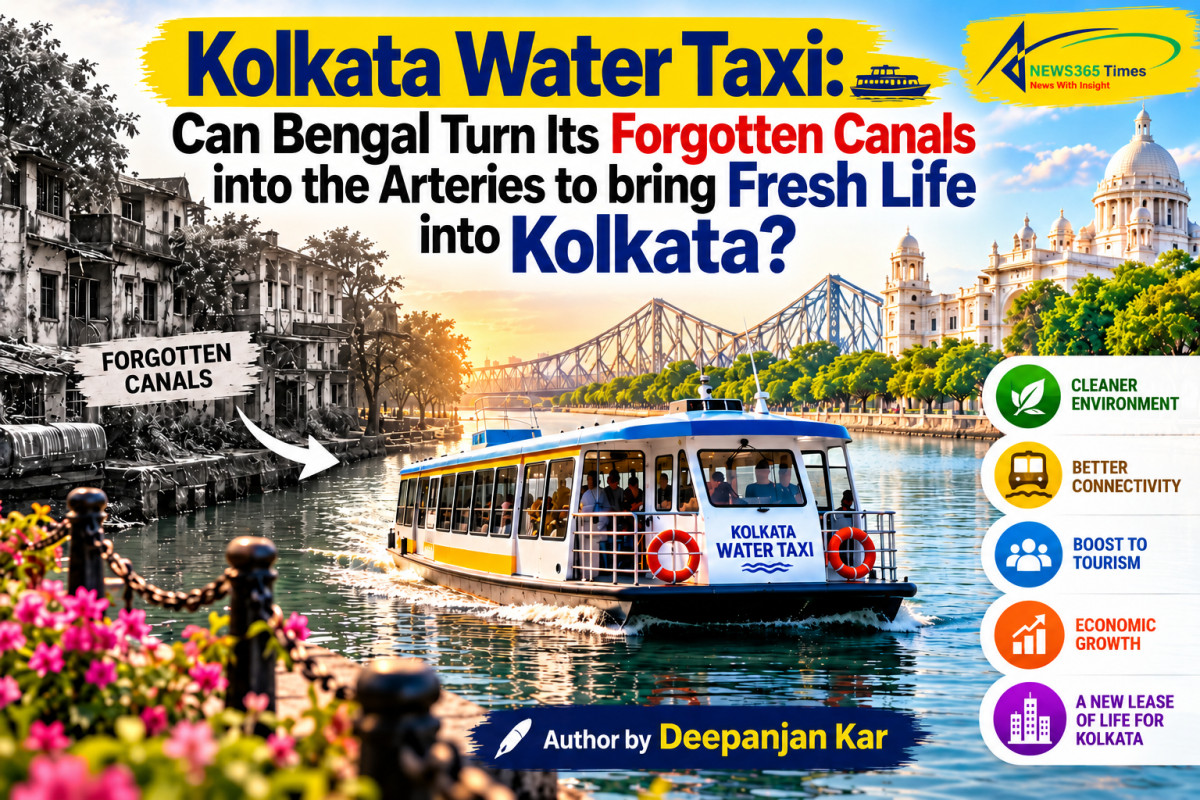
One compelling proposition is the “Kolkata Water Taxi”.
What makes this idea particularly attractive is that Kolkata would not be starting with a blank sheet of paper. The city already possesses a unique, extensive, but substantially under-utilised network of canals and waterways.
Historically, several of these waterways served both drainage and navigation functions. Tolly’s Nullah, the Circular Canal, Bhangore Khal and Kestopur Khal form part of Kolkata’s historic water infrastructure. Tolly’s Nullah dates back to 1777, the Circular Canal to the nineteenth century, while other waterways subsequently became important components of the region’s navigation and drainage network.
In other words, Kolkata already possesses much of the underlying physical inheritance: the canal network, a historical navigation legacy, drainage infrastructure and the institutional framework associated with these waterways.
The fundamental problem is that these assets have become fragmented across drainage, environmental management, transport and land-use functions. Instead of viewing the canals merely as drains or neglected waterways, Bengal should begin looking at them as strategic urban corridors.
Previous governments have spoken of transforming Kolkata into a world-class city, sometimes invoking comparisons with London. But recreating the appearance of another city through decorative street furniture or isolated architectural references can only go so far. A far more meaningful aspiration would be to learn from cities such as Amsterdam, not by imitating their appearance, but by adopting the principle that waterways can become living elements of a modern urban economy.
Kolkata could rediscover its own identity through its canals.
The proposal, therefore, should go well beyond a conventional “water taxi”. It could be conceived as a Canal-Based Integrated Urban Development & Mobility Corridor, with the canal functioning as the central spine around which multiple forms of urban infrastructure are integrated:
- water-based public transport;
- complementary elevated or surface mobility;
- pedestrian and cycling infrastructure;
- flood and storm-water management;
- environmental restoration;
- landscaped public spaces and waterfronts; and
- carefully planned redevelopment of adjoining land.
The most important point is that such an idea is neither historically alien to Kolkata nor conceptually unprecedented. The city’s canal system was once associated with both navigation and drainage, and previous metropolitan transport planning has also recognised the potential of Kolkata’s waterways for passenger and freight movement.
Why should Kolkata’s canals remain symbols of neglect when they could become arteries of renewal and rejuvenation.
A rejuvenated canal network could potentially address several challenges simultaneously: mobility, urban regeneration, environmental improvement, flood resilience and the revival of neighbourhoods along neglected waterways. The “Kolkata Water Taxi” could therefore become not merely another mode of transport, but the visible centrepiece of a larger twenty-first-century transformation of the city.
Bengal does not need to become another London or another Amsterdam.
It needs to rediscover what Kolkata already possesses, modernise it with imagination, and create a model that is unmistakably its own.
What's Your Reaction?
 Like
1
Like
1
 Dislike
0
Dislike
0
 Love
0
Love
0
 Funny
0
Funny
0
 Wow
0
Wow
0
 Sad
0
Sad
0
 Angry
0
Angry
0

English Daily News Platform #News #Latestupdates #Tech #Business #Politics #Indianews #India. Regd No : JMAGC/HR/00072 (JMAGC ), MIB ,Govt of India





Comments (0)