
Golden era of good old days : Jane Kahan Gaye Wo Din
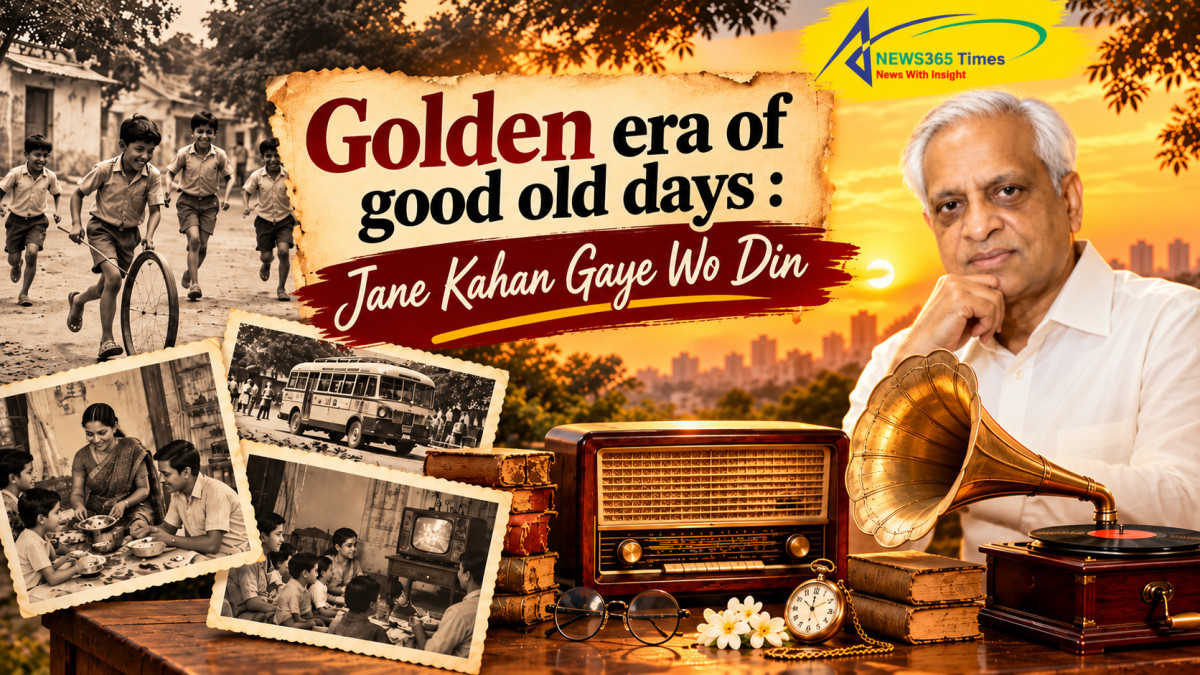
World-renowned Gazal-Maestro Jagjit Singh is best remembered for his gazal “Wo Kagaz Ki Kishti, Wo Barish Ka Pani” which reminds old-timers a golden era of good old days when family-members, young-children-elderly used to enjoy real family-life together full of eternal joy and harmony with all the family members enjoying dinner together after working head of the family returning home. Now-a-days, advanced culture of mobile-phones and television have made family-members living their own lives separately in their individual rooms. “Wo Kagaz Ki Kishti” having reemergence of persons of all ages gets was most applauded in live-programmes of Jgjit Singh.
People used to discuss on current events on shops of milk-curd and paan after listening to prime-time news-bulletins in Hindi (8.45 pm) and English (9 pm) broadcast by All India Radio (Akashwani) with radio-sets installed on every shop of paan and milk-curd. It was an era when roof-tops of houses were seen with TV-antennas and wired loop to get radio-signals to see favourite TV serials with Doordarshan having monopoly in telecast-service and Radio Ceylon getting huge earning from its famous “Binaca Geet Mala” presented every Wednesday by Amin Sayani. Children-programme every Sunday at 9 am was favourite breakfast time craze for children. “Aapki Chitthi Mili” with listener’s’ comments on Akashwani programmers at 12 noon to be followed by humour-filled “Laharen” and then “Aapki Psand” programme on listeners’ choice of famous film-songs were other attractions for listeners. There used be special programmes for women in the day while “News Sameeksha” gave a platform to people for improving news-bulletins of All India Radio (Akashwani). Hindi-dramas late at 9.30 pm was another famous feature at 9.30 pm which has since lost relevance in modern era’s over-stretched TV serials. Modern generation can never listen to golden impressive voice of renowned news-readers like Devkin Nandan Pandey (Hindi) and Melle-Vile-Demellow (English) in comparison to shouting TV news-readers of private channels. Likewise, “Hawa Mahal” was equally favourite night-programme broadcast from Akashwani.
Cricket-commentaries were enjoyed in sunny mornings relayed by Akashwani (All India Radio) by locals not going to stadiums. Those going to stadiums to enjoy doubly enjoyed the day-long event like a picnic by spreading bed-sheets on wider steps of the stadium with lunch taken along at the stadium during lunch hours. People in queues to enter stadium were given advertising materials by corporates like paper sun-shields.
Four-seaters providing point-to-point service were the economical public transport rather than present days’ e-rickshaws. For Delhites, people travelled from Fountain (Bhai Martidass Chowk) to Regal Cinema Hal at Connaught Circus (New Delhi). Cinema-tickets were commonly available in black-market where now-a-days cinema-halls have become heritage. Horse-driven tongas with rich families having their beautifully painted tongas and bagghies being common mode of travel in the city. Once even the then President of India Dr Rajendra Prasad once travelled in his famous bagghy pulled by six horses from Rashtrapati Bhawan to Chandni Chowk accompanied by his bodyguards on horses. Tram-service in Old Delhi was the cheapest mode of local travel from Lahori Gate, Lal Kuan, Chawri Bazar, Jama Masjid, Esplanade Road, Chandni Chowk and Khari Baoli then back to tram-station at Lahori Gate which also used to be market for old shoes. Those having private tongas used to enjoy lovely tonga-ride in streets of New Delhi with mercury-lights hanging on roads from top and heart-felt smell of Raat-ki-Rani flowers on both sides of roads.
There were mainly two zones of Delhi-110006 and New Delhi-11001 with so many colonies having been developed much later where earlier there was agricultural land only. There was Delhi Cloth Mills at Bara Hindu Rao run by famous Shriram Group where once even a lion was seen in the early morning probably coming from nearby forest where even dead bodies were seen in the morning after being looted and murdered by dacoits. Now there is Bara Hindu Rao Hospital at that place where earlier to be forest.
It was an era when sellers of various items including like chaats of various types, paani-puri, fruit-chaats, kulfis, Daulat-ki-Chaat, were sold by street-vendors unlike present days, when people have to visit eatery shops for enjoying such delicious dishes. Even there were street-vendors were selling cloth by roaming in streets. All these vendors used to sell these items by singing melodiously to attract customers.
Marriages used to be a month-long get together of close relations assembled together despite with all elders and children staying together in houses of family having marries-celebrations enjoying togetherness till late night with sharing rooms together differently for ladies, gents and children. Instead of individual bed-rooms for different family-members, complete family used to sleep on roof-tops with every one folding and spreading their sleeping kits by themselves. There used to be a unique unforgettable smell on roof-tops made of stone-plates when children had permanent duty to sprinkle water before laying down their charpais on roof-tops for sleeping. Indoor-games like Pahal-Dooj, rope-jumping etc giving good exercise for children are now replaced by costly gyms. Women used to grind wheat earlier washed and dried in sunlight in hand-rotated chakkis used to be a fine exercise for women. All the pesticides were washed out in pre-washed wheat. All such aspects used to provide a better and healthy life with less disseats while now most diseases are caused due to people getting away from such healthy life-style.
Dharmshalas, sprawling lawns of rich relations used to be venue for marriage-celebrations at a time when presently five-starred culture has moved not only marriage-functions but even sad after-death rituals are performed in five-starred hotels by rich and affording at times by taking loans for show of richness in status-conscious society. For upper-class people destination-marriage even at times in foreign countries have become quite common.
That was an era of family-lives being enjoyed together amongst elderly, youngsters and children alike enjoying dinner together when family-heads returned from their work-places. Ladies used to cook dinner by sitting on ground. Boiled milk slowly heated up on coal-fired stoves was enjoyed at bed-time rather than tea or whisky! It was duty of children to roll out beddings on cots woven by ropes rather than in present days’ bed-rooms individually.
I still remember of myself going in groups to far-away Wazirabad and then swimming in pure river water of holy Yamuna upto bathing ghat next to Nigambodh Ghat where we used to learn swimming which was also a wonderful exercise resulting in a sound sleep. Only such learning of swimming in rivers made Aarti Sah to create world-record in crossing English Channel on 29th September 1959. Elderly women from rich families used to take morning-bath in the holy Yamuna and then used to go for worshipping in their private tongas in various temples at Esplanade Road which is still now a street of temples with different deities.
Eleven days of Ramlilas starting from Ganesh-pujan and ending with Ram-Bharat Milap in those days were main attraction especially for children when Televisions were not so common. Children used to occupy chairs at Ramlila-venues as early as at 4 pm in the evening even though staging of Ramlilas used to begin late at 9 pm. Daily day-night processions with beautifully decorated chariots with two of them being of heritage importance having wooden horses with silver chairs and carvings on all the eleven days of Ramlila filled with many music-parties competing each other with latest orchestra, new dresses and popular hits of film-songs attracted huge crowd on both sides of roads were main attraction those days with villagers from nearby villages coming in bullock-carts during reverse journey of night-procession. Even on the day of Dussehra, a band of school-children from ASVJ School (Daryaganj) used to participate in front of Ram-chariot. Now in present era of coloured television and smart phones, all such aspects are things of past with day-night Ramlila processions remaining a mere formality. Even there are only few viewers of Ramlilas when people go to Ramlila views just to enjoy fabulous dishes of Delhi-6 with famous-most caterer of Old Delhi Lalaram Shrikishandass attracting most crowd with even VVIP guests enjoying his famous dishes cooked in pure Desi Ghee without onion and garlic.
That was an era when even children from rich and elite families went in government-aided schools run and managed by charitable trusts rather than sending children for studies in public schools. Students from government-aided ASVJ School in Daryaganj used to occupy top positions in merit-lists of Higher Secondary Examinations conducted by Central Board of Secondary Education.
What's Your Reaction?
 Like
0
Like
0
 Dislike
0
Dislike
0
 Love
0
Love
0
 Funny
0
Funny
0
 Wow
0
Wow
0
 Sad
0
Sad
0
 Angry
0
Angry
0

English Daily News Platform #News #Latestupdates #Tech #Business #Politics #Indianews #India. Regd No : JMAGC/HR/00072 (JMAGC ), MIB ,Govt of India






Comments (0)