
Indian Foreign Policy: Evolution, Achievements, Challenges and the Road Ahead
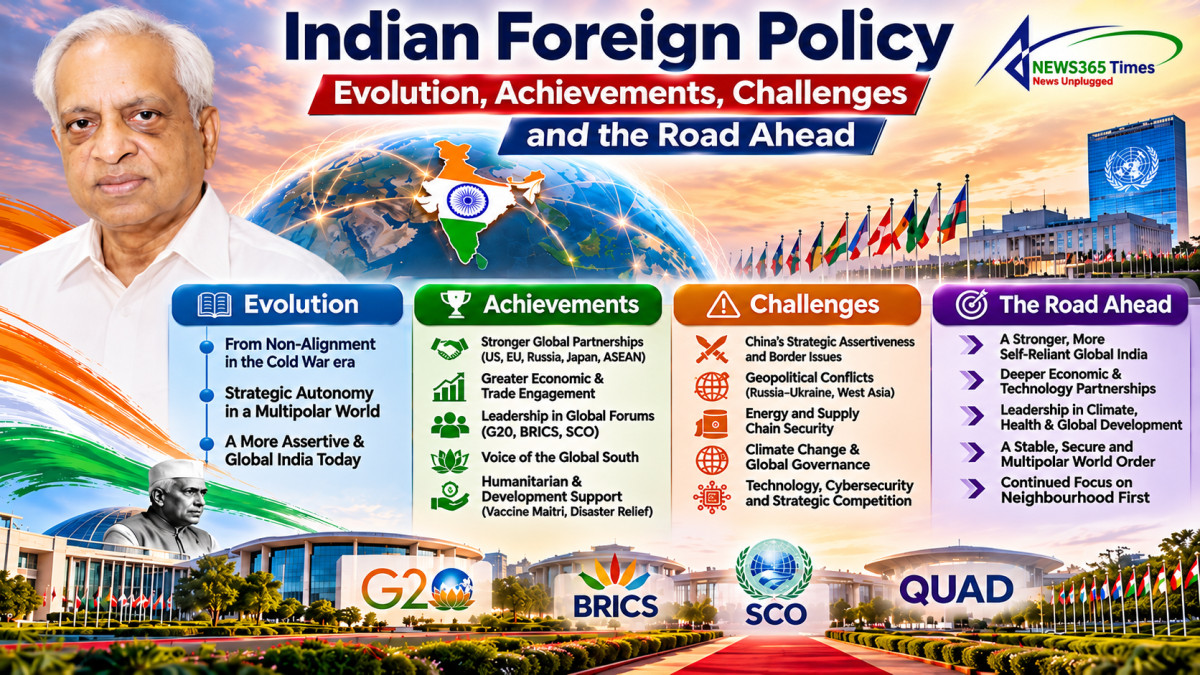
India's foreign policy since independence on 15 August 1947 has undergone a remarkable transformation. Emerging from nearly two centuries of British colonial rule, India inherited a difficult international environment, an economically impoverished population, the trauma of Partition, unresolved territorial disputes and the enormous responsibility of building a democratic nation. Its foreign policy therefore had to serve several objectives simultaneously: protecting national sovereignty, preserving territorial integrity, promoting economic development, maintaining international peace and securing an influential position in world affairs.
Over nearly eight decades, India's approach to international relations has reflected changing domestic priorities and international circumstances. The idealism of Jawaharlal Nehru, the security-conscious diplomacy of Indira Gandhi, the pragmatic initiatives of successive governments, the economic diplomacy following the 1991 reforms and the assertive strategic engagement of the twenty-first century have all contributed to shaping modern India's international identity. One important feature, however, has remained relatively constant: India's determination to retain independence in foreign policy and avoid becoming permanently subordinate to any major power bloc. India's journey has been from non-alignment to strategic autonomy, from economic self-reliance to global economic integration, and from regional aspirations to an increasingly prominent role in international affairs. But despite having recognizing Israel as a nation in the year 1950, Nehru’s pseudo-secular politics prevented India to have full diplomatic relations with Israel.
The Nehruvian Era (1947–1964): Non-Alignment and Independent Foreign Policy
Jawaharlal Nehru, India's first Prime Minister and also its first Foreign Minister, was the principal architect of independent India's foreign policy. He believed that political independence would be incomplete if India surrendered its freedom of judgement in international affairs to powerful countries. The international environment was dominated by the Cold War between the United States and the Soviet Union. Both superpowers were attempting to expand their political, military and ideological influence. Newly independent countries were frequently pressured to join one camp or the other. Nehru rejected this approach. He advocated non-alignment, which meant that India would not become a member of either military bloc and would retain the freedom to decide international questions according to its own national interests. Non-alignment did not mean neutrality, indifference or isolation. India could support one country on a particular issue and oppose it on another. The fundamental principle was independent judgement rather than automatic support for any superpower. India also played an important role in promoting Asian and African solidarity. The Asian Relations Conference in New Delhi in 1947 and the Bandung Conference of 1955 helped establish India's reputation as a champion of decolonisation, racial equality and the political independence of developing countries. In 1954, India and China agreed upon the Five Principles of Peaceful Coexistence, popularly known as Panchsheel:
- Mutual respect for territorial integrity and sovereignty.
- Mutual non-aggression.
- Mutual non-interference in internal affairs.
- Equality and mutual benefit.
- Peaceful coexistence.
These principles became an important part of India's diplomatic philosophy. India also became an active member of the United Nations, supporting international cooperation, peaceful settlement of disputes and the abolition of colonialism. However, Nehru's foreign policy was not without serious shortcomings. The most significant setback was the deterioration of relations with China. Despite the Panchsheel agreement and Nehru's efforts to establish friendship with Beijing, border disagreements gradually intensified. China's occupation of Tibet in 1950 and the subsequent disagreements over the Himalayan frontier created growing mistrust. The situation culminated in the Sino-Indian War of 1962, in which India suffered a humiliating military defeat. The war exposed serious weaknesses in India's military preparedness, intelligence assessment and diplomatic strategy. It demonstrated that goodwill and declarations of peaceful coexistence could not substitute for adequate defence capabilities. Nehru's international standing suffered considerably, and the defeat deeply affected his health and political authority. He died in May 1964. Nevertheless, his contribution to India's foreign policy remains fundamental. He established the principle that India should maintain independent relations with all major powers and should not allow its international choices to be dictated by external pressures. But despite having recognizing Israel as a nation in the year 1950, Nehru’s pseudo-secular politics prevented India to have full diplomatic relations with Israel.
Lal Bahadur Shastri (1964–1966): Security and Pragmatism
Lal Bahadur Shastri inherited a difficult international situation following the 1962 defeat. His government had to strengthen India's defence capabilities while simultaneously addressing economic difficulties and food shortages. In 1965, Pakistan launched military operations against India, leading to the Indo-Pakistan War. India successfully resisted Pakistani aggression, demonstrating that the country had recovered considerably from the military setback of 1962.
The Soviet Union played an important diplomatic role in bringing India and Pakistan to the negotiating table. The resulting Tashkent Agreement was signed on 10 January 1966, under Soviet mediation, by Shastri and Pakistani President Ayub Khan. Shastri died in Tashkent the following day under circumstances that have continued to attract public interest. His relatively short tenure reinforced an important lesson: India's foreign policy had to combine peaceful diplomacy with military preparedness and a realistic assessment of threats.
Indira Gandhi (1966–1977 and 1980–1984): Strategic Assertiveness
Indira Gandhi brought a more assertive and security-oriented approach to foreign policy. The most significant development of her first tenure was the Indo-Soviet Treaty of Peace, Friendship and Cooperation, signed in August 1971. The treaty was particularly important because the United States and China were developing closer relations with Pakistan, while Pakistan was facilitating diplomatic contacts between Washington and Beijing. India faced the possibility of a difficult strategic environment in the event of war with Pakistan. The treaty with the Soviet Union provided India with an important diplomatic and strategic counterweight. It did not formally make India a Soviet military ally, but it represented a substantial departure from the appearance of equidistance between the superpowers.
The Bangladesh Liberation War of 1971
The creation of Bangladesh in December 1971 was arguably the greatest diplomatic and military achievement of Indira Gandhi's foreign policy. Following the Pakistani military crackdown in East Pakistan in March 1971, millions of refugees entered India. The resulting humanitarian, economic and security crisis placed enormous pressure on the Indian government. India extended political and material support to the Bangladesh liberation movement. When war broke out in December 1971, Indian armed forces intervened alongside the Mukti Bahini. Pakistan's Eastern Command surrendered on 16 December 1971. Bangladesh emerged as an independent country. India's diplomatic preparation, military planning and international engagement contributed to a decisive outcome. The United States had moved its Seventh Fleet into the Bay of Bengal, while the Soviet Union provided India with important diplomatic support. The episode demonstrated that India could pursue its national interests despite opposition from major powers. In 1974, India conducted its first nuclear explosion at Pokhran, describing it as a peaceful nuclear explosion. This demonstrated India's scientific and technological capabilities and established the foundations of its subsequent nuclear policy. Indira Gandhi also pursued a more prominent role for India in the Non-Aligned Movement. During her second tenure, India faced a turbulent regional environment. The Soviet invasion of Afghanistan in 1979, the Iranian Revolution and growing tensions in West Asia altered the geopolitical landscape. India maintained close relations with the Soviet Union while attempting to preserve working relationships with Western countries and the Arab world. Her assassination in October 1984 brought this phase of Indian foreign policy to an end.
Rajiv Gandhi (1984–1989): Modernisation and Regional Engagement
Rajiv Gandhi sought to modernise India's international image and strengthen relations with technologically advanced countries. He placed greater emphasis on science, technology, telecommunications, economic cooperation and international development. His government attempted to improve relations with China. His visit to Beijing in December 1988 was particularly significant because it helped initiate a process of diplomatic normalisation after years of strained relations. However, India's regional intervention in Sri Lanka proved controversial. In 1987, India signed the Indo-Sri Lanka Accord and deployed the Indian Peace Keeping Force (IPKF) to help implement the agreement. The intervention eventually became a costly and politically complicated military engagement. The IPKF became involved in fighting the LTTE, and Indian forces withdrew in 1990. The experience demonstrated the limitations of military intervention in the internal conflicts of neighbouring countries. Rajiv Gandhi's tenure also witnessed India's involvement in the Maldives in 1988, when Indian armed forces intervened to defeat an attempted coup against President Maumoon Abdul Gayoom. The operation demonstrated India's capacity to act as a regional security provider.
With PV Narsimharao as Prime Minister
The collapse of the Soviet Union in 1991 fundamentally transformed the international environment. For decades, the Soviet Union had been India's principal strategic partner and a major source of defence equipment. Its disintegration created serious diplomatic, economic and military uncertainties. At the same time, India faced a severe balance-of-payments crisis. Prime Minister P. V. Narasimha Rao, who assumed office in 1991, recognised that India's foreign policy needed to adapt to the changing international economic and political environment. Economic liberalisation became a central component of foreign policy. India opened its economy, encouraged foreign investment, expanded international trade and began developing stronger relationships with the United States, Western Europe and East Asian economies. One of Rao's most important initiatives was the Look East Policy, launched in 1991. Its purpose was to strengthen India's economic, political and strategic relationships with Southeast Asia and the wider Asia-Pacific region. India subsequently developed closer relations with ASEAN countries and became increasingly engaged with East Asian institutions. India established full diplomatic relations with Israel in January 1992. This marked a significant change in its foreign policy, which had traditionally been influenced by solidarity with Palestine and the Arab world. India thereafter developed important defence, agricultural, technological and intelligence relationships with Israel, while continuing to support Palestinian statehood. PV Narsimharao rectified Nehru’s mistake by having full diplomatic relation with Israel in the year 1992. P. V. Narasimha Rao in the year 1994, made the strategic decision to appoint Leader of the Opposition Atal Bihari Vajpayee as the head of the Indian delegation to the United Nations Human Rights Commission (UNHRC) in Geneva to effectively counter Pakistan. It was the best-ever combination of Prime Minister and Opposition Leader, the world had ever seen.
With Atal Bihari Vajpayee as Prime Minister
In May 1998, Prime Minister Atal Bihari Vajpayee's government conducted a series of nuclear tests at Pokhran. India declared itself a nuclear-weapon state, although it was not recognised as such under the Nuclear Non-Proliferation Treaty. The tests attracted international criticism and economic sanctions, particularly from the United States and Japan. However, they also fundamentally changed India's strategic position. India subsequently declared a policy of credible minimum nuclear deterrence and a commitment to no first use, subject to the qualifications contained in its stated nuclear doctrine. The 1990s therefore marked a major transition from the relatively closed economic and diplomatic orientation of the Cold War era towards greater global engagement. Vajpayee's foreign policy combined national security assertiveness with an effort to establish constructive relationships with major powers. Despite the nuclear tests of 1998, he pursued improved relations with the United States. The negotiations between Indian External Affairs Minister Jaswant Singh and US Deputy Secretary of State Strobe Talbott helped reduce tensions and establish a foundation for closer bilateral relations. In February 1999, Vajpayee travelled to Lahore by bus and signed the Lahore Declaration with Pakistani Prime Minister Nawaz Sharif. The initiative was intended to improve relations and reduce the dangers associated with nuclear weapons. However, Pakistan's military establishment subsequently supported the Kargil intrusion in Jammu and Kashmir. The Kargil War of 1999 demonstrated the continuing hostility between the two countries and the difficulties of achieving lasting peace. India successfully expelled the intruding Pakistani forces and received substantial international diplomatic support.
Vajpayee's government continued to pursue dialogue, including the Agra Summit of 2001 and the subsequent peace initiatives. A major achievement of this period was the gradual improvement in India-US relations. India was increasingly viewed by Washington as an important democratic power, a potential economic partner and a significant actor in Asian security. Vajpayee also strengthened India's relations with Russia, France, Japan and other important countries. His government recognised that India's international influence depended not merely on military strength but also on economic growth, technological development and diplomatic credibility. It was Atal Bihari Vajpayee who ordered to put photo of Pandit Jawaharal Nehru in South Block again which was removed by foreign-ministry officials after fall of Congress-led government.
Manmohan Singh (2004–2014): Global Integration and the Indo-US Nuclear Agreement
The government led by Prime Minister Manmohan Singh continued India's integration into the international economic and political system. India's rapid economic growth during this period strengthened its international standing. Its expanding market, skilled workforce and technological capabilities made it an increasingly attractive partner for major economies. The most important foreign policy achievement of this period was the Indo-US Civil Nuclear Agreement. Negotiations culminated in the 2008 agreement, which ended India's decades-long isolation from much of the international civilian nuclear trade. The agreement was particularly significant because India was not a signatory to the Nuclear Non-Proliferation Treaty but nevertheless received access to international civilian nuclear cooperation. The Nuclear Suppliers Group granted India a waiver in September 2008, allowing it to participate in international nuclear commerce. This represented a major diplomatic success and acknowledged India's growing importance in international affairs. The Manmohan Singh government made several attempts to improve relations with Pakistan. The composite dialogue process addressed Kashmir, terrorism, trade, water and other outstanding disputes. However, the terrorist attacks in Mumbai on 26 November 2008, which killed more than 160 people, severely damaged the peace process. India insisted that meaningful dialogue could not proceed without credible action against terrorist organisations operating from Pakistani territory. India's economic and diplomatic engagement with China expanded substantially during this period. Bilateral trade increased, high-level visits took place and negotiations continued over the boundary dispute. However, the growing trade deficit and China's increasing strategic and military presence in India's neighbourhood remained concerns. India became increasingly active in international institutions and groupings. Its participation in the G20, BRICS, East Asia Summit and other multilateral platforms reflected its desire to influence global economic governance. India also continued demanding reform of the United Nations Security Council, including permanent membership for itself. The Manmohan Singh years thus witnessed the consolidation of India's emergence as an important global economic and diplomatic power.
Narendra Modi (2014–Present): Strategic Autonomy, Multi-Alignment and Global Ambitions
The assumption of office by Narendra Modi in May 2014 brought a more visible, energetic and leader-driven style of foreign policy. Modi attached considerable importance to international travel, summit diplomacy, personal relationships with world leaders and projecting India's image as an emerging global power. The underlying approach has often been described as multi-alignment: maintaining productive relations with competing powers without entering an exclusive alliance with any one of them. This is an evolution of the traditional principle of non-alignment rather than its complete abandonment. One of Modi's earliest initiatives was the Neighbourhood First Policy. The leaders of neighbouring South Asian countries were invited to his swearing-in ceremony in May 2014. India sought to strengthen relations with Bangladesh, Bhutan, Nepal, Sri Lanka, Maldives and other neighbouring countries through trade, infrastructure, electricity cooperation, connectivity and development assistance. The settlement of the India-Bangladesh land boundary issue in 2015 was an important diplomatic achievement. India also provided significant economic assistance to Sri Lanka during its severe economic crisis in 2022. However, India's neighbourhood policy has encountered difficulties. Relations with Nepal have periodically been strained, particularly following the 2015 constitutional crisis and the subsequent border controversy. Relations with Bangladesh have also experienced political and diplomatic uncertainties. The growing Chinese economic and strategic presence in South Asia has created an additional challenge. Pakistan remains the most difficult bilateral relationship because of cross-border terrorism and the unresolved Kashmir dispute. In 2014, the government upgraded the Look East Policy into the Act East Policy. The objective was to expand India's engagement with ASEAN, Japan, South Korea, Australia and other Indo-Pacific countries. India has increasingly emphasised maritime security, connectivity, trade, defence cooperation and regional stability. The policy is particularly important because Southeast Asia lies at the intersection of major international trade routes and the strategic competition between China and the United States. India's participation in the East Asia Summit and ASEAN-led regional institutions reinforces its commitment to an open and inclusive Indo-Pacific. India-US relations have strengthened considerably over the past decade. Defence cooperation, technology, intelligence sharing, maritime security, trade and investment have become important pillars of the relationship. The United States increasingly regards India as an important partner in maintaining the balance of power in the Indo-Pacific. The four-member grouping known as the Quad, comprising India, the United States, Japan and Australia, has become an important platform for cooperation. Its agenda includes maritime security, infrastructure, critical technologies, supply-chain resilience and regional stability. India, however, has consistently avoided describing the Quad as a military alliance. There have also been differences between India and the United States concerning trade, tariffs, immigration, human rights and India's relationship with Russia. These disagreements illustrate the limits of strategic convergence. India's relationship with Russia remains one of the most important continuities in its foreign policy. Russia has historically been a major supplier of India's defence equipment and continues to play an important role in defence technology, energy and nuclear cooperation. The Russian invasion of Ukraine in February 2022 created a difficult diplomatic situation for India. India abstained from several United Nations resolutions criticising Russia and called for dialogue and diplomacy to resolve the conflict. It also continued purchasing substantial quantities of Russian oil, partly because of the availability of discounted supplies. Western governments, particularly the United States and European countries, expressed concerns about these purchases. India maintained that its energy policy must be guided by national economic interests and the welfare of its population. This episode clearly demonstrated India's continuing commitment to strategic autonomy. It was unwilling to abandon a longstanding strategic relationship simply because of pressure from Western powers. China represents perhaps the most complicated strategic challenge facing India. The two countries have substantial economic interdependence but also serious political, military and territorial disagreements. The Doklam confrontation of 2017 and the deadly Galwan Valley clash of June 2020 exposed the fragility of bilateral relations. Twenty Indian soldiers and an undisclosed number of Chinese soldiers lost their lives in the Galwan confrontation. India responded with military deployments, economic measures and restrictions on several Chinese applications. The relationship subsequently witnessed attempts at stabilisation through military and diplomatic negotiations. An important development occurred in October 2024, when India and China reached an understanding concerning patrolling arrangements in the Depsang and Demchok areas of eastern Ladakh. This helped facilitate disengagement in the remaining friction areas covered by the arrangement and created opportunities for renewed diplomatic engagement. Nevertheless, the boundary dispute remains unresolved. India must therefore combine diplomatic engagement with military preparedness and infrastructure development along its northern borders. India's policy towards Pakistan has remained dominated by cross-border terrorism. The Pathankot airbase attack in 2016 and the Uri terrorist attack in the same year led to a more assertive Indian response. Following the Uri attack, India announced that its armed forces had conducted surgical strikes against terrorist launch pads across the Line of Control. In February 2019, following the Pulwama terrorist attack that killed 40 Indian security personnel, India conducted an airstrike against a terrorist training facility at Balakot in Pakistan. These developments marked a shift towards a willingness to employ military instruments in response to major terrorist attacks. The Pahalgam terrorist attack of April 2025, which killed 26 civilians, further intensified India-Pakistan tensions. India subsequently launched Operation Sindoor in May 2025, targeting terrorist infrastructure in Pakistan and Pakistan-administered territory. The ensuing military confrontation and its eventual cessation demonstrated the continuing danger of escalation between two nuclear-armed neighbours. India's position has remained that terrorism and normal diplomatic relations cannot coexist without credible action against terrorist infrastructure. India's foreign policy towards West Asia has become increasingly sophisticated. Historically, India's relationship with the Arab world was influenced by energy security, the welfare of millions of Indian expatriates and support for the Palestinian cause. However, India has also developed a strong strategic partnership with Israel. Under Modi, relations with Israel have expanded in defence, agriculture, water management, intelligence, science and technology. At the same time, India has maintained close relationships with Saudi Arabia, the United Arab Emirates, Qatar, Iran and other countries in the region. This balanced approach reflects India's recognition that its interests in West Asia cannot be pursued through exclusive relationships. The India-Middle East-Europe Economic Corridor (IMEC), announced in 2023, represents an ambitious attempt to strengthen trade and connectivity between India, the Middle East and Europe. Its implementation, however, depends on regional stability, financing and cooperation among participating countries. India has increasingly presented itself as a voice of developing countries. The Global South includes countries in Asia, Africa, Latin America and other developing regions that frequently face common problems concerning poverty, development finance, food security, energy, technology and climate change. India hosted the Voice of Global South Summit in January 2023 and made development concerns a prominent part of its international diplomacy. Its successful hosting of the G20 Summit in New Delhi in September 2023 was another important diplomatic achievement. The inclusion of the African Union as a permanent member of the G20 during India's presidency was particularly significant. India also promoted the idea of a more representative and equitable international order. Its approach has sought to bridge the concerns of developing countries and the priorities of advanced economies. India has maintained active participation in BRICS and the Shanghai Cooperation Organisation. These institutions provide India with opportunities to engage countries that are not necessarily aligned with Western strategic interests. BRICS has become particularly significant as its membership has expanded and its agenda has broadened to include development finance, trade, international monetary arrangements and global governance. India's participation in these groupings does not mean that it has abandoned its partnerships with Western countries. Instead, it demonstrates the practical application of multi-alignment. A major feature of contemporary Indian foreign policy is the growing importance of economic and technological considerations. India has sought to reduce dependence on foreign defence suppliers through domestic manufacturing under initiatives such as Make in India and Atmanirbhar Bharat. Defence exports, cooperation in semiconductor manufacturing, space technology, artificial intelligence, digital public infrastructure and critical minerals have acquired increasing diplomatic importance. India's technological capabilities, particularly in information technology, space exploration and digital payments, have also become instruments of international cooperation. The government has increasingly recognised that economic strength and technological independence are essential components of national security. The years 2025 and 2026 have presented India with particularly complex diplomatic challenges. The international order is becoming increasingly unpredictable. The United States and China are competing for economic, technological and military supremacy. Russia's war with Ukraine continues to affect international security and energy markets. Conflicts in West Asia have created uncertainty over energy supplies, trade routes and regional stability. India has attempted to preserve its strategic autonomy while strengthening relationships with countries representing different geopolitical interests. The relationship with the United States remains essential to India's long-term interests, particularly in defence, advanced technology, investment and the Indo-Pacific. However, trade disagreements and American pressure concerning India's purchases of Russian oil have demonstrated that even close strategic partners can have conflicting economic interests. In 2026, negotiations have continued towards improving trade relations and expanding cooperation in energy, defence and technology. The important lesson for India is that strategic partnership should not be confused with surrendering independent economic and diplomatic decision-making. India continues to attach importance to Russia because of longstanding defence cooperation, energy requirements and its wider geopolitical interests. The challenge is to maintain this relationship without compromising India's expanding economic and technological partnerships with the United States and Europe. India must also take account of Russia's increasing dependence on China. The relationship therefore requires careful management rather than unquestioning political alignment. The gradual improvement in diplomatic engagement between India and China does not mean that the fundamental differences have disappeared. The unresolved boundary dispute, China's close relationship with Pakistan and its expanding influence in South Asia remain major concerns. In 2026, both countries have continued exploring incremental improvements in their relationship, including diplomatic and economic engagement. However, the border question remains central to the future of bilateral relations. India's diplomatic influence increasingly depends on its ability to represent the concerns of developing countries.
Its priorities include:
- Reform of the United Nations Security Council.
- Greater representation of developing countries in international financial institutions.
- Affordable access to technology.
- Climate finance and equitable energy transitions.
- Food and energy security.
- International cooperation against terrorism.
- Development assistance and infrastructure financing.
India's development partnerships and regional connectivity initiatives remain important instruments of its foreign policy. An increasingly important dimension of Indian diplomacy is technological cooperation. Artificial intelligence, cybersecurity, semiconductor manufacturing, space exploration, digital infrastructure and critical minerals are now central to international economic and security competition. India has considerable opportunities in these fields, but it must also reduce excessive dependence on foreign technologies. A parliamentary committee report in September 2026 highlighted the need for a more integrated Indian strategy covering digital governance, artificial intelligence, cybersecurity and space diplomacy. The importance of this emerging area cannot be overstated. In the coming decades, technological independence may prove as important as military strength in determining a country's international influence. Looking at India's foreign policy from 1947 to 2026, it is possible to identify several important achievements, as well as areas where its performance has been less satisfactory.
India and UN not taking effective steps to prevent atrocities on Hindus in Bangladesh
Following the student-led uprising that forced Sheikh Hasina from power in August 2024, Bangladesh has experienced major political upheaval, legal action against minority rights leaders, and ongoing debates regarding the scale of violence against religious minorities. Chinmoy Krishna Das, a prominent Hindu monk, head of the Pundarik Dham in Hathazari, and spokesperson for the Bangladesh Sanatan Jagaran Mancha, was arrested in November 2024. Authorities charged him with sedition over allegations that Bangladesh's national flag was disrespected during a minority rights rally in Chattogram. On 11th September 2026, Chattogram district authorities granted Das a five-hour parole to attend the funeral rites of his 70-year-old mother, Sandhya Rani Dhar, in Hathazari before returning him to jail. Accounts regarding the severity and nature of attacks on Hindus and other minorities in Bangladesh vary significantly across advocacy groups, media outlets, and government officials. Minority rights organizations, such as the Bangladesh Hindu Buddhist Christian Unity Council (BHBCUC), have reported widespread communal violence since Hasina's exit. Data cited by rights monitors in November 2026 documented nearly 3,000 incidents of communal violence between August 2024 and June 2026, including 146 minority deaths (119 Hindu) through October 2026, alongside attacks on temples, vandalism of homes and businesses, and forced resignations of Hindu educators. Minority Hindu population in Bangladesh has shrunk to just eight-percent from earlier 22-percent in erstwhile east Pakistan to 13.5-percent in the year 1974 (first census after formation of Bangladesh) and now less than eight percent due atrocities and killings of Hindus and their conversion to Islam.
But surprisingly no one from the world including even India which played an important role in freedom of Bangladesh in the year 1971 are keeping total silence on torture, killings, rapes, kidnappings, forced conversion to Islam and other atrocities on minority Hindus in Bangladesh. India, Israel and other such like-minded countries should immediately approach United Nations Organization (UNO) for an immediate and strict joint military action in Bangladesh to ensure a peaceful and safe living of Hindus there and to create a fear-psychology against atrocities on Hindus there. Nobel Peace Prize given to Mohammed Yunus in the year 2006 should be snatched back for his being established as enemy to Peace by being a mute spectator to atrocities on minority Hindus in Bangladesh during his short regime in the country.
What's Your Reaction?
 Like
0
 Dislike
0
 Love
0
 Funny
0
 Wow
0
 Sad
0
 Angry
0

English Daily News Platform #News #Latestupdates #Tech #Business #Politics #Indianews #India. Regd No : JMAGC/HR/00072 (JMAGC ), MIB ,Govt of India






Comments (0)