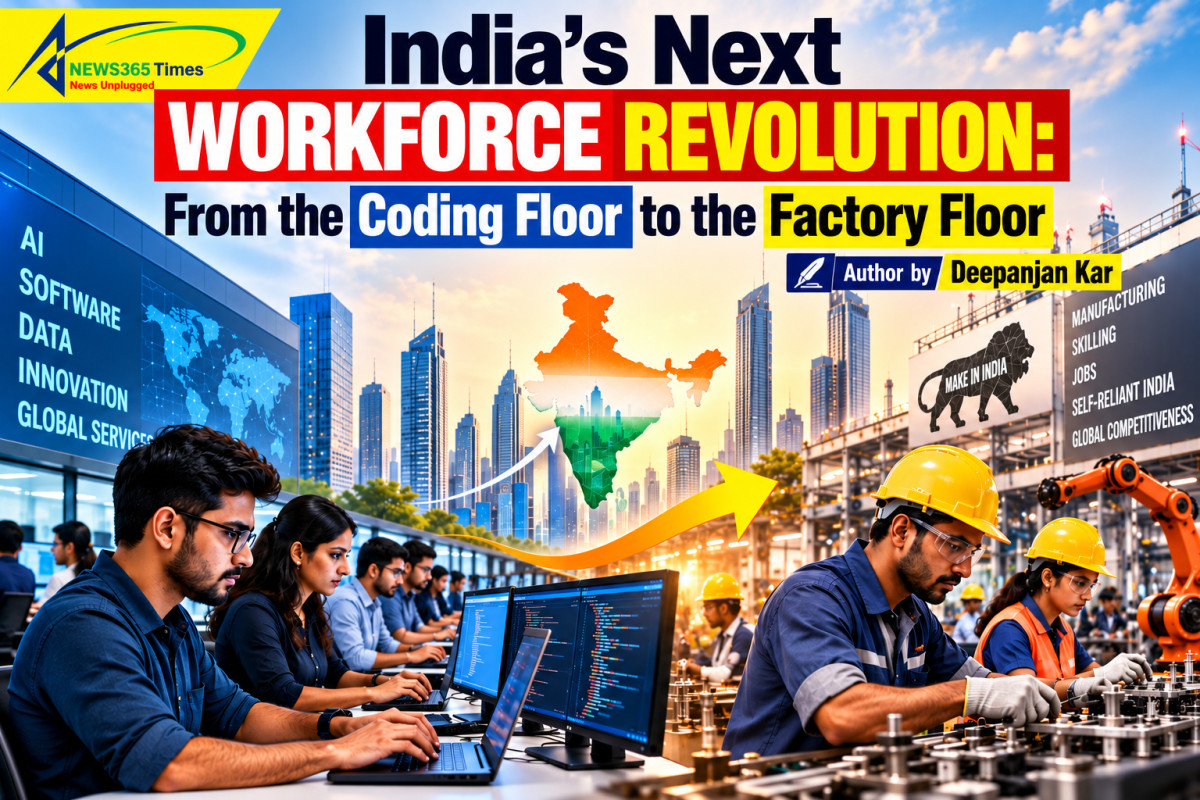
India did not merely become the world’s IT and outsourcing hub by chance. The foundation was laid when some of the world’s largest corporations began rethinking their operating models, offloading software development and other non-core support functions in their pursuit of cost optimisation, efficiency and higher profitability.
India was perfectly positioned to absorb this opportunity. Its enormous pool of educated, technically capable and cost-competitive manpower provided global enterprises with the scale and talent they needed. What started as a relatively simple outsourcing model soon evolved into a sophisticated global delivery ecosystem.
Over the past two decades, this model scaled to unprecedented proportions, transforming India into a global powerhouse for software services, business process management, technology support and, eventually, global capability centres.
In the late 1990s and 2000s, when the US Dollar, Euro and Pound were fuelling a global outsourcing wave for IT, KPO, BPO and later GCCs, India’s part visionary, part profiteer’s made a bet: mass-produce engineers for these jobs. From 750 engineering colleges in 1995’s (with TCS, Infosys, Wipro setting up offices worldwide) to over 3,500 by 2014, we created the largest English-speaking technical workforce in history. It was ahead of the curve. It truly worked.
But every overbuilt model has a decay curve. By 2018-19, AICTE itself was shutting down seats. Placement rates in Tier 2/3 colleges fell below 60%. The product was degree-rich, skills-poor, and now the core buyer, the routine IT services, L1 support, mass coding, back-office analysis were facing their own automation shock from the advent of AI. The same demographic dividend that was once plugged into Bangalore now faces a white-collar bottleneck.
Just as once a greatest story fell weaker, a second, far more physical story saw itself strengthening.
The Great Re-Plumbing: From Services to Manufacturing
For 30 years, India tried to become a manufacturing hub and couldn't. Now three forces were aligning at once:
Geo-economics: China+1, PLI schemes, and global supply chains were de-risking by moving electronics, semiconductors, EV’s, precision components and specialty chemicals to India.
Domestic demand: 1.4 billion consumers, EV’s, green energy, defense indigenisation are creating internal manufacturing consumption that doesn't depend on exports.
Infrastructure: Mumbai-Delhi Industrial freight corridors, new sea ports, industrial cities in Tamil Nadu, Gujarat, Maharashtra, AP, UP, MP, Assam, facilities are mushrooming left, right and centre. Companies from Foxconn and Micron to Tata Electronics and L&T are building shop floors faster than we can staff them.
This is where the core insight lands: there is no manpower problem if we reframe manpower. India does not lack engineers. It lacks production-ready technicians, tool-room operators, mechanical & electronics integrators, SMT line engineers, die-casting specialists, polymer technicians, industrial electricians, and chemical plant operators who can be plugged into the line on Day 1.
An engineering degree teaches you to derive the formula for injection molding. A vocational academy teaches you to run a plastic moulding machine with high effectiveness. Industry needs the second.
If we had built 1,000 hands-on Manufacturing Academies besides the 1,000 more generic engineering colleges, the transition would be seamless today.
What a Modern Vocational Academy Actually Is
Not an ITI 1.0. Not a theory-heavy polytechnic. A modern academy is:
Branch-specific but integrated: Separate tracks for Mechanical & Tooling, Electronics & SMT, Electrical & Automation, Chemical & Process, Plastics & Composites, Metal Forming & Welding, but all under one roof with shared Industry standards and format.
Machine-first, classroom-second: 70% shop floor, 30% classroom. Realtime handling of computer numerical control, programming logic control, variable frequency drive, collaborative robots, electrostatic lines, clean rooms.
Production : Students produce actual parts for the finished goods, not dummy jobs. Quality rejection is part of grading.
3-month to 18-month stackable: Certificate to Advanced Diploma, with lateral entry for B.E. graduates who need re-skilling.
This is the jump-start resource you are talking about.
A viable 4-pillar funding model for state governments and manufacturing firms:
State Gives What Only State Can: Land, Students, and Legitimacy
State government provides long-lease industrial land inside or adjacent to WBIDC/GIDC/MIDC parks - not in a remote education zone. It provides capital subsidy through existing schemes - SANKALP, STRIVE, state skill missions - and crucially, integrates academy certification with state employment exchanges and apprenticeship portals. Cost: 30% of total, mostly non-cash.
Anchor Firm Gives What Only Firm Can: Machines, Curriculum, and Offtake
A consortium of 3-5 anchor firms in that cluster, say, an auto OEM, a Tier 1, and an electronics EMS - contributes second-life but current-gen machinery, master trainers, live SOPs, and a binding offtake: "We will hire X% or give paid OJT to Y students per batch." Their capex is booked as CSR + PLI skilling incentive + asset they can depreciate. Cost: 35-40%.
The Academy Runs as a Special Project Vehicle, Not a Department. Set up as a company with a board of State Skill Mission + Anchor Firms + NSDC. Revenue streams: student fees capped at Rs. 30-50k subsidized via loans, production revenue from job-works done by trainees, and short-term upskilling fees paid by MSMEs around the park. This makes it self-sustaining after year 3. Viability Gap Funding covers the first 2 years.
Central Schemes as Multiplier
Link every academy to: PM Kaushal Vikas Yojana for operating cost, Apprenticeship embedded degree, and DST's NIDHI for tooling startups spun out of academy. Firms get reimbursement of stipends under NAPS.
Tamil Nadu's partnership with for 42 TNSDC- Siemens Centres of Excellence, and Karnataka's MoU with and Bosch for Advanced Manufacturing Centres, already prove the template. Gujarat's partnership with Micron for semiconductor technician training inside Sanand GIDC is the newest avatar.
Why This Solves Three Problems at Once
For youth: A B.E. Mechanical graduate from a Tier-3 college in Coimbatore facing AI-driven hiring freeze in IT can do a 6-month Mechatronics & EV Drivetrain academy inside Hosur and get placed at Rs. 4.5 LPA on the shop floor - a job AI cannot offshore.
For industry: Instead of spending 8 months re-training freshers, they get line-ready resources. Attrition drops because skills are locally rooted.
For the state: It converts an unemployability crisis into an industrialization accelerator. Every 100 crore PLI investment needs 1,200 trained technicians. If you create the academy before the factory, the factory stays.
India's first engineering boom was a bet on brains exported over software & Internet. The second manufacturing boom must be a bet on hands trained on metal, plastic, silicon and chemicals.
We don't need fewer institutions. We need different institutions. Overproduction of engineers was not a mistake, it was rehearsal. The infrastructure, the parental aspiration for technical education, the private capital willing to invest in colleges, all exist. Now redirect that energy from white-collar dream to shop-floor reality.
Public-Private Partnership for vocational academies is not charity. It is the most efficient plug that connects India's demographic surplus to the world's manufacturing deficit.

 Like
1
Like
1
 Dislike
0
Dislike
0
 Love
0
Love
0
 Funny
0
Funny
0
 Wow
0
Wow
0
 Sad
0
Sad
0
 Angry
0
Angry
0









Comments (0)