
Reforms required in Governance ofIndia: Regulations of NGO’s necessary
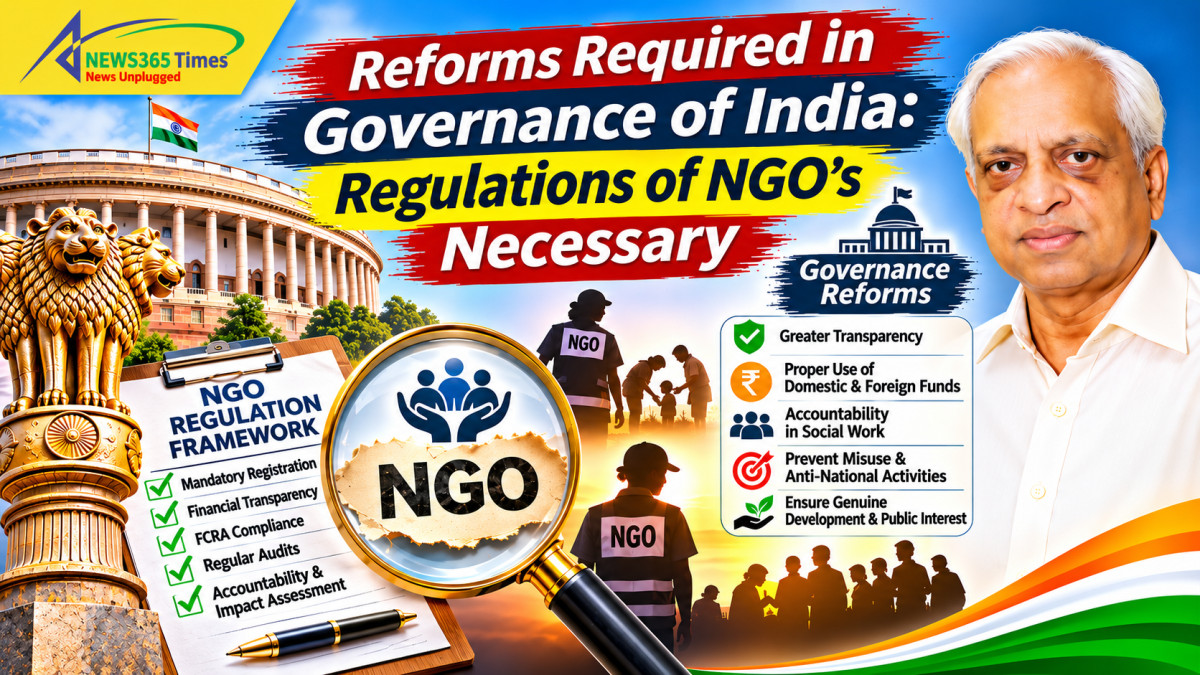
Governance reforms in India have shifted from centralized planning and bureaucratic controls toward digital public infrastructure, citizen trust, and institutional modernization. According to the Department of Administrative Reforms and Public Grievances and NITI Aayog, recent initiatives focus on "Minimum Government, Maximum Governance" and long-term structural alignment toward Viksit Bharat@2047.
Key Pillars of Recent Reforms
Digital & Citizen-Centric Delivery: Expansion of e-Governance, paperless offices (e-Office), Direct Benefit Transfers (DBT), and faster grievance redressal systems.
Trust-Based & Regulatory Shifts: Measures like self-attestation of documents, decriminalizing minor offences under the Jan Vishwas initiative, and easing compliance burdens for businesses and citizens.
Civil Services & Recruitment: Initiatives such as Mission Karmayogi for role-based capacity building, abolition of interviews for lower-category posts, and stricter anti-cheating laws for public examinations.
Institutional & Sectoral Modernization: NITI Aayog's Governance & Reforms Division—established in April 2025—coordinates cross-cutting administrative, legal, and economic reforms alongside sector openings in areas like space and banking.
Implementation & Capacity: Bridging administrative inertia, uneven state-level adoption, and local governance gaps.
Inclusion & Accountability: Addressing digital divides, ensuring real-time project accountability, and sustaining public trust
Direct and indirect government-funding to NGOs should be stopped
Survey once conducted by students and alumnae of institutions like the Indian Institutes of Technology (IITs), Delhi University (DU) and Tata Institute of Social Sciences (TISS) on government-funded organizations that claimed to be working for public welfare revealed widespread and systemic abuse. Earlier also Intelligence Bureau report indicated about misuse of Indian NGOs for anti-national agenda by foreign-contributors where it was revealed that India GDP has been adversely affected to big extent of 2-3 percent through such foreign-funded NGOs. Many NGOs are said to have been funded for cultural evasion in India. Foreign-funded NGOs spend in rupees and receive funds in dollars by sending these foreign-contributors exaggerated photos and videos of events to get huge foreign-funding. Many NGOs are tools to divert foreign-funds of individuals. It may be some foreign powers may be funding Indian NGOs with aim of disruption in governance to destabilize the country. Siphoning of government-funds for NGOs run by influential ones in political and bureaucratic circles in name of their family-members in earlier UPA regime was quite usual and at least now should be prevented by stopping any kind of direct or indirect funding of NGOs at public-expense including from funds at discretion of Parliamentarians and state-legislators. These NGOs pay lucrative salaries and perks to their officers who are either relation to power-filled politicians and bureaucrats, or of persons running these NGOs. Buildings built on land allotted on concessional rates to NGOs should become government-property because of large-scale funding already done to these NGOs by the government. It may be recalled that in the year 2017, in a months-long Dharna at Jantar Manter (New Delhi), the National South Indian Rivers Interlinking Farmers Association (Desiya Thennindiya Nadigal Inaippu Sangam) led by P. Ayyakannu ate rats holding live mice and dead snakes in their mouths and carried human skulls to symbolize starvation to draw attention to agrarian distress. The group is also known for dramatic water-related protests over the Cauvery river dispute, including standing in neck-deep water in Tamil Nadu and burying themselves in the dry Cauvery riverbed sand in Tiruchirappalli. This group travelled back in business class on flights raising eye-brows on source of funding provided to the group. According to a study-report, India has an NGO for every 400 citizens, where NGOs are mainly used as some business-shops by those owning these. Any provision of tax-exemption for donations made to NGOs should be abolished. All NGOs should be under purview of Right-To-Information (RTI) Act and also of Lokpal.
Forgotten recommendations of National Commission for Review of the Constitution
Atal Bihari Vajpayee led NDA government at the centre in the year 2000 constituted Nation Commission for Review of the Constitution with Justice (retired) Manepalli Narayan Rao Venkatachaliah as its chairperson submitting report of the Commission in the year 2002. But important recommendations of the Commission are not yet implemented despite strong majority of BJP in Lok Sabha. Central government should initiate a discussion on report of the Commission for taking a final view on implementation of the same. It is quite usual to ignore recommendations of Commissions set at high public-cost to the exchequers even by the political rulers having set up these Commissions.
Reconstitute Prime Minister National Relief Fund
Prime Minister National Relief Fund (PMNRF) was constituted by first Prime Minister Pandit Jawaharlal Nehru in the year 1948 when Congress was the only dominating political party PMNRF therefore had Congress President as a permanent member of six-member committee. But with subsequent change in political system, BJP has replaced Congress as strong ruling party not only at the Centre but in many states also. It becomes a practical necessity that constitution of PMNRF committee may be suitably revised so that Congress President may be replaced by Leader of Opposition in Lok Sabha. PMNRF had also one of its committee-members as Deputy Prime Minister, a post not necessarily being always existing. Therefore, PMNRF constitution should be to have a Union Minister nominated by PMNRF Chairperson who happens to be Prime Minister.
A representative from the Federation of Indian Chambers of Commerce and Industries (FICCI) already exists in the original PMNRF committee. But original PMNRF constitution had a permanent nominee from Tata Trustees because Tatas were the leading-most industrial giant in the country at that time. To be fair to each industrial-group and to get added contribution to PMNRF, sixth seat for some particular industrial group should be decided through auction or tender every year whereby the industrial-group offering maximum contribution may become sixth committee-member of PMNRF.
SHOs in Delhi Police should be IPS officers with six-months tenure in a Police Station
Reports of indecent behavior and corruption in police-station of Delhi are quite common. Since normally people are afraid of and avoid complaining against an SHO, system should be there that well-behaved IPS officer officers rather than promotee inspector-level persons may be made SHOs in Police Stations. Furthermore, to avoid usual settings in area of jurisdiction of a police-station, SHOs should be posted in a particular police-station for maximum one year.
Complaints marked to multiple authorities be not entertained - ID proof be must with every complaint
It is quite usual that many complainants while filing complaints against government-employees and others paid from the public-exchequer, mark copies to dozens of authorities like President, Prime Minister, CAG, CVC, Chief Justice of India and many others even though the original complaint is to be dealt by some single agency. Many-a-times anonymous and fake complaints in name of others mainly involved in public-causes are also filed. Such practice unnecessarily involve huge man-hours and resources of so many public-authorities. Even though there are said to be some government-guidelines in this respect, yet Department of Personnel and Training (DoPT0 should issue fresh guidelines in this regard with due publicity through advertisements in newspapers and TV channels. To avoid filing fake complaints in name of others, it should be made compulsory to attach copy of ID proof of the complainant with every complaint. Complaints filed with copies to multiple authorities should be filed without any action. Advisories in this regard should be marked to every public-authority and government-department.
VVIP security should not be for show of status
Central government deserves compliments for taking bold decision freeing a strong force of professionally trained Black Cat Commandos from VIP security providing proximate and mobile security cover commandos armed with sophisticated assault weapons under the top Z-plus category to thirteen high-risk VIPs that entails about two dozen personnel for each one of them. Use of Black Cat Commando force created in the year 1984 was never meant to be used as VIP security-cover, and was rather created for meeting sudden critical situations. It was a misuse of such a force to provide security-cover to VIPs mainly for status-symbol. It is significant that the decision will affect to those from present political rulers also apart from several former political rulers from opposition parties. Fact remains that several such former political rulers from opposition parties out of total thirteen with Z-plus security now even do not require Z-plus security-cover. Otherwise also these opposition leaders have become ultra-rich after entering politics, and can afford their own private security-cover if they feel themselves too much unsecure.
Gandhi Peace Prize and Best Parliamentarian awards given for several years together: Should be announced every year rather than accumulating
Central government announced prestigious Gandhi Peace prize instituted on 125th birth-anniversary of MK Gandhi together for four years from 2015 to 2018. It is wrong practice to accumulate such prizes and awards together for so many years. It is noteworthy that even Best Parliamentarian Award to be given annually is also usually clubbed for three years in a bid to please-all-policy by giving this honour to one Parliamentarian each from ruling party, largest opposition party and remaining other small parties. System should be for auto-cancellation of award for the year in which the award or prize is not announced so that only one award may only be announced at a time that too only for the year for which announcement is made thus auto-cancelling the lapsed awards for earlier years. System will make governance-system announce such prestigious awards and prizes every year.
Talent and experience first required for those appointed as ministers
It is regretting that highly educated IAS officers governed by ministers (both at Centre and states) which generally neither have administrative experience nor even educational-qualifications of graduate level at times. First and foremost need is to establish some Indian Political Service (IPS) on lines of Indian Administrative service (IAS) which may be compulsory to be passed before contesting any election in the country. It will automatically abolish dynastic politics prevailing in most political parties. Other reforms in poll-system like having an upper-age limit of say 65 years for contesting elections, having two-child norm, abolition of pension etc are also necessary for turning Indian democracy into a qualitative democracy to become a role-model for other democratic nations of the global word.
Frequent Flyers Points by various airlines on air-tickets purchased or reimbursed at
Government-expense should be transferred in government-accounts
Various airlines-companies give Frequent-Flyers-Points (FFP) to their customers for promoting their sales and clients, which when accumulated provide passengers even free air-travel. There is a large section of people including Parliamentarians, government-employees and others who frequently fly at expense of central and state governments or their undertakings. All airlines-companies should be asked to compulsorily open Frequent-Flyers-Accounts in names of central and all state governments where only FFPs may be credited for air-tickets purchased or reimbursed at public-expenses. FFPs on air-tickets purchased directly at public-expenses can be credited directly to such opened government-accounts for crediting FFPs. In case of reimbursement later by governments, reimbursement may be allowed only when traveler gives certificate or proof of getting FFPs credited in government-accounts. All travel-expenses at public-expense must be put on websites of respective public-authorities.
PSUs should follow government rules for all types of spending
It is learnt that some ministers often use funds from Public sector undertakings (PSUs) for being spent on their residential or official accommodation after their spent-limit from the ministry or government-departments is exhausted. Practically all such misuse of PSUs cannot be prevented. Best is to make PSUs follow normal government-rules for all types of spending rather than their having own sets of rules or discretionary powers vested with their senior officers. Moreover, merger of several PSUs like public-sector oil-companies pending for long should be fastened to avoid useless spent on heavy overheads.
Outsourced employees in government : Salary payment should be through banks only
Trend of getting services in departments and ministries of Union and state governments apart from public-authorities through outsourced employees is regularly increasing and has become quite dominant. But agencies providing outsourced employees often indulge in malpractices like under-payment of salary by paying it in cash to employees by getting signatures on blank receipts. It should be made compulsory that salary to all outsourced employees working in public-authorities and in government departments/ministries etc must compulsorily be made through bank-transfer or payee’s-account cheques only. Rather salaries in private establishments should also be through electronic bank-transfer. It will make ‘Pradhan Mantri Jan Dhan Yojna’ still more successful with members of public finding it a compulsion to have a bank-account.
Ban photo-publicity of politicians at cost of public-exchequer
Supreme Court once imposed a ban on photo-pubicity through public-exchequers by allowing photos of only President of india in government-advertisements. But later the rule was relaxed to permit use of photos of ministers also in government-advertisements. It was nice of the then Chief justice of India that he gracefully directed that his photo would not be published in the advertisement given regarding a function at Supreme Court. Original verdict of Supreme Court should be followed through a government-notification that government-advertisements may carry only photo of President of India in government-advertisements. It is noteworthy that there has been an unhealthy competition especially by state Chief Ministers to give costly multi-page advertisements even in national dailies for their photo-publicity. Long video-documentaries flood TV news-channels projecting political rulers especially on eve of elections. All this should be stopped.
Alarmingly high medical and travel allowances claimed by Delhi MLAs
Data once provided by Delhi Legislative Assembly Secretariat regarding abnormally high medical and travel allowances claimed by members of the then members of Delhi Legislative Assembly, which is in addition to a hefty package of normal salary and daily allowances revealed that the highest medical allowance claimed by an MLA Vipin Sharma was rupees 13193055 as compared to lowest rupees 8182 claimed by Prahlad Singh Sawhney. On the other hand Shyam Lal Garg topped the list in respect of travel-allowances with rupees 387417 while the lowest claimed wasrupees 17682 by Dayanand Chandila.
Big question is how and why medical or travel allowances being given to members of Delhi Legislative Assembly. All MLAs should take medi-claim policies from their normal big package of salary and daily allowances. At the most, money for medi-claim policies can be given to MLAs if they insist as their right on the public-exchequer funded by tax-payers’ hard-earned money. Or otherwise, they should get themselves treated at government-hospitals which provide free medical facilities to even general public. Rather their going to government-hospitals for personal treatment may tend to have a check on overall condition and services of government-hospitals by people’s elected representatives. MLAs have no right to get foreign or other private treatment at public-cost which government cannot provide to general public. It is not clear why travel-allowances in tune of lakhs of rupees are given to each MLA while their field of operation is limited just to territory of Delhi. It may be that such travel-allowances might have been paid for luxury trips enjoyed by them in name of study-trips. All relevant details of trips and travel-allowances of MLAs should be put on website also in accordance with circular from Department of Personnel & Training (DoPT) issued according to observations contained in a verdict of Central Information Commission. Making such details public can act as a deterrent check on misuse of public funds claimed in name of tours and travels. Even subsequent to a CIC-direction, all travel-details of president of India are now put in public domain through Rashtrapat Bhawan website.
Reduce cost on managing RTI Act by strict measures to avoid its misuse
Misuse of RTI Act must be prevented by amending RTI Rules through a government-notification rather than amending RTI Act. Notification should be to declare all public-private-partnerships, sports-bodies, cooperative-societies and other such bodies, public-authorities under RTI Act. Land and Building Departments of central and state governments should study all cases of allotment of land or government-accommodations at subsidised rates or lease, and declare all these as public-authorities under RTI Act. For future, land or government-accommodations should be provided at subsidised rates on pre-condition of beneficiaries coming under purview of RTI Act. Offices like those of President, Prime Minister, Governor, Lt Governor and Chief Minister must not not act like “Post Offices” by transferring RTI applications under section 6(3) of RTI Act to concerned departments. These offices should entertain RTI applications pertaining to their respective offices only, and returning rest others to RTI applicants advising applicants to file RTI applications directly to concerned departments. Considering vast participation of public-money in private sector banks, all private sector banks must be under purview of RTI Act. Already all employees up-to highest post of CMD are public servants according to Banking Regulation Act. Reserve Bank of India (RBI) had to impose restrictions on withdrawal of money for some time on a prominent private sector bank. Former CMD of another prominent private sector Bank is under arrest for serious charges of misappropriation of public-money in the Bank. Inspection Reports of private banks revealed under RTI Act by RBI reveal gross misuse of public money by top management. Another private sector bank is in notoriety for large number of Non-Performing Assets (NPAs). Heavy fluctuation in share-prices of certain private sector banks tend to doubt regarding safety of public money in private sector banks. Deposit Insurance and Credit Guarantee Corporation (RBI subsidiary) has to pay maximum rupees five lakhs from state-funds to each depositor of the bank including those in private sector which collapses due to massive irregularities, which is public-funding to declare private sector banks as “public-authorities” under section 2(h) of RTI Act. RTI fees should be uniform at rupees 50 with first twenty copied pages of documents provided free-of-cost. Handling cost of a postal-order of value rupees ten costs postal-department about rupees fifty with cost of handling of postal-orders by a public-authority and bank-clearing even extra. Postal Department should issue special RTI-stamps (like earlier stamps for licence-fees of radios and TV sets) in denominations of rupees 2, 10 and 50 which will save crores of rupees annually to public-exchequers in using postal-orders as mode of payment of RTI fees. These RTI stamps should be available at all post-offices and counters of public-authorities and other convenient sale-points. Post-free RTI-applications addressed to central public-authorities should be accepted at all about 160000 post-offices rather than just about 4500 post offices presently. It is not difficult because every post-office however small it may be, daily sends post-bag to Head Post Office with registered post, cash and unsold revenue-articles. This post-bag can carry post-free RTI-applications received at the post-office. ID proof should be compulsory with any RTI application, First appeal and Second Appeal to avoid frivolous filing of RTI applications. RTI-responses and orders of First Appellate Authorities should be auto-emailed rather than RTI-applicants required to search portals for viewing of RTI-responses and orders by First Appellate Authorities. Websites designed by National Informatics Centre (NIC) for central public-authorities should be mandatorily for all states. This has become necessary for state like Odisha which has made online filing of RTI-applications a mockery when it is compulsory to download online-filled RTI-application, and then send it by post to concerned department. All transparency-Acts prevailing before RTI Act 2005 came into existence like including Delhi-Right-To-Information (DRTI) Act 2001 having lost their relevance should be repealed to further reduce cost on handling RTIU matters.
What's Your Reaction?
 Like
0
 Dislike
0
 Love
0
 Funny
0
 Wow
0
 Sad
0
 Angry
0

English Daily News Platform #News #Latestupdates #Tech #Business #Politics #Indianews #India. Regd No : JMAGC/HR/00072 (JMAGC ), MIB ,Govt of India






Comments (0)