
India’s Defense System makes India proud for its Defense Forces: India’s initiative necessary to save human rights of minority Hindus in Bangladesh
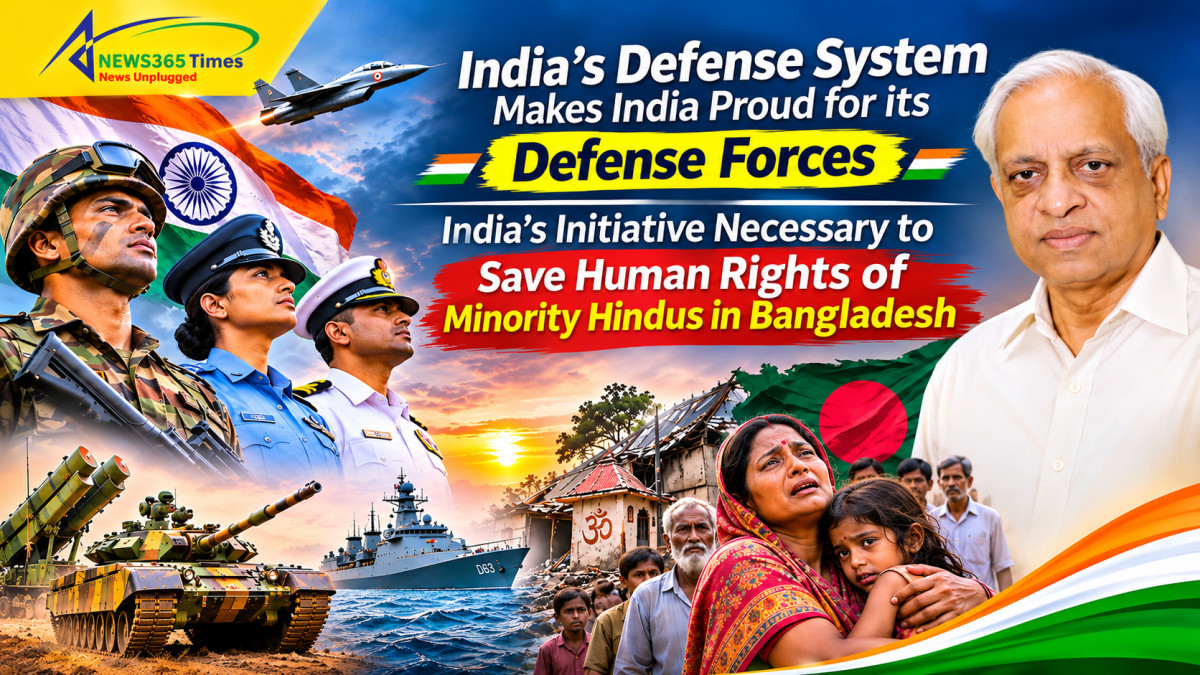
India’s defense system and policy are undergoing a major shift from foreign import reliance towards indigenous capability, jointness, and active deterrence. Governed constitutionally with the President as Supreme Commander and executive authority held by the Prime Minister and the Cabinet Committee on Security (CCS), the system balances border security, maritime protection, and strategic autonomy.
Strategic & Policy Pillars
Credible Deterrence and Strategic Autonomy: India combines diplomatic engagement with military readiness and a "no-first-use" nuclear doctrine. Rather than joining rigid military blocs, India practices multi-alignment—maintaining strategic and defense ties with partners such as the United States, Russia, France, Israel, and the Quad.
Atmanirbhar Bharat & Indigenization: Self-reliance in defense manufacturing is a core policy priority. Instruments include positive indigenization lists, higher foreign direct investment (FDI) limits, the Defense Acquisition Procedure (DAP) 2020, and the Defense Procurement Manual (DPM) 2025 to streamline revenue procurement and support domestic industry.
Jointness and Modernization: Structural reforms have established the Chief of Defense Staff (CDS) and the Department of Military Affairs (DMA) to improve tri-service integration, push toward Integrated Theatre Commands, and prepare for modern domains like space, cyber, autonomous systems, and AI.
Command & Institutional Structure
Ministry of Defense (MoD): Oversees policy and administration through key departments, including Defense, Military Affairs, Defense Production, Defense Research and Development, and Ex-Servicemen Welfare.
Armed Forces:
Indian Army: The largest branch, focused on land warfare and border defense across regional commands, equipped with main battle tanks, artillery, tactical and strategic missiles, and special forces.
Indian Air Force (IAF): Responsible for airspace security and air power across operational and functional commands, flying combat aircraft, transport fleets, helicopters, and air defence assets.
Indian Navy: Protects maritime borders, coastlines, and sea lanes across the Indian Ocean Region using aircraft carriers, submarines, surface combatants, and naval special forces.
Supporting & Research Bodies: The Defense Research and Development Organization (DRDO) drives indigenous R&D, while the Indian Coast Guard and Border Roads Organization support maritime security and frontier infrastructure.
Force Scale and Budget: India fields over 1.55 million active personnel and has a sanctioned defense budget of ₹7.86 lakh crore for FY 2026.
Air & Missile Defense: India layers short-, medium-, and long-range air defense systemssuch as Akash, MRSAM, and S-400—alongside ballistic missile defense and counter-drone capabilities, integrated through command networks.
Indigenous Platforms & Exports: Major domestic acquisition approvals by the Defense Acquisition Council (DAC) include platforms like Tejas Mk-1A fighter jets and LCH Prachand helicopters, alongside growing defense exports and private-sector/DPSU participation.
India supported China as permanent member of UN Security Council while China and Pakistan are opposing India to be a permanent member of UN Security Council
India is facing burnt of wrong-doing of earlier regimes where the first Prime Minister of India was instrumental in initiating process of making China not only as member of UN but also a permanent member of UN security-council. On the other hand, China with Pakistan are opposing India to become permanent member of UN security Council. If China would not have been a permanent member of UN Security Council, it could not have veto-power against security-requirements of India like it did by utilizing its veto-power against declaration of Masood azar as a global terrorist.
Bitter fact remains that foreign policies of first Prime Minister of India Pandit Jawaharlal Nehru including on Tibet, Nepal were mainly aimed him to make a global leader and perhaps also an aspirant for Nobel Peace Prize. Kashmir-problem is also a legacy of wrong policies of first democratically elected government of India.
Forgotten heroes of pre-independence surgical-strike against British rulers
Unfortunately, successive central governments have done nothing for glorification of real heroes of freedom-struggle while even the present central government continues worshipping a person who was indeed responsible for vetoing deserving Sardar Vallabh Bhai Patel as first Prime Minister of India instead crowning Jawaharlal Nehru on the responsible post. No political party remembered the historical day of 13th March when on this date in the year 1940, great patriot Sardar Udham Singh made a surgical strike inside Britain at Caxton Hall in London by shooting down Michael O Dwyer for his sin of infamous Jaliawalan Bagh massacre, even though he knew very well that he would be hanged to death for his heroic deed. Only present central government can take desired steps to keep memory of pre-independence freedom-fighters like Sardar Udham Singh, Bhagat Singh, Sukhdev, Rajguru, Ashrafulla Khan, Lala Lajpat Rai etc by so many modes including putting their pictures and precise profile on currency notes of different denominations rather than of just one politically-worshipped person.
Regular killing of army-men in Kashmir by Pakistan-sponsored terrorism – Permanent solution possible without war
Union government always assures of fitting reply to Pakistan which often results in some persons of Pakistan-army or militants killed by Indian army. But such regular counter-attacks in no way prevent more killing of army-men. Present central government should be complimented for repealing articles 370 and 35A of constitution despite opposition of pseudo-secular opposition parties to bring Jammu and Kashmir in national network without any special status. It is a well-known fact that supporters of Pakistan and militants helping anti-India forces are present in Kashmir-population.
BCCI income should be given to martyrs of Indian forces
Board for Control of Cricket in India (BCCI) has extra huge income which is showered on our super-rich cricketers in tunes of crores of rupees separately as salary, pension, award-money and match-fees. It is noteworthy that these cricketers usually earn large income from other sources as well like from modelling in advertisements. Such system further deepens class-disparity in the society in a highly disproportionate manner. Income from public-craze of cricket must not be taken as monopoly of cricketers. It is significant that even famous Hindu temples under government-supervisory do not give huge offerings coming there only to priests there. A system must be formulated whereby total annual income of a cricketer in a particular year from BCCI in any form may not exceed say rupees fifty lakhs, which will even then be double the annual salary received by top-paid bureaucrat in the country. Huge income of BCCI should be better distributed amongst families of martyrs having laid down their lives during the year defending Indian borders.
Tackling drug-problem amongst Punjab youth
It is a common knowledge that Punjab is presently facing its biggest threat when Pakistan has been instrumental to make Punjab youth drug-addicted, so that the bordering Indian state may no longer have a dedicated youth-force to rise to occasion at need of hour like war-time. Brave Punjabi youth were amongst the main factors of India winning Indo-Pak wars in the years 1965 and 1971. Lack of proper employment opportunities has also resulted in large-scale migration of Punjabi youth to other countries. Sikhs by nature is a warrior-community, and thus constitute a major portion in Indian army. Proper utilisation of Sikh-youth for being trained to be absorbed in Indian army will effectively tackle serious problem of their being drug-addicted or being migrated out of India, apart from providing a brave-front at Indo-Pak border at Punjab. Union government should set up Army schools and units of National Defence Academy in plenty in Punjab, so that Punjabi youth may join army at an early stage thus blocking all chances of their being drug-addicted at later stage. A long-term strategy in this regard can also result in tackling Kashmir-problem at a later stage through well-trained Punjabi youth. Rather there should be a national policy to set up Army schools and units of National Defence Academy in plenty in all the bordering states, also to utilise retired army-personnel set up in their home-states as stand-by at war-time. So many rich families with root-base in Punjab are presently Non-Resident-Indians (NRIs) settled in other countries. These NRIs can be motivated to open schools aimed at promoting games in their native state of Punjab. It will give Punjabi youth an additional opportunity to make India shine at world’s sports’ map, which unfortunately is a neglected field when world’s second-largest populated country ranks amongst the lowest ones at Olympics.
Cancelling defence-deals (AugustWestland helicopter deal) by India: Blessing in disguise for foreign suppliers
Union Defence Ministry once revealed that India has yet to recover a sum of rupees 2134 crores from since-cancelled deal of twelve VVIP helicopters purchased from August-Westland company since major part of the total cost has already been paid by India in form of bank-guarantee mostly to foreign banks even though just three out of total twelve helicopters were supplied to India. It is significant that even though the deal was cancelled by India in January 2014 because of reported kickbacks in the earlier UPA regime, August-Westland could not keep its delivery-scheduled which was to be completed as early as in May 2013. It may be noted that deliberate loopholes were left in legal-agreements signed by India in such deals so that defaulting foreign companies rather get extra in name of compensation or otherwise for the cancelled dubious deals under conspiracy of Indian beneficiaries getting kickbacks. Such drawbacks in deal were also exposed in infamous ‘Caribjet’ scandal signed by Air India where India had to pay ‘compensation’ for cancelling the contract because of deliberately left loopholes in the legal-agreement, and the contract had to be cancelled because aeroplanes taken on hire by Air india were not found airworthy.
Non air-conditioned tanks purchased from Russia to serve in desserts of Rajasthan
Comptroller & Auditor General (CAG) of India once rightly expressed concern on purchase of T-90 non-air-conditioned tanks from Russia by India. In present era requiring air-conditioned comfort even in cars as necessity rather than luxury, it is shocking and surprising that non-air-conditioned tanks were purchased for Indian army in the earlier UPA regime which could not even adversely affect working capability of army-persons operating these tanks but also cause harm to sophisticated instruments inside the tanks. What more, these tanks were to operate in desserts of Rajasthan. Also Indian navy ultimately purchased decades-old aircraft-carrier Admiral Gorshkov (rechristened INS Vikramaditya) that too after several cost-revisions and repeatedly changed delivery-schedules. Lots of technical difficulties including engine-failure were faced in bringing the super-costly and obsolete ‘white-elephant’ from Russia to India. It is significant that the opposition which raised so much hue and cry on purchase of world’s best Bofors guns, remained surprisingly silent on all such controversial defence-deals made from Russia.
Display Republic Day Tableaus at some prominent place in Delhi later too
Tableaus presented by different states, ministries and other public-authorities at Republic Day Parade in New Delhi on 26th January are master-piece of art prepared at very high costs after days of hard work by artists and technicians coming from different parts of the country. Earlier there was a healthy practice to put these tableaus for display for general public in open ground in front of Red Fort at Delhi for three days till Beating Retreat on 29th January. But ever since the open ground is developed in a fancy (closed) park, these tableaus are not available for view of general public after the parade on 26th January is over. For value-effective utilisation of high cost spent on these tableaus, Union Defence Ministry should park these tableaus at some centrally located place in Delhi well connected by Metro-service for public-viewing for about a week or so. Folk-dances can also be arranged at such place by artists coming to Delhi towards Republic Day celebrations, where even military-band can also perform on some days.
India’s initiative necessary to save human rights of minority Hindus in Bangladesh
Following the student-led uprising that forced Sheikh Hasina from power in August 2024, Bangladesh has experienced major political upheaval, legal action against minority rights leaders, and ongoing debates regarding the scale of violence against religious minorities. Chinmoy Krishna Das, a prominent Hindu monk, head of the Pundarik Dham in Hathazari, and spokesperson for the Bangladesh Sanatan Jagaran Mancha, was arrested in November 2024. Authorities charged him with sedition over allegations that Bangladesh's national flag was disrespected during a minority rights rally in Chattogram. On 11th September 2026, Chattogram district authorities granted Das a five-hour parole to attend the funeral rites of his 70-year-old mother, Sandhya Rani Dhar, in Hathazari before returning him to jail. Accounts regarding the severity and nature of attacks on Hindus and other minorities in Bangladesh vary significantly across advocacy groups, media outlets, and government officials. Minority rights organizations, such as the Bangladesh Hindu Buddhist Christian Unity Council (BHBCUC), have reported widespread communal violence since Hasina's exit. Data cited by rights monitors in November 2026 documented nearly 3,000 incidents of communal violence between August 2024 and June 2026, including 146 minority deaths (119 Hindu) through October 2026, alongside attacks on temples, vandalism of homes and businesses, and forced resignations of Hindu educators. Minority Hindu population in Bangladesh has shrunk to just eight-percent from earlier 22-percent in erstwhile east Pakistan to 13.5-percent in the year 1974 (first census after formation of Bangladesh) and now less than eight percent due atrocities and killings of Hindus and their conversion to Islam.
But surprisingly no one from the world including even India which played an important role in freedom of Bangladesh in the year 1971 are keeping total silence on torture, killings, rapes, kidnappings, forced conversion to Islam and other atrocities on minority Hindus in Bangladesh. India, Israel and other such like-minded countries should immediately approach United Nations Organization (UNO) for an immediate and strict joint military action in Bangladesh to ensure a peaceful and safe living of Hindus there and to create a fear-psychology against atrocities on Hindus there. Nobel Peace Prize given to Mohammed Yunus in the year 2006 should be snatched back for his being established as enemy to Peace by being a mute spectator to atrocities on minority Hindus in Bangladesh during his short regime in the country.
What's Your Reaction?
 Like
0
 Dislike
0
 Love
0
 Funny
0
 Wow
0
 Sad
0
 Angry
0

English Daily News Platform #News #Latestupdates #Tech #Business #Politics #Indianews #India. Regd No : JMAGC/HR/00072 (JMAGC ), MIB ,Govt of India


Comments (0)