
Possibilities with Sheikh Hasina’s trying a return to Bangladesh? How and when? What are the implication?
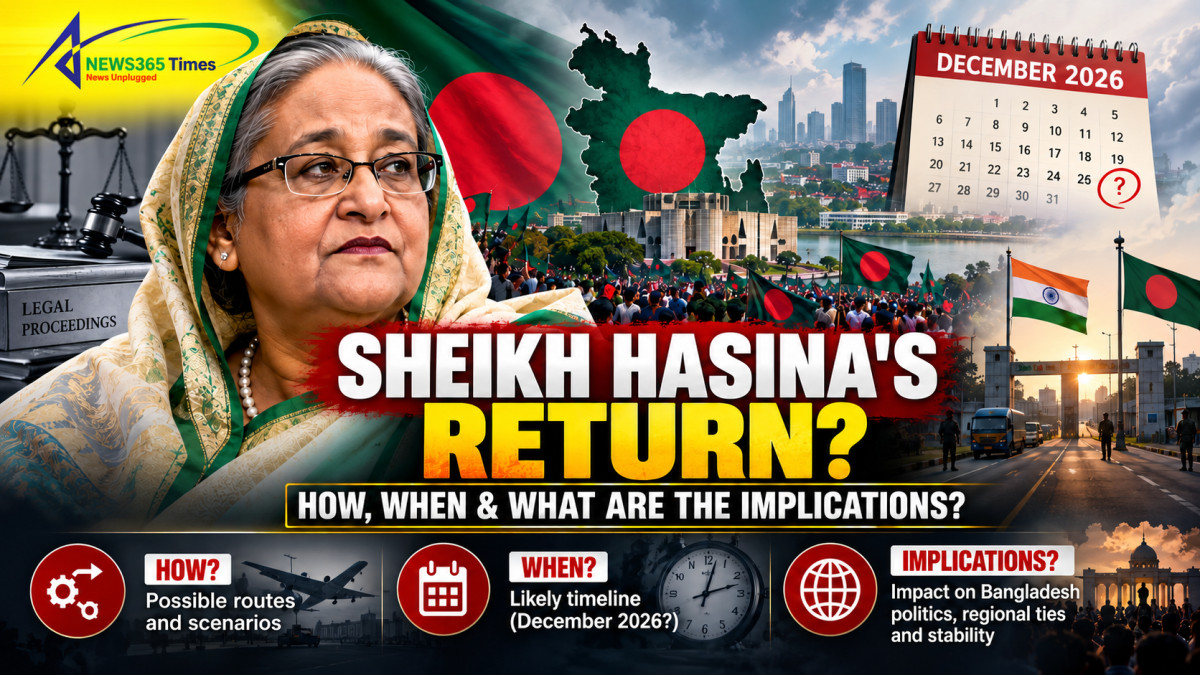
Sheikh Hasina’s return to Bangladesh remains legally hazardous and politically volatile, though she has stated a resolve to return.
Possibility, Mechanism, and Timing
The Stated Intent: Hasina declared in an interview with NDTV that she has made a "solemn commitment" to return to Bangladesh by December 2026, stating she is prepared to face legal consequences or imprisonment to lead the revival of the Awami League.
The Legal Barrier: Following her exit in August 2024, Dhaka’s International Crimes Tribunal (ICT) convicted her in absentia and handed down a death sentence for crimes against humanity linked to the student-led uprising. Touching down in Bangladesh without judicial relief or an explicit immunity framework would mean immediate arrest and potential execution or detention.
How It Could Happen:
Voluntary Surrender/Defiance: Arriving openly, courting arrest, and attempting to turn the trial into a political rallying cry for her cadre.
Extradition (Unlikely): The interim administration led by Muhammad Yunus has formally submitted repeated extradition requests under the 2013 India-Bangladesh treaty. However, New Delhi has not acceded, relying on treaty provisions that permit refusing extradition for offenses of a "political character" or lacking "good faith".
Political Settlement: An eventual transition to a newly elected civilian government that negotiates conditions for Awami League participation or judicial review.
Domestic and Geopolitical Implications
Polarization and Street Violence: Her return would trigger intense friction between loyal Awami League cadres and student groups, the Bangladesh Nationalist Party (BNP), and Jamaat-e-Islami, raising risks of widespread law-and-order breakdowns.
Awami League Mobilization: The Awami League has been structurally paralyzed with top leaders jailed, exiled, or barred. Hasina's physical presence would act as a centralizing focal point to rebuild the party apparatus.
Pressure on the Transitional Order: It would test the interim setup's judicial independence, prison security, and human-rights compliance under intense international scrutiny.
How Does It Help (or Complicate Things for) India?
The prospect of her return presents a double-edged dynamic for New Delhi:
Potential Strategic Benefits for India:
Removes a Diplomatic Wedge: Hasina’s presence in New Delhi has served as the single largest irritant between India and Bangladesh's post-August 2024 administration. A voluntary return removes the accusation that India is harboring a fugitive, easing bilateral diplomatic friction.
Rebalancing Political Space: During her 15-year tenure, Hasina addressed India’s primary security imperatives eradicating anti-India northeast insurgent safe havens, securing border connectivity, and containing radical outfits. Reviving the secular/pro-1971 political current inside Bangladesh counterbalances the surge of anti-India sentiment and hardline Islamist factions.
Risks and Downsides for India:
Loss of Regional Stability: If her return ignites civil strife or violent protests, border instability on India's eastern flank increases, threatening trade corridors, transit agreements, and minority safety.
Domestic Backlash in Bangladesh: If Hasina's return is perceived by the Bangladeshi public as coordinated or backed by New Delhi, anti-India political rhetoric would intensify, further complicating Indian outreach to alternative political forces in Dhaka.
The Treaty Exceptions (Bilateral Framework)
Article 8: Lack of "Good Faith" and the "Interests of Justice" Shield
The most formidable defense available to New Delhi is Article 8(1) of the treaty:
The Provision: Extradition may be refused if the requested state determines that the accusation is not made in good faith in the interests of justice, or if it would be unjust or oppressive to surrender the individual.
Application: India can argue that charges brought by the interim administration especially trials conducted in absentia before a restructured International Crimes Tribunal (ICT) constitute political retribution and justice rather than an impartial pursuit of justice.
Article 6: The "Political Offence" Paradox
Article 6(1) permits refusal if the offense is deemed to be of a "political character."
The Counter-Clause [Article 6(2)]: Bangladesh often cites Article 6(2), which explicitly lists crimes that cannot be treated as political including murder, manslaughter, terrorism, and violent assaults.
India's Defense: Even when charges are framed around violent crimes (e.g., murder or crimes against humanity) to circumvent Article 6(1), the overarching context of mass political protests, regime change, and the targeted prosecution of the former ruling party allows India to invoke Article 8 to establish that the prosecution itself is politically motivated.
Article 10 & 13: Evidentiary Scrutiny for In Absentia Convictions
While the 2016 amendment removed the requirement to establish a strict prima facie evidentiary case for undertrials (allowing warrants or charge-sheets to suffice), Article 10(4) continues to impose specific documentation requirements when extradition is sought to enforce an existing conviction.
Under Article 10(5), India's Ministry of External Affairs (the designated Central Authority) has the right to demand supplementary information, inspect trial records, and verify the legality of the sentencing process, effectively pausing or stalling proceedings indefinitely on procedural grounds.
Indian Domestic Law: Extradition Act, 1962
Any treaty obligation must be executed in accordance with India's domestic enabling statute, the Indian Extradition Act of 1962:
Section 31 (Restrictions on Surrender): Explicitly prohibits surrendering a fugitive criminal if the offense is of a political character, or if the requisition has been made with a view to try or punish the person on political grounds.
Section 29 (Power of Central Government to Discharge Fugitives): Grants the Union Government absolute sovereign discretion to cancel any warrant, discharge a fugitive, or stay proceedings if the request appears oppressive, trivial, or not made in good faith.
Because the central executive holds final authority under Section 29, the Indian judiciary rarely interferes when the government refuses extradition on foreign policy or national interest grounds.
Fair Trial and Due Process Concerns (International Law)
India can ground its refusal in fundamental principles of international law and treaty commitments:
Fair Trial Guarantees (ICCPR, Article 14): Both India and Bangladesh are state parties to the International Covenant on Civil and Political Rights (ICCPR). Trials conducted in absentia that culminate in capital sentences without the presence of the accused or robust representation routinely fail international fair-trial thresholds.
Capital Punishment and Non-Refoulement: Under customary international law principles, states often refuse to extradite individuals to jurisdictions where they face the death penalty unless the requesting state provides binding, diplomatic guarantees that the execution will not be carried out. If Bangladesh seeks her return to execute an ICT death sentence, India can refuse on human rights grounds.
Absence of Compulsory Dispute Adjudication
The India-Bangladesh Extradition Treaty lacks a neutral, third-party dispute settlement mechanism (such as automatic referral to the International Court of Justice or a binding arbitration panel).
Interpretation of terms like "good faith," "interests of justice," or "political character" is left entirely to the discretion of the requested state's executive branch.
Furthermore, Article 21(3) contains an exit clause allowing either party to terminate the entire agreement with six months' written notice, underscoring that extradition is ultimately a tool of bilateral comity, not an unconditional obligation.
Bottom Line: Between Article 8 (bad faith / interests of justice), Section 29 of the Extradition Act, 1962 (sovereign executive discretion), and international due-process objections surrounding in absentia death sentences, India holds complete legal discretion to reject or indefinitely defer any formal extradition request for Sheikh Hasina.K
What's Your Reaction?
 Like
0
Like
0
 Dislike
0
Dislike
0
 Love
0
Love
0
 Funny
0
Funny
0
 Wow
0
Wow
0
 Sad
0
Sad
0
 Angry
0
Angry
0

English Daily News Platform #News #Latestupdates #Tech #Business #Politics #Indianews #India. Regd No : JMAGC/HR/00072 (JMAGC ), MIB ,Govt of India








Comments (0)