
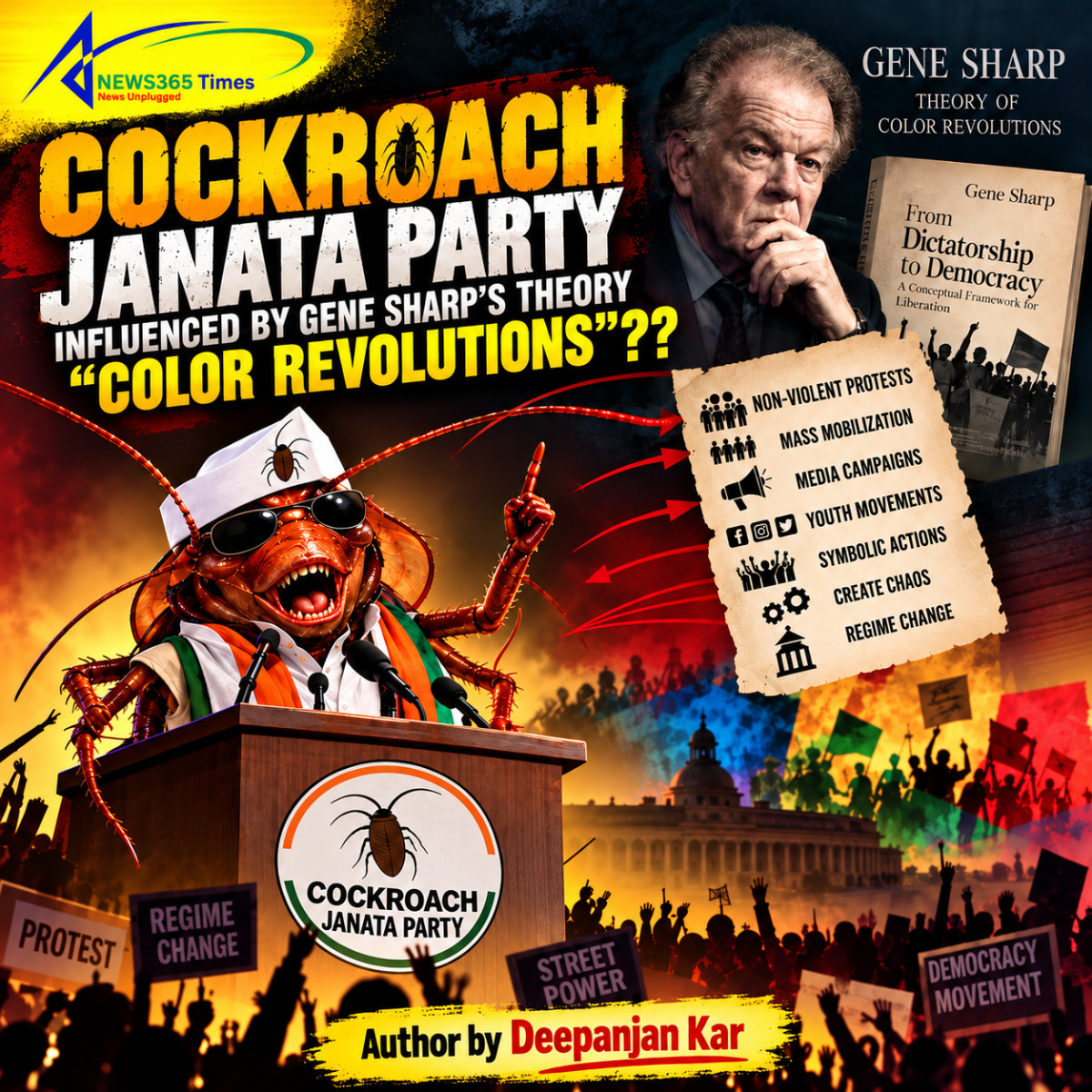
Cockroach Janata Party influenced by Gene Sharp’s Theory “Color Revolutions”??
Today the important question that needs to be raised is about the economics of misinformation in the digital age. The current situation goes beyond fake news. It challenges a fundamental problem in the social-media business model: if a person earns money by attracting millions of viewers through false information, who should bear the consequences when that information is subsequently proven to be false?
The view deserves serious consideration as a public-policy measure, with important safeguards in place.
The fundamental problem:
Today, an independent journalist, influencer, commentator or content creator can build an audience on YouTube, Facebook and Instagram. Advertising and other monetisation mechanisms can reward content that attracts attention.
Now let’s consider this as an example:
Step 1: Publish a sensational claim
A creator publishes a false allegation about a person, institution or public event including large electoral process.
Step 2: The content goes viral
High engagement generates views, attention and potentially advertising income.
Step 3: Society bears the cost
Reputations may be damaged, communities divided, and public trust undermined, riots, protests culminating to public property damage, throwing general society off balance etc
Step 4: Accountability must follow
The question is whether proven wrongdoing should trigger repayment of earnings, loss of monetisation privileges or further legal consequences.
The central concern is a possible asymmetry between private profit and public harm. A creator may retain the financial benefit even when others suffer the consequences.
That is the incentive structure which needs to change.
2. Let’s evaluate and what could be the penalties
The proposal has three main elements. Each serves a different purpose.
A. Recover revenue earned through proven disinformation
If a final judicial finding establishes that a creator deliberately published materially false information to generate engagement and the associated revenue, the earnings attributable to that misconduct could be recovered.
The idea: recover the revenue linked to the offending content, rather than automatically confiscating all income earned by that person.
B. Suspend or permanently withdraw monetisation rights
The first serious violation could lead to a warning, correction requirement or temporary suspension, depending on intent and harm. Repeated, deliberate violations could result in permanent loss of monetisation privileges.
This is a particularly practical measure because it directly removes the financial incentive to repeat the misconduct.
C. Prevent repeat offenders from evading penalties
The creator should not be able to lose one monetised account and simply open another under a different name to continue the same activity.
The idea : use proportionate, legally authorised identity verification and cross-account enforcement, with privacy safeguards and a right of appeal, not an automatic blanket ban on every new account.
There is already some precedent for the underlying principle. YouTube’s published policies allow it to withhold or adjust certain earnings, suspend monetisation and terminate accounts for policy violations, including repeated violations and attempts to evade restrictions. However, these are platform enforcement powers; they are not equivalent to your proposed court-ordered recovery of revenue following a finding of deliberate disinformation.
3. The critical distinction: false news versus dissent
The legislation must distinguish between four different situations.
|
Type of content |
Appropriate treatment |
|
Deliberately fabricated facts intended to deceive |
Strong sanctions where the required legal standard is met |
|
Reckless publication of a serious, demonstrably false allegation |
Potential sanctions, subject to proof of the required elements |
|
An honest reporting error or an unverified claim later corrected |
Correction, clarification and proportionate treatment |
|
Political criticism, investigative journalism, satire or an unpopular opinion |
Must not be penalised merely because it is controversial or challenges those in power |
Being anti-establishment is not the same as spreading fake news. Nor is being a rebel, criticising a government, exposing alleged corruption or challenging an accepted narrative proof of wrongdoing.
A journalist might publish a claim that turns out to be wrong despite reasonable verification. Another might deliberately fabricate a story. Treating both identically would punish responsible journalism along with deliberate deception.
Equally, the truth should not depend merely on whether a powerful person or institution objects to a publication.
4. Should a public-interest litigation trigger the penalty?
Yes, make a final judicial finding, rather than the mere filing of a lawsuit, the trigger.
Otherwise, a wealthy individual, corporation or political organisation could file a case simply to silence a journalist. Even an unsuccessful case could cause the journalist to lose income for months.
I would suggest the following safeguards:
- Independent adjudication: A competent court or legally empowered independent body determines whether the content breached a clearly defined law.
- Proof of wrongdoing: The legal test distinguishes deliberate deception or the applicable degree of recklessness from a genuine mistake.
- Right to respond: The creator can present evidence, sources, context and corrections.
- Proportionate penalties: Financial recovery is linked to the offending publication, with stronger consequences for repeated or particularly harmful misconduct.
- Appeal and reinstatement: A creator can challenge the finding and seek restoration of monetisation if the decision is overturned.
This approach would make the policy harder to weaponise against independent journalism.
5. There is already a foundation to build upon
This is not an entirely new regulatory concept.
- YouTube: Its published policies provide for earnings adjustments, demonetisation and account termination in specified circumstances. That would go a step further by explicitly connecting the financial rewards of publishing to legal accountability for deliberate deception.
6. A proposed policy framework
Need is to frame a Digital Content Accountability and Monetisation Framework, with the following provisions.
Digital Content Accountability Framework
Proposed policy principles, not existing legislation
Revenue clawback
Recover demonstrably attributable earnings from content found by a competent authority to involve deliberate, legally actionable deception.
Progressive sanctions
Use corrections and warnings where appropriate, followed by temporary or permanent demonetisation for serious or repeated violations.
Identity-linked enforcement
Prevent banned creators from circumventing monetisation restrictions through replacement accounts, subject to privacy law and due process.
Platform responsibility
Require platforms to preserve relevant monetisation records, provide transparent enforcement procedures and comply with lawful orders.
Protection for legitimate journalism
Safeguard public-interest reporting, criticism, satire, good-faith errors and contested opinions from penalties imposed merely because someone disputes them.
Let’s consider whether recovered funds should compensate identifiable victims where legally justified, rather than simply returning all the money to the platform. That would make the system more focused on repairing harm than merely punishing the creator.
7. The bigger question: who should be accountable?
There are three parties in this ecosystem:
- The creator, who produces and publishes the material.
- The platform, which distributes it and may monetise the resulting attention.
- The advertiser, whose money may indirectly reward the content’s reach.
The creator should be accountable for proven misconduct. Platforms should also be accountable for their own failures to comply with applicable laws and binding orders. But a platform should not automatically be liable for every false claim published by a user.
The policy must also avoid giving platforms unlimited discretion to decide what is true. Transparent standards, independent review and judicial oversight are essential.
The most powerful idea is : if digital content creators can monetise public attention, they must also accept proportionate financial accountability when that attention has been deliberately generated through proven deception.
Let’s retain the three pillars, revenue recovery, loss of monetisation and prevention of repeat offending, but refine the identity-ban provision and build in strong safeguards for independent journalism.
The aim should not be to control what people think or say. It should be to ensure that deliberate deception is not a profitable business model.
What's Your Reaction?
 Like
0
Like
0
 Dislike
0
Dislike
0
 Love
0
Love
0
 Funny
0
Funny
0
 Wow
0
Wow
0
 Sad
0
Sad
0
 Angry
0
Angry
0

English Daily News Platform #News #Latestupdates #Tech #Business #Politics #Indianews #India. Regd No : JMAGC/HR/00072 (JMAGC ), MIB ,Govt of India











Comments (0)