
Celebrating Girl-Child Day on 24th January while aborting Female-Foeticide continues Regulations necessary also in respect of female-dresses
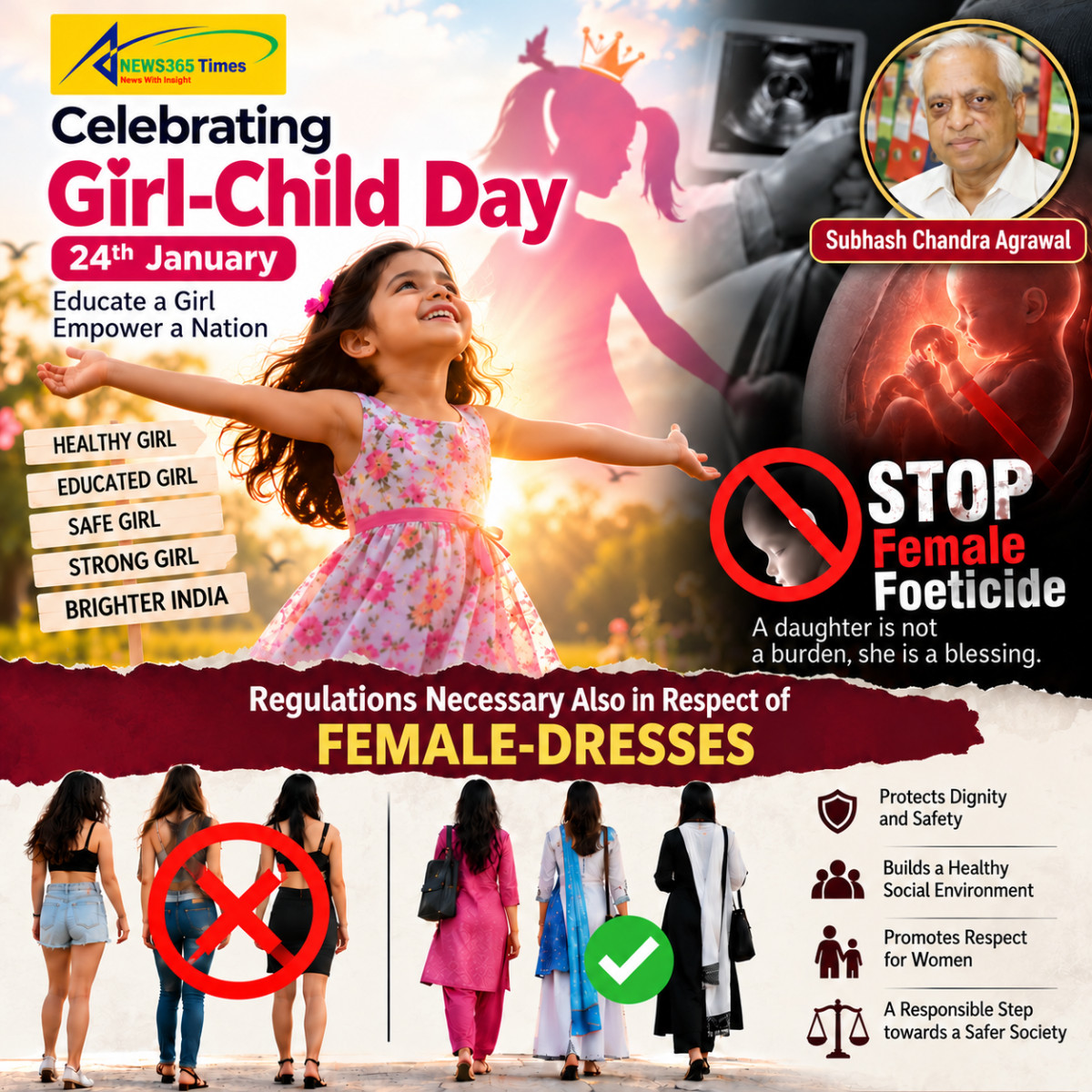
Preventing Female-Foeticide through practical steps
Ladies especially girls are now excelling in every field may it be Civil Services Examination or country’s defence system. India is proud to have a woman President Draupdi Murmu. Woman Prime Minister Indira Gandhi led nation to the historic-victory in 1971 Indo-Pak war.
But unfortunately in our Indian society, a section of people still considers girls to be an undesired burden only because of continuance of dowry-system in the society and ever-increasing marriage-expenses especially in status-conscious upper-section of society. Practical steps should be taken by not only government but also by people in the society themselves so that birth of girl-child may be taken as a boon rather than a bane.
Abortion of female-foeticide has given rise to unnatural proportion of less male than female in many Indian states. Mere celebrating Girl-Child day on 24th January every year is not enough. Registration of properties in women-names showed remarkable rise in Delhi after stamp-duty on such deals was subsidized for women. Union and state governments should take all possible measures for similar concessions like can be for reduction of GST on items like vehicles registered in name of women. Interest-rates for home and other loans may be subsidized while on deposits it can be extra for women. Some fields like dentists and gynaecologists in medical-science should have at least 75-perecent reservation for women. Females should have a sense of security by having automatic and instant rights in ancestral and personal property of husbands, but only for married life without divorce.
Presently girl-child is taken as unwanted burden because of increasing expenses in their marriages. India should follow Pakistan by allowing only soft drinks and simple beverages in marriage-related functions. Mega-budgeted marriages should not be attended by leaders on posts. Mega-expenses in marriage-related functions should be effectively checked by government by imposing taxes and other such practical steps by making event-management firms, caterers, hotels, wedding-card manufacturers and others concerned compulsorily report to some prescribed authority for their role in marriage-related functions as an effective check to make marriage-events simple. Cash, gift-platters etc from bride’s parents to guests of other side should be prevented under dowry-act. Cash-gifts should be compulsorily replaced by cheques. It should be made compulsory to declare complete details of marriage-related functions and gifts (including through cash or bank-transfer) in Income Tax Returns.
At the same time, all efforts should be made to check new-emerging fast trend of daughters-n-law misusing their position for falsely implicating their husbands and in-laws in false cases and accusations of harassment and demands made to their parents. Law should be modified for safeguarding husbands and in-laws from arm-twisting by newly-wed girls.
Female Dresses
Every Indian religion including Hinduism, Jainism, Sikhism, Islam and others require ladies to cover their bodies adequately in their own interests. Gurudwaras Managing Committees deserve all appreciation for tightening rules for females coming to holy Gurudwaras to wear decent dresses covering their bodies adequately. Even other countries like including China and United Kingdom have lately realised that ladies should have proper dresses. Police-authorities in China considered it proper for ladies not to wear mini-dresses including tight pants and mini-skirts because of increasing incidents of eve-teasing. Beijing Police even warned ladies against going on upper floor of buses to avoid being photographed in obscene manner. Even schools in UK also banned skirts requiring girls to wear pants for similar reasons. First IPS woman officer Kiran Bedi had also echoed likewise. Already in most Indian hospitals, skirts for nurses have since been replaced by Salwar-Kameej. Many Indian schools and colleges have also banned skirts worn by girl-students. There should be dress-code for teachers also.
Deep neck, low-length or sleeveless tops which do not adequately cover body-parts like chest, under-arms or waist-line are vulgar dresses which can be taken as an attraction for eve-teasing or ragging and should be avoided in self-defence by women, because no government can practically provide security and safety to each and every woman round the clock from sex-hungry men present everywhere in our society. It is for women themselves to safeguard themselves by avoiding wearing indecent dresses so as not to attract sex-hunger of men in the society. Even in sports like tennis, girls should wear shorts rather than only in skirts with underwear. Media often picks photos with skirts of playing girls in the air indecently projecting on their inner-wears at times in some obscene and vulgar manner. Otherwise also shorts are always comfortable in playing tennis.
Fashion-parades where female models scorch the ramp at lingerie show with their semi-nude bodies in ‘attractive’ inner-wears should be totally banned. What is the meaning of ‘inner-wear’ if these become the only-wear before general public? Evidently the viewers were more attracted towards semi-nude bodies of female models rather than inner-wear turning the only-wear worn by them! Is there any logic in allowing fashion-parades in dresses which otherwise are not worn in public? Rather India should follow Islamic nations like Pakistan where even swim-suit rounds are not permitted in beauty contests. Afghanistan even after freeing itself from Taliban regime considered it appropriate to boycott the Afghan-born girl settled abroad for her participating in an international pageant with swim-suit round. Beauty of ladies can be better judges in their national dresses rather than in swimming-suits.
Saree still remains most popular and attractive dress of Indian women. Any attempt to restrict saree will be attack on ancient Indian culture and heritage dress. Accidents with women in saree as pillion-riders on two-wheelers are mainly because many models of two-wheelers do not have a proper foot-rest for women in sarees. Even some two-wheelers do not have a provision for foot-rest for pillion riders. Therefore, instead of thinking any idea to ban women with sarees as pillion-riders on two-wheelers, manufacturers of two-wheelers should be directed to compulsorily provide a proper foot-rest for pillion-riders. It is good that Indian government encourages saree as a national dress in all national events.
What's Your Reaction?
 Like
0
Like
0
 Dislike
0
Dislike
0
 Love
0
Love
0
 Funny
0
Funny
0
 Wow
0
Wow
0
 Sad
0
Sad
0
 Angry
0
Angry
0

English Daily News Platform #News #Latestupdates #Tech #Business #Politics #Indianews #India. Regd No : JMAGC/HR/00072 (JMAGC ), MIB ,Govt of India







Comments (0)