
CONSUMER PROTECTION ACT NEEDS DRASTIC CHANGES
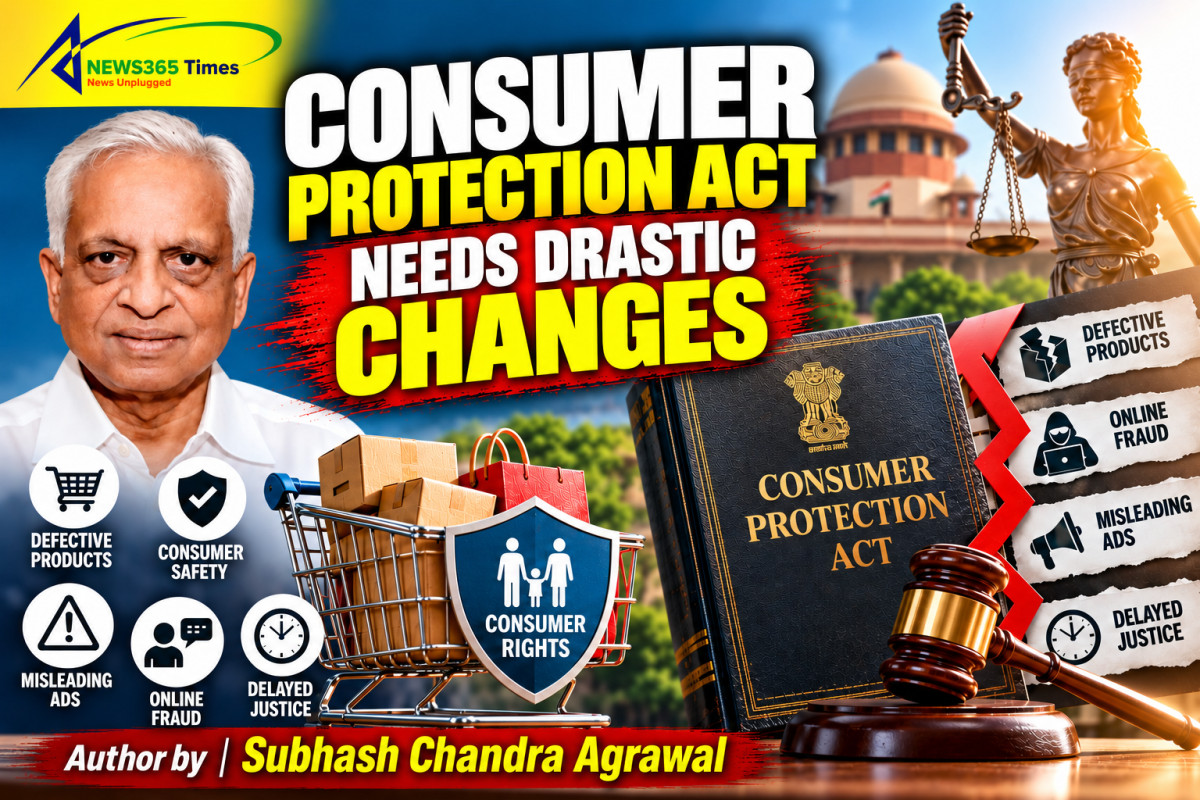
Consumer Protection Act 2019 needs root-level changes either in the Act itself or by modifications in rules so that need for filing complaints may not be arise. A very little fraction of consumers approach consumer-forums for their consumer-rights against malpractices of big manufacturers because of very cumbersome procedure and spent of so many man-days in consumer-courts./.
Portal Jago-Grahak-Jago on website of Department of Consumer Affairs (Government of India) acts like a post-office to deliver eye-wash replies from companies against whom complaints are lodged. Consumers are advised to approach Consumer Court if they are not satisfied with replies of the companies received through the portal. The portal must be made practically effective with the Department itself trying to resolve problems of the consumers.
All companies should compulsorily put on their websites contact-details including names of concerned senior officers and Directors. All such websites of companies should compulsorily give details of government-portals and consumer-forms. Annual-Maintenance-Contracts (AMCs) should be considered as Extended Warranties since most companies befool consumers by not entertaining many aspects covered under AMCs.
All packaged commodities must be packed in true metric-spirit in either units of 1, 2, 5, 10, 20, 50, 100, 200, 500, 1000 and thereafter in multiples of 1000 basic units abolishing any need of printing unit-price on packs. A popular milk-brand (Namaste-India) has started packaging milk-packs in 950 mltrs and 1900 mltrs to look like earlier packs of 1000 mltrs and 2000 mltrs respectively. Commodities like Ghee are packed in litres in packs of 1 or 5 litre, but in kgs in pack of 15 kgs. Uniform system should be for marketing such products either by weight or by volume.
Drug-manufacturers at times cheat consumers by packing commonly advertised medicines like cough-lozenges in eight per strip rather than normal ten. Many drug-manufacturers started packing medicines in strips of 15 rather than 10 simply to increase sale. Suggested packaging-system may be for medicines also unless exemption is sought from competent-authority for dose-wise administration. At times free gifts given by manufacturers to promote other products are swallowed by traders. System should be to tie free gift with marketed product. “Not for sale alone” should be prominently printed on free gift.
Since Supreme Court has allowed use of A-4 size paper, any further production of legal-size paper must be banned. Slight modification in A-4 size paper be made from present 29.5 cms x 21 cms to 30 cms x 20 cms to be in tune with metric spirit.
Commodities and services with government-administered prices should be in round figure of rupee one per unit like for petrol-diesel and in multiples of rupee fifty in commodities like LPG refill. Likewise all postal-tariffs can be in multiples of rupees ten except for ordinary post-cards and registered newspapers which may have subsidized postal-tariff of rupee one. It will not affect consumers, since delivery-persons never return balance coins. Rounding-off prices can earn extra revenue for governments.
It is welcome that the Federation of Hotel and Restaurant Association of India and the National Restaurant Association of India have lost the case at Delhi High Court challenging guidelines issued by the Central Consumer Protection Authority on levying service-charge in bills of hotels and restaurants. Consumer Protection Act should be amended so that hotels and restaurants may not be able to impose any extra levy other than government-taxes. Moreover, Consumer Protection Act should ban colonial practice of paying tips directing hotels and restaurants to prominently display “No Tips” boards.
India being the largest consumer-base, can impose conditions on foreign companies exporting commodities to India to set up their manufacturing units in India especially when many such foreign companies flood Indian markets with products manufactured in countries other than the country of origin. Example is setting of biggest manufacturing plant of Samsung mobile phones in Noida (UP). It will result in huge earn of foreign exchange by way of export from India rather than drain of foreign exchange in importing such commodities. Union government should ban import of items which are already available in India in much superior quality.
Bureau of Indian Standards (BIS) should call meeting of printer-manufacturers including representatives of foreign companies to minimise types of ink-cartridges. Largest selling foreign company Hewlett-Packard (HP) has too many types of ink-cartridges of similar shape and size for their vast range of inkjet and laser printers. Such standardisation will heavily reduce cost of ink-cartridges. Condition should be that such accessories may be allowed to be manufactured by Indian manufacturers. Standardisation of mobile-chargers on lines of electrical plugs and sockets should also be done for mobile-phones of all makes and companies.
Union government should also induce standardization of common accessories like tyres and batteries so that same parts may be used in different models of cars produced by various car-manufacturers. It will heavily bring down cost of consumables through their bumper production in extra large numbers in some limited sizes and specifications. It can be achieved by merging some nearing sizes and specifications. Such guidelines though also mentioned in auto-policy of Union government, are never followed in actual practice. There may be just two variants apart from the third with automatic gears, one basic Lx for economy customers and the other Vx with all company-fitted extra accessories and luxuries for affording customers.
Presently there is no limit of allowed total profit-margin on a commodity between Maximum-Retail-Price (MRP) and Ex-factory price of commodities allowing huge total trade-margins. Even economically priced generic medicines have printed MRP which is ten times higher than their wholesale-price. Halonix tube-light (20 watts) with MRP rupees 349 is available at Bhagirath Palace (Delhi) wholesale-market for electrical goods at just rupees 80 (BPL with MRP rupees 299 at rupees 90). Likewise G&G ink-cartridge with MRP of rupees 3999 (for HP printer) is available at Nehru Place (Delhi) at just rupees 460 (Prodot with MRP rupees 2800 at rupees 450)2800 at . Such big trade-margins induce corruption in purchases. Moreover, victims are normal consumers especially in rural areas, which do not have access and knowledge of wholesale markets. Department of Consumer Affairs must fix maximum total trade-margin for any commodity to bring down MRP of commodities.
Even renowned confectioners having daily sale in lakhs of rupees, do not issue bills resulting in big loss to the exchequer. Confectioners should be directed to compulsorily stick a copy of GST-invoice on each box of unbranded sweets sold in loose. GST authorities should be advised to have a common GST rate of say 12-percent on all food-items where presently luxury sweets attract GST rate of just 5-percent while salted items attract 12-percent GST giving liberty to confectioners often selling both the items to show more sale of sweets to save GST under composite-scheme. Such can be case with other unbranded commodities taxable under GST sold loose. Fear-psychology should be developed whereby traders may themselves voluntarily issue GST-invoices to customers even without being asked for.
National Anti-Profiteering Authority (NAPP) should entertain suggestions coming from experts and members of public. A consumer-forum in Chandigarh once imposed a fine of rupees 9000 on a renowned shoe-company for charging rupees three as cost of paper-bag. But same shoe-company and many famous branded shopping malls, are still charging cost of paper-bags from the shoppers. Department of Consumer Affairs should prohibit by law “selling” of shopping bags just for packing goods.
What's Your Reaction?
 Like
0
Like
0
 Dislike
0
Dislike
0
 Love
0
Love
0
 Funny
0
Funny
0
 Wow
0
Wow
0
 Sad
0
Sad
0
 Angry
0
Angry
0

English Daily News Platform #News #Latestupdates #Tech #Business #Politics #Indianews #India. Regd No : JMAGC/HR/00072 (JMAGC ), MIB ,Govt of India








Comments (0)