
Celebrating RTI Act on 12th October : Objective incomplete without Citizen’s Charter and Grievance Redressal Bill
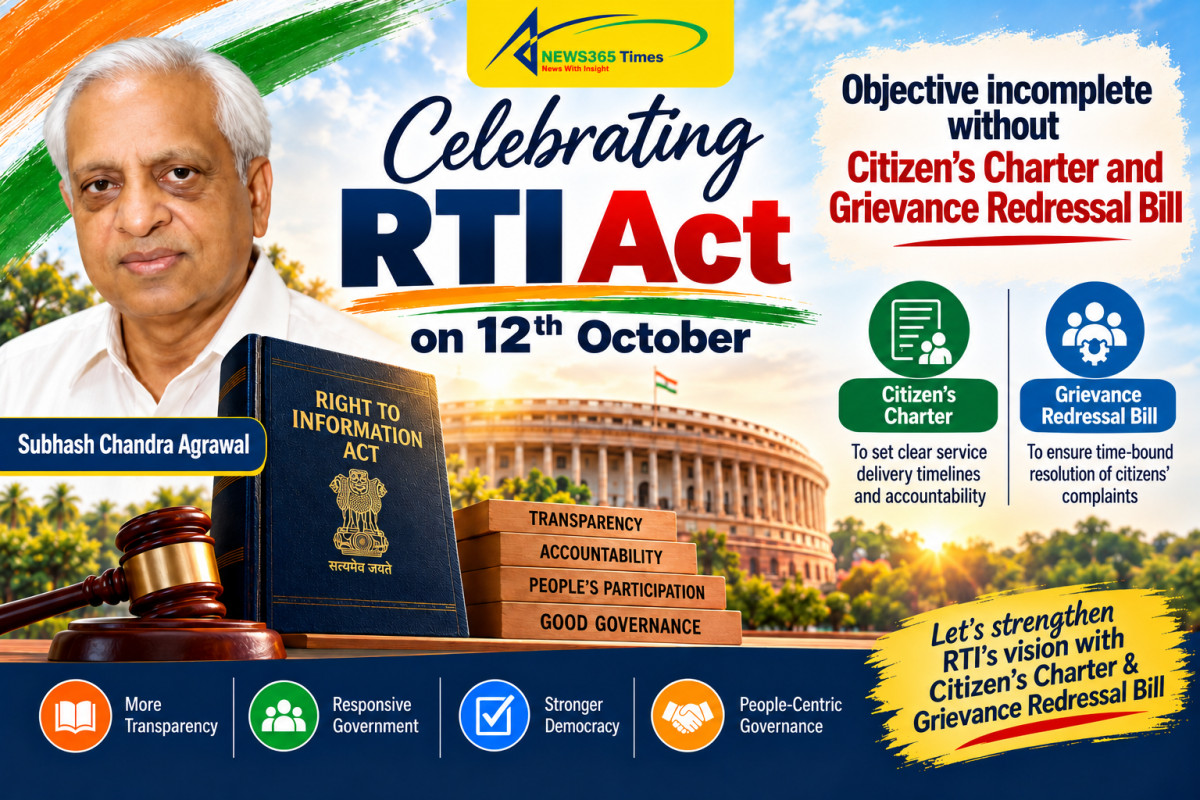
There was a proposal to introduce “The Right of Citizens for Time Bound Delivery of Goods and Services and Redressal of their Grievances Bill, 2011” (The Citizen’s Charter and Grievance Redressal Bill) after implementation of “Right-To-Information Act, 2005” to fulfill the objective of providing timely redressal of Grievances to the public. But unfortunately the much-awaited and most desired bill has still not been introduced. Rather “The Citizen’s Charter and Grievance Redressal Bill” is much more necessary to achieve the desired goal. Union Government should fulfill the much-needed requirement by introducing the said bill which will make government-functionaries to solve problems of the people in an effective manner reducing over-burdened government-functionaries presently utilizing much of their time and resources Under Right-To-Information Act. Rather with quick disposal of public-grievances through “The Citizen’s Charter and Grievance Redressal Bill” will make government-functionaries working fast thus resulting in further savings of time and resources of government-departments and public authorities.
Otherwise also, a fresh look is necessary for revising RTI Rules drafted long back in the year 2012 to prevent misuse of RTI Act which will further drastically reduced time and resources of public authority spent on handling RTI matters. Ever since first amendment in RTI Act was done ever since its implementation on 12th October2005, some NGOs and opposition parties are crying that sunshine Act is diluted! But the amendment made in the year 2019 aimed to change status and tenure of Information Commissioners, in no way affected users of RTI Act. Insertion of section 44(3) in “The Digital Personal Data Protection Act 2023” removing riders to section 8(1)(j) of RTI Act in fact necessary to preserve Parliamentary privilege and remove confusion through the term “public-interest”. Having a rider of “Public Interest” was not needed in view of section 8(2) of RTI Act which provides access to information in case public interest overweighs the harm protected. It is for the first time that Central Information Commission has full strength of Chief Information Commissioner and ten Information Commissioners sworn on 15.12.2025.
Otherwise also, earlier two Commissioners went on disposing the cases at a fast speed with Vinod Kumar Tiwari having disposed of 12700 cases with quality judgements elaborately worded in a short span of just 24 months while this figure does not include matters of Show-Cause notices and Non-Compliance matters. It is significant that he even heard some cases on different dates to ensure enough opportunity to respondent public-authorities to defend their case like in his verdict dated 16.01.2025 in petition-number CIC/GNCTD/A/2024/108412 in the matter “Sanjeev Kumar versus Directorate of Health Services (GNCTD”. He even imposed penalty on the PIO and awarded compensation to the petitioner apart from making recommendations while highlighting malpractices in working of private hospitals with DHS being the mute spectator. Even Delhi High Court dismissed a writ-petition WPC 596/2026 against this verdict on first day of hearing i.e. 16.01.2026. Even present Chief Information Commissioner Raj Kumar Goyal echoed likewise in his verdict dated 16.01.2026 observing that despite 20 years of implementation of the RTI Act, public information officers and first appellate authorities in DHS (GNCTD) were not alert to their legal responsibilities terming it to be a serious issue.
At the same time, Vinod Kumar Tiwari praised such officers who respond to matters nicely not only while responding to RTI applications, but also while presenting their case before the Commission. Example is decision dated 17.11.2025 in file-number CIC/DDATY/A/2024/114518 in the matter “Pawan Jindal versus Delhi Development Authority (DDA)” where he praised Rahul Gupta, PIO-cum-Executive Engineer (DDA) for his nicely presenting the case before the Commission. Such praise in a CIC-verdict motivates others to do similar nice work to handle RTI matters.
However, RTI rules (and not the RTI Act) need important modifications mainly to prevent misuse of the Act and minimising challenge to CIC verdicts in courts. Notification should be to declare all public-private-partnerships, sports-bodies, cooperative-societies and other such bodies, public-authorities under RTI Act. Land and Building Departments of central and state governments should study all cases of allotment of land or government-accommodations at subsidised rates or lease, and declare all these as public-authorities under RTI Act. For future, land or government-accommodations should be provided at subsidised rates on pre-condition of beneficiaries coming under purview of RTI Act.
Offices like those of President, Prime Minister, Governor, Lt Governor and Chief Minister must not act like “Post Offices” by transferring RTI applications under section 6(3) of RTI Act to concerned departments. These offices should entertain RTI applications pertaining to their respective offices only, and returning rest others to RTI applicants advising applicants to file RTI applications directly to concerned departments.
Considering vast participation of public-money in private sector banks, all private sector banks must be under purview of RTI Act. Already all employees up-to highest post of CMD are public servants according to Banking Regulation Act. Reserve Bank of India (RBI) had to impose restrictions on withdrawal of money for some time on a prominent private sector bank. Former CMD of another prominent private sector Bank is under arrest for serious charges of misappropriation of public-money in the Bank. Inspection Reports of private banks revealed under RTI Act by RBI reveal gross misuse of public money by top management. Another private sector bank is in notoriety for large number of Non-Performing Assets (NPAs). Heavy fluctuation in share-prices of certain private sector banks tend to doubt regarding safety of public money in private sector banks. Deposit Insurance and Credit Guarantee Corporation (RBI subsidiary) has to pay maximum rupees five lakhs from state-funds to each depositor of the bank including those in private sector which collapses due to massive irregularities, which is public-funding to declare private sector banks as “public-authorities” under section 2(h) of RTI Act.
Section 27 and 28 of RTI Act give power to Competent Authorities and state-governments to draft their own rules which include fixing of RTI fees. Several Competent Authorities and states misused their power by having RTI fees as high as rupees 500However Supreme Court in its verdict dated 20.03.2018 imposed a capping of rupees fifty to be maximum RTI fees. RTI-fees should be uniformly rupees 50 inclusive of copying-charges of first twenty copied pages Making basic RTI-fees at rupees fifty will largely prevent misuse of RTI Act. There must not be any fees for filing First or Second Appeals.
Handling cost of a postal-order of value rupees ten costs postal-department about rupees fifty with cost of handling of postal-orders by a public-authority and bank-clearing even extra. Postal Department should issue special RTI-stamps (like earlier stamps for licence-fees of radios and TV sets) in denominations of rupees 2, 10 and 50 which will save crores of rupees annually to public-exchequers in using postal-orders as mode of payment of RTI fees. These RTI stamps should be available at all post-offices and counters of public-authorities and other convenient sale-points. Post-free RTI-applications addressed to central public-authorities should be accepted at all about 160000 post-offices rather than just about 4500 post offices presently. It is not difficult because every post-office however small it may be, daily sends post-bag to Head Post Office with registered post, cash and unsold revenue-articles. This post-bag can carry post-free RTI-applications received at the post-office.
Decision dated 02.11.2012 by Punjab & Haryana High Court in the matter “Fruit and Vegetable Union versus Unknown” (CWP 4787 of 2011) requiring ID proof compulsorily with every RTI application, First Appeal and petitions filed with Information Commissions should be compulsorily adopted throughout the country Police-enquiry conducted at behest of some Indian missions abroad established that a petitioner approached Central Information Commission with name and address both of which did not exist. RTI-responses and orders of First Appellate Authorities should be auto-emailed rather than RTI-applicants required to search portals for viewing of RTI-responses and orders by First Appellate Authorities. Websites designed by National Informatics Centre (NIC) for central public-authorities should be mandatorily for all states. This has become necessary for state like Odisha which has made online filing of RTI-applications a mockery when it is compulsory to download online-filled RTI-application, and then send it by post to concerned department.
Delhi High Court in its order dated 08.08.2018 in WPC 8278 of 2018 in the matter “Anil Dutt Sharma versus Government of NCT Delhi and others” mentioned – This Court is of the prima facie view that the Right-To-Information Act, 2005 would now override the Delhi Right To Information Act, 2001. DRTI Act has lost all with implementation of RTI Act 2005. Very few applications are filed under DRTI Act. All such acts legislated by individual states, before RTI Act 2005 came into existence must be repealed.
What's Your Reaction?
 Like
0
Like
0
 Dislike
0
Dislike
0
 Love
0
Love
0
 Funny
0
Funny
0
 Wow
0
Wow
0
 Sad
0
Sad
0
 Angry
0
Angry
0

English Daily News Platform #News #Latestupdates #Tech #Business #Politics #Indianews #India. Regd No : JMAGC/HR/00072 (JMAGC ), MIB ,Govt of India








Comments (0)