

Generative AI, AI Agent, Agentic AI – three terms that confuse even technology professionals. One relatable story that will make you never mix them up again.
By Deepanjan Kumar Kar
You walk into a restaurant on a Friday evening. You are hungry, slightly indecisive, and in no mood to think too hard. You sit down, and a friendly person appears at your table. What happens next depends entirely on which version of artificial intelligence is serving you and the difference will tell you everything you need to know about one of the most important technological distinctions of our time.
The terms Generative AI, AI Agent, and Agentic AI are used almost interchangeably in headlines, boardroom decks, and technology pitches. They are not interchangeable. They describe three genuinely different levels of capability – different in what they can do, how they do it, and critically, how much they can do without you. The restaurant is our way in.
Act I: The Waiter Who Has Read Every Menu Ever Written
You sit down. A waiter appears. You say: “I’m thinking something with pasta, something rich and comforting, maybe with mushrooms.” The waiter smiles and says: “You’ll love our pasta Alfredo with wild mushrooms, it’s creamy and indulgent, pairs beautifully with a Chardonnay.”
They have absorbed through training, an almost incomprehensible volume of menus, food reviews, cookbooks, flavour profiles, and culinary traditions. When you speak, they draw on all of that to produce a response that feels knowledgeable, considered, even inspired. And they do it instantly, fluently, every single time.
That is the defining constraint of Generative AI: it can only advise. The moment you ask it to do something like place the order, check whether the kitchen still has the pasta, call you a cab to get home, then it has hit its wall. Generative AI exists entirely within the conversation. It has no hands. It cannot reach into the world.
This is not a criticism. For an enormous category of tasks such as drafting documents, explaining concepts, generating code, writing marketing copy, summarising reports. Generative AI is transformative. Every major company on earth is already using it to compress hours of knowledge work into minutes. But when the task requires action rather than language, something more is needed.
Act II: The Waiter Who Can Actually Do Things
Now imagine a different waiter. Same warmth, same encyclopaedic knowledge of the menu. But this one has a radio earpiece connected to the kitchen, a tablet linked to the reservation system, and the ability to send your order directly to the chef the moment you decide. You say “I’ll have the pasta Alfredo” and they tap twice. Done.
The fundamental upgrade is deceptively simple: the AI has been given tools. It has given real connections to real systems. It has the ability to place orders, check stock levels, retrieve account details, send emails, or update a calendar. The language model inside is the same. What changed is that it can now reach beyond the conversation and into the world.
The reason-act-observe loop is what makes an AI Agent genuinely powerful for operational work. The agent receives a task. It reasons about which tool to use and uses it. It observes the result. It decides what to do next. This loop repeats and sometimes dozens of times until the task is complete.
The limitation is of an AI Agent is scope. A single AI Agent does one job at a time. Our restaurant waiter is excellent but they are managing your table. Complexity that spans multiple systems, multiple stakeholders, and multiple simultaneous decisions is where the single agent begins to strain.
Act III: The Restaurant Runs Itself
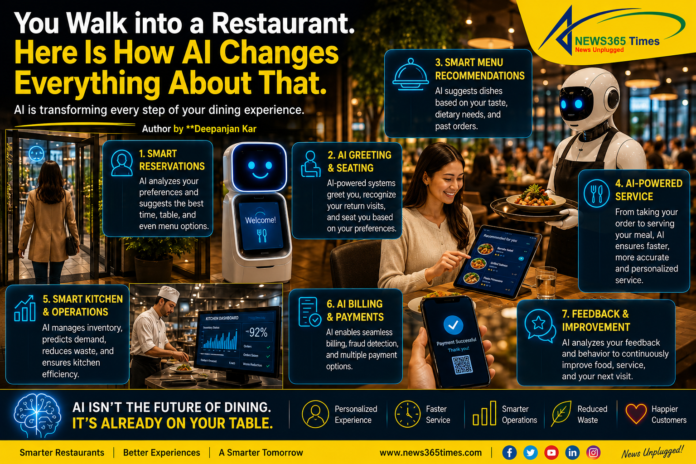
Now picture the same restaurant but something is different tonight. There is no single waiter managing your evening. Instead, there is a system. The host who greeted you at the door noted your table preference and your dietary history and fed it forward. The recommendations engine surfaced tonight’s specials based on what the kitchen has in abundance. The moment you ordered, the kitchen received it, prepped it, and a runner was dispatched. Meanwhile, the sommelier was simultaneously alerted, the bill was being assembled in the background, and a loyalty credit was applied to your account based on your visit history.
No single person or an agent did all of that rather it was a coordinated system of specialists, each handling their domain, all passing information between themselves, all working toward the same outcome: your dinner, seamlessly delivered.
The crucial distinction between an AI Agent and Agentic AI is not intelligence, it is coordination. Each individual agent in an agentic system may be no more capable than the single agent in Act II. What changes is that they communicate, they divide labour, they check each other’s work, and they collectively produce outcomes that no single agent could achieve alone.
Beyond the Restaurant: Real-World Use Cases
The restaurant is a metaphor, but the business implications are concrete. Here is how the same spectrum plays out across industries.
How to Order Wisely
The biggest mistake organisations make is trying to skip straight to agentic systems because the demos look impressive. In our restaurant metaphor: you would not ask a first-year front-of-house trainee to simultaneously run reservations, manage the kitchen, handle billing, and coordinate the sommelier on their very first shift. You would train them on one thing first, watch them master it, then expand their responsibility.
The sensible sequence runs in the same three stages as this article. Start with Generative AI to compress knowledge work, accelerate drafts, and reduce the time your best people spend on first-pass documents. Once you trust the quality, introduce AI Agents for bounded operational tasks where success is clear and measurable. Only then design agentic systems for complex, cross-functional workflows and do it with guardrails, staged autonomy, and human review at the critical junctures.