

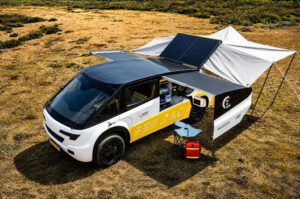
According to the team, the vehicle has a driving range of up to 715 km on paved roads and an average off-road range of 360 km, depending on terrain. It is powered by a 50 kWh battery and 542 solar cells, including 326 integrated into the roof and 216 mounted on extendable solar panels. The vehicle measures 5 m by 1.9 m, weighs 1,350 kg, and has a top speed of 120 km/h. It uses a self-developed solar inverter with a reported efficiency of 97%.
Unlike a conventional ambulance, which transports patients to a hospital, Stella Juva is designed to bring healthcare services to remote communities. Equipped with integrated power outlets, it can operate medical equipment including a vaccine and medicine cooler, a portable X-ray machine, an ultrasound device, a blood pressure monitor, a thermometer, an automated external defibrillator (AED), and other first-aid supplies.
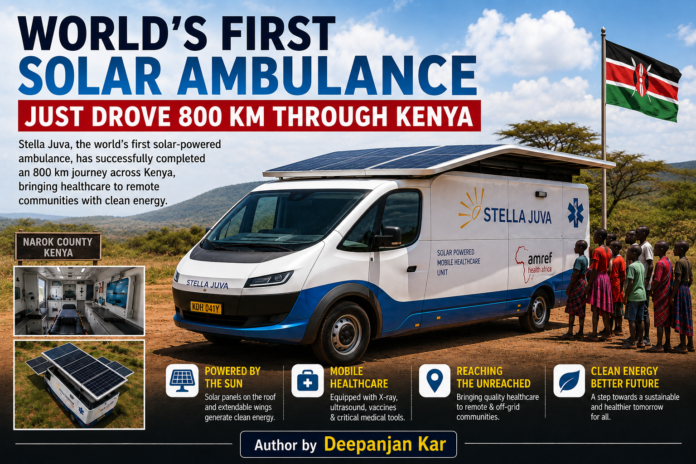
A groundbreaking solar-powered ambulance, described by its developers as the world’s first, has successfully completed an 800-kilometre test journey across Kenya, demonstrating how renewable energy could help deliver healthcare to remote communities.
Named Stella Juva, the vehicle was developed by Solar Team Eindhoven, a group of 23 students associated with Eindhoven University of Technology, in collaboration with Amref Health Africa. Unlike a conventional ambulance designed mainly to transport patients, Stella Juva functions as a mobile healthcare unit, taking medical equipment and power directly to underserved areas.
The solar vehicle is equipped with an X-ray machine, ultrasound equipment, an automated external defibrillator and refrigerated storage for vaccines. Solar panels mounted on its roof generate electricity while the vehicle is on the move, while additional extendable panels can provide extra power when it is stationary.
During the Kenyan trial, Stella Juva travelled across challenging terrain and visited remote locations, including areas around Narok where access to electricity and healthcare infrastructure can be limited. In one test, the vehicle generated more solar energy than it consumed while operating its onboard medical equipment simultaneously, highlighting its potential to function independently of the electricity grid.
The two-day trial indicated that the mobile clinic could potentially provide healthcare services to around 200 people. No real patients were treated during the technical test, but the successful journey demonstrated the vehicle’s ability to combine sustainable transport with off-grid medical services.
The successful Kenyan trial marks an important step for solar-powered healthcare innovation. While Stella Juva remains a prototype and has not yet entered commercial deployment, its developers hope the project will inspire governments, healthcare organisations and industry partners to explore similar solutions for remote and energy-poor regions.