

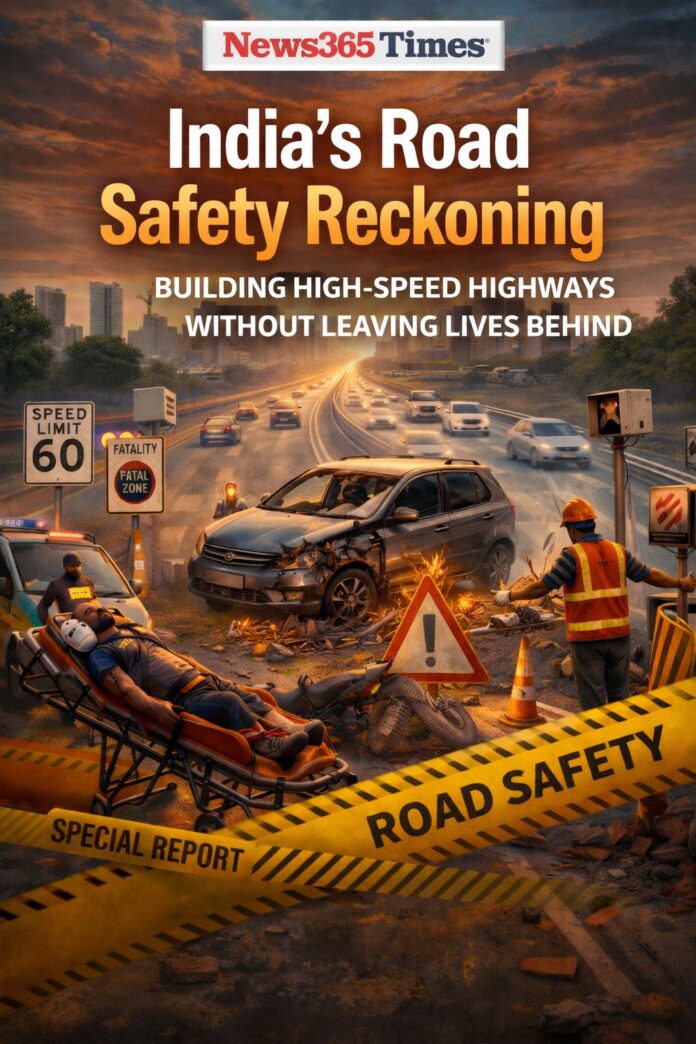
India is constructing highways at a pace unmatched in its history—expressways, economic corridors, urban arterials, and logistics spines are transforming mobility and commerce. Yet, beneath this infrastructure momentum lies a stark contradiction: India continues to lose more than 1.7 lakh lives every year on its roads.
Road safety is no longer a transport-side issue. It is a public health crisis, an economic drain, and a governance challenge—one that demands urgent systemic correction as India accelerates toward a $5-trillion economy.
“Fast roads without safe systems are not progress—they are risk multipliers.”
The numbers India cannot ignore
India accounts for nearly 11% of global road fatalities, despite having a far smaller share of the world’s vehicles. Over-speeding, poor helmet and seatbelt compliance, unsafe pedestrian infrastructure, and delayed trauma care continue to dominate crash causation.
The uncomfortable truth is this: Most road deaths in India are predictable—and therefore preventable.
Infrastructure growth vs. human safety: where the system breaks
Speed without control
New highways and widened urban roads have dramatically increased average travel speeds. However, speed management systems—engineering, enforcement, and behaviour—have not kept pace.
High speeds combined with mixed traffic (two-wheelers, pedestrians, tractors, trucks) create lethal outcomes, especially near junctions and access points.
Design blind spots in modern roads
Despite better standards, recurring safety gaps persist:
- Poorly designed junctions and U-turns
- Unsafe pedestrian crossings near schools, markets, and bus stops
- Unprotected road edges, open drains, rigid poles, and unshielded medians
- Inadequate work-zone safety during construction
- Uncontrolled access openings on high-speed corridors
“A road is only as safe as its most vulnerable user—pedestrians, cyclists, and two-wheelers.”
Enforcement that struggles to scale
Manual traffic enforcement cannot cope with India’s traffic volumes. While e-challans, ANPR cameras, and speed detection systems are expanding, coverage and consistency remain uneven across states and cities.
The golden hour gap
Survival after a crash depends heavily on response time and trauma care quality. In many regions, delayed ambulance arrival, lack of trauma centres, and confusion over cashless treatment still cost lives that could have been saved.
Corporate India steps in: safety beyond factory gates
Road safety is no longer confined to public roads—it is increasingly becoming a corporate governance and ESG issue.
One notable leader in this space is Neeraj Sinha of Tata Steel, who has consistently highlighted that a significant proportion of serious incidents in industrial ecosystems occur outside plant boundaries—on approach roads, highways, and employee commute routes.
Under such leadership, large industrial groups are integrating:
- AI-enabled traffic monitoring
- Fleet telematics and speed governance
- Driver fatigue management
- Safety culture training beyond compliance
“Zero harm cannot stop at the factory gate—it must extend to every road an employee or contractor travels.”
India’s road safety change-makers
Several professionals and institutions are shaping India’s road safety transformation through policy, research, advocacy, and execution:
- Piyush Tewari, Founder, SaveLIFE Foundation – instrumental in legal reforms, Good Samaritan protections, and evidence-based corridor safety models
- Geetam Tiwari – global authority on pedestrian and two-wheeler safety and urban road design
- Dinesh Mohan (late) – pioneer of injury-prevention thinking in Indian road safety
- Neeraj Sinha, Tata Steel – advancing corporate-led road safety governance
- Academic ecosystems such as TRIPP (IIT Delhi) – anchoring data-driven safety research and policy advisory
What works: the 10 actions that save lives fast
If India wants visible impact within 12–24 months, the solutions are already known:
- Credible speed limits + automated enforcement
- Black-spot rectification as mission-mode micro projects
- Safe pedestrian crossings and refuge islands
- Junction redesign before road widening
- Strict access control on highways
- Zero tolerance for helmet and seatbelt violations
- Mandatory work-zone safety standards
- Commercial fleet safety regulation
- Cashless, golden-hour trauma care
-
Real-time crash data linked to engineering fixes
“Road safety is not about awareness alone—it is about design, discipline, and decisive governance.”
Why road safety is an economic imperative
Every fatal crash is more than a statistic—it is:
- Lost workforce productivity
- Increased healthcare burden
- Higher insurance and logistics costs
- Long-term family impoverishment
Countries that reduced road deaths did not wait for behaviour to change—they designed roads that forgive human error.
The News365 Times View
India’s infrastructure ambition is historic—and necessary. But growth that costs lives is unsustainable.
Road safety must now be treated as core national infrastructure, not a peripheral transport issue.
The next phase of India’s highway revolution must be measured not just in kilometres built, but in lives saved.