

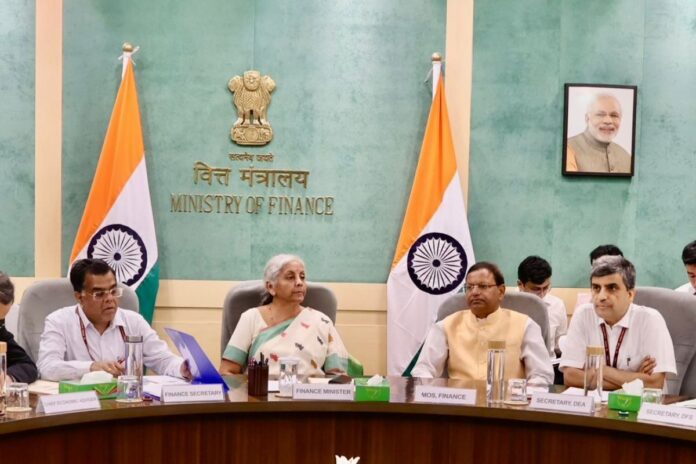
Ground-Level Intelligence
| In a significant departure from conventional Budget-making, the Department of Economic Affairs will deploy senior officials to manufacturing units — large, medium, and small — to gather first-hand operational and policy insights before Union Budget deliberations begin. |
By Economy & Policy Desk | News365 Times 30 May 2026 · New Delhi
| KEY DIMENSIONS OF THE DEA FACTORY VISIT INITIATIVE
◆ Senior DEA officials to personally visit manufacturing units across scale — large, medium, and small ◆ Externally aided and multilaterally financed projects also included in the outreach scope ◆ Objective: assess operational realities, regulatory friction, and sector-specific policy gaps ◆ Inputs to directly feed into Union Budget planning and economic policy design ◆ Marks a methodological shift — from secondary data reliance to first-hand ground intelligence ◆ Signals Finance Ministry’s intent to sharpen Budget’s targeted sectoral interventions |
A Methodological Shift in Budget Craft
India’s Budget-making process has, over the decades, largely been driven by consultations with industry chambers, sector associations, and inter-ministerial submissions — all of which, while valuable, are mediated representations of ground reality. The DEA’s decision to send its own officers into the field marks a meaningful shift: it is an acknowledgement that the distance between Mint Street deliberations and the lived experience of a factory owner in Ludhiana, Rajkot, or Durgapur can distort the policy lens in ways that aggregate data does not correct for.
This initiative positions the DEA — traditionally a macroeconomic architecture body responsible for capital markets, multilateral engagements, and investment policy — as an active listener on the industrial ground. By including not just Tier-I manufacturing clusters but also medium and small units, the exercise deliberately reaches into the long tail of India’s industrial economy, which contributes disproportionately to employment and which has historically been underrepresented in the formal Budget consultation process.
“The initiative reflects the Ministry of Finance’s sharp focus on obtaining first-hand feedback from manufacturing units and industrial clusters — to size up and, in turn, support economic policymaking and Union Budget planning.”
— Mohan Shukla, Chairman, Board of Governors, News365 Times
A Window for Industry to Speak to the Finance Ministry Directly
Beyond its significance as a policy intelligence tool, the initiative opens a rare and direct channel for industries — particularly those that do not have the lobbying resources or organisational bandwidth of large chambers — to place their operational, regulatory, and sector-specific challenges squarely before the policymakers who shape Budget priorities. For sectors grappling with inconsistent GST input credit chains, delayed government payments, environmental compliance costs, or the challenge of competing with cheaper imports, this could represent a genuine moment of access.
The inclusion of externally aided projects in the survey scope is also noteworthy. These projects — funded through development finance institutions, bilateral loans, and multilateral credit lines — often occupy a unique operational space: subject to both Indian regulatory frameworks and the conditionalities of external financiers. The DEA’s attention to this segment signals an intent to integrate the lessons from these capital-intensive, technically complex projects into a broader understanding of how public investment interacts with on-ground industrial performance.
What the Industry Must Now Do
For India’s industrial leadership — from boardrooms of listed manufacturers to the owners of cluster-based MSMEs — this initiative represents both an opportunity and a responsibility. The quality of input that reaches Budget planners through this exercise will depend significantly on how prepared and candid stakeholders are when DEA officials arrive. Anecdotal evidence presented without supporting data may fail to move the needle; but well-documented, specific, and forward-looking submissions have the potential to genuinely inform the contours of next year’s fiscal framework.
Industry bodies, trade associations, and state investment promotion boards should use the window created by this initiative to facilitate coordinated, sector-representative submissions — ensuring that the views of small and medium manufacturers are not drowned out by the louder voices of large industrial houses.
Reading the Signal: Budget 2026–27 Priorities
The decision to undertake this exercise at this point in the fiscal calendar is itself a policy signal worth reading carefully. As India navigates a global economic environment marked by trade policy volatility, shifting supply chain architectures, and subdued private capital expenditure growth in certain segments, the government appears to be signalling its intent to ensure that the forthcoming Budget is calibrated with surgical precision to the real bottlenecks constraining India’s manufacturing output and competitiveness. The DEA’s reach into the factory floor may well be the first act of what promises to be one of India’s more attentively crafted Union Budgets in recent memory.
| CHAIRMAN’S PERSPECTIVE · NEWS365 TIMES
Mohan Shukla CHAIRMAN, BOARD OF GOVERNORS · NEWS365 TIMES The Finance Ministry’s factory visit initiative is far more than a procedural step in the Budget calendar — it is an admission of epistemic humility by the policymaking establishment. For too long, the Budget has been shaped by what data systems can capture and what organised industry can articulate; the silent majority of India’s manufacturing ecosystem — the MSME clusters, the contract manufacturers, the sub-tier suppliers — have had to make do with policies designed around averages and approximations. This initiative, if executed with genuine intent and adequate follow-through, has the potential to bridge that gap in a meaningful way. It may also provide an erudite insight for industries to highlight operational, regulatory, and sector-specific challenges directly to the policy thinkers and policymakers of the Finance Ministry — a window that industry must be prepared and organised enough to use wisely. At News365 Times, we will be watching closely how this ground intelligence is eventually reflected in Budget priorities, and we will report on it without fear or favour. |