

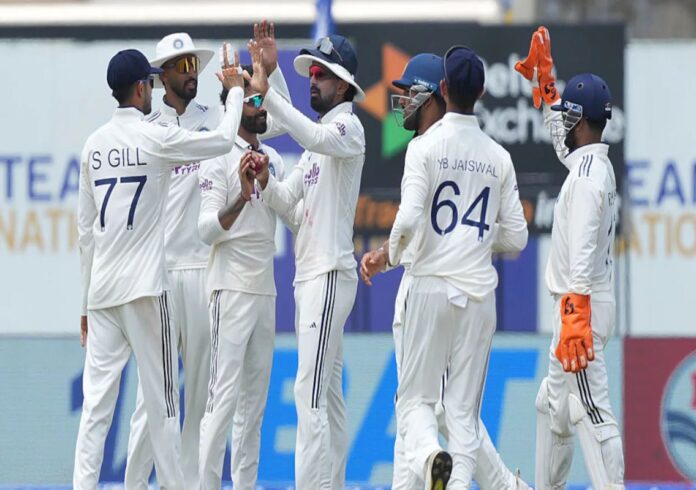
Galle: India will look to complete a series-opening victory against Sri Lanka on Day 5 of the first Test at the Galle International Stadium. Sri Lanka began the final day facing a daunting target of 372 runs, while India needed six wickets to secure victory.
At the close of play on Day 4, Sri Lanka had reached 84/4 in their second innings. Dhananjaya de Silva and Sonal Dinusha were at the crease, with the hosts still requiring 288 runs for an unlikely win. India, meanwhile, needed six more wickets to wrap up the Test.
The match has produced several significant moments already, including Rishabh Pant becoming the first Indian batter to hit 100 Test sixes and a frustrating no-ball from Ravindra Jadeja that denied India the wicket of Dhananjaya de Silva.
India need six wickets for victory
India entered Day 5 in a strong position after reducing Sri Lanka to 84/4.
The visitors’ bowlers made regular breakthroughs during the third session on Day 4, putting Sri Lanka under considerable pressure in the fourth innings.
Manav Suthar was particularly impressive, claiming two wickets, while Mohammed Siraj and Prasidh Krishna also struck.
However, Sri Lanka managed to survive the remainder of the day through Dhananjaya and Dinusha.
The equation remains heavily in India’s favour.
The visitors need six wickets, whereas Sri Lanka require 288 runs. For the hosts to win, they would need to produce one of the biggest fourth-innings chases in their Test history.
Dhananjaya survives Jadeja scare
One of the most dramatic moments of Day 4 involved Ravindra Jadeja.
The Indian spinner appeared to have dismissed Sri Lankan captain Dhananjaya after inducing an edge. KL Rahul completed the catch at first slip, and India briefly celebrated what looked like an important breakthrough.
The celebration was short-lived.
Jadeja had overstepped, resulting in a no-ball. The delivery was therefore not counted as a legal ball and Dhananjaya remained at the crease.
The incident produced an animated reaction from head coach Gautam Gambhir and could become an important moment if Dhananjaya plays a significant role on Day 5.
Sri Lanka’s hopes rest on Dhananjaya and Dinusha
Dhananjaya de Silva and Sonal Dinusha are Sri Lanka’s main hopes at the start of the final day.
Dinusha has already demonstrated his ability to bat for long periods in this Test, having scored a century in Sri Lanka’s first innings.
Dhananjaya is an experienced Test batter and the team’s captain.
Their partnership will be crucial if Sri Lanka are to make India work hard for the remaining wickets.
The immediate objective for Sri Lanka will be to survive the opening session.
If they can avoid early wickets, pressure could gradually shift back towards India.
India set a target of 372
India’s second innings lasted only 49 overs but produced enough runs to set Sri Lanka a substantial target.
Yashasvi Jaiswal fell for a duck early in the innings after being caught behind off Asitha Fernando.
KL Rahul and Devdutt Padikkal then helped stabilise India’s innings before Prabath Jayasuriya dismissed Rahul.
India captain Shubman Gill also fell to Jayasuriya for eight.
The middle order subsequently ensured that India continued to build the lead.
Rishabh Pant produces another memorable innings
Rishabh Pant was one of the key contributors during India’s second innings.
The wicketkeeper-batter scored 66 off 69 balls, striking eight fours and two sixes.
His innings was particularly significant because one of those sixes took him to 100 sixes in Test cricket.
Pant became the first Indian batter and only the fourth player overall to reach the landmark, following Ben Stokes, Brendon McCullum and Adam Gilchrist.
He also became the fastest batter to reach 100 Test sixes, achieving the feat in his 51st Test.
Pant’s record highlights India’s attacking approach
Pant’s milestone was another example of the attacking style that has become an important part of India’s Test batting.
His ability to score boundaries quickly allowed India to increase the scoring rate during the second innings.
The 66-run knock also helped India build enough of a lead to give their bowlers a realistic opportunity to dismiss Sri Lanka on the final day.
For India, Pant’s presence in the middle order provides an additional way of putting pressure on opposition bowling attacks.
Sri Lanka face a massive fourth-innings challenge
A target of 372 is difficult under any circumstances.
The challenge becomes even greater in Galle, where the pitch can offer assistance to spin as a Test progresses.
Sri Lanka must therefore negotiate India’s bowling attack for a full day while also maintaining a scoring rate capable of keeping the chase alive.
A defensive approach could lead to a draw if the batters survive long enough, but India will constantly attack with close fielders and different bowling combinations.
The hosts therefore face a delicate balance between survival and scoring.
Manav Suthar emerges as a key threat
Manav Suthar was one of India’s most effective bowlers on Day 4.
The left-arm spinner claimed two wickets during Sri Lanka’s second innings and played an important role in putting the hosts under pressure.
His performance has added another dimension to India’s bowling attack.
With Jadeja also available, India have two left-arm spinners capable of operating from different angles and creating pressure over long spells.
The final-day conditions could make their role even more important.
Siraj and Prasidh provide pace support
India’s pace attack has also contributed important breakthroughs.
Mohammed Siraj and Prasidh Krishna each claimed a wicket during the third session.
Their role will be to exploit any movement with the new ball early on Day 5 and create opportunities for India’s spinners later in the innings.
Early wickets would significantly reduce Sri Lanka’s chances of forcing a draw or attempting the chase.
Shubman Gill faces an important captaincy test
India captain Shubman Gill now faces an important tactical challenge.
The visitors are close to victory, but Sri Lanka still have six wickets in hand and experienced batters at the crease.
Gill will have to rotate his bowlers carefully and ensure that India maintain pressure without allowing the Sri Lankan batters to settle.
Field placements will also be crucial.
India will want to keep attacking fields while protecting against easy boundary opportunities.
Final-day pitch could favour India’s spinners
The Galle surface is traditionally associated with spin, particularly as a Test progresses.
India can therefore expect Jadeja and Suthar to play major roles during the final day.
If the surface offers increasing turn and uneven bounce, batting could become progressively more difficult.
Sri Lanka’s batters will need to use their feet effectively and avoid playing for big shots unless the situation demands it.
India, meanwhile, will look to create pressure through sustained spells and close catching positions.
What Sri Lanka need to do
Sri Lanka’s immediate priority is survival.
The hosts need to prevent India from taking early wickets and ideally build a substantial partnership.
Dhananjaya and Dinusha will be expected to absorb the pressure before attempting to accelerate.
If Sri Lanka reach the second session with several wickets still intact, the match could become considerably more competitive.
However, losing two or three wickets early would leave the lower order exposed against India’s spin attack.
What India need to do
For India, the strategy is straightforward: take six wickets.
The visitors do not need to chase a target or force the scoring rate.
They can attack Sri Lanka with their full bowling resources and use the pitch to their advantage.
The key will be patience.
Sri Lanka are likely to adopt a defensive approach, meaning India’s bowlers may need to create opportunities rather than simply wait for mistakes.
A Test filled with major talking points
The Galle Test has already produced several memorable moments.
Pant’s record-breaking 100th Test six has been one of the biggest highlights.
India have also seen important contributions from their bowlers, while Sri Lanka have shown considerable resistance despite being put under pressure.
The Jadeja no-ball added another dramatic twist.
The final day could now determine whether those moments form part of an Indian victory or a hard-fought draw.
Day 5 could be decided in the first session
The opening session of Day 5 could prove decisive.
If India take two or three wickets quickly, Sri Lanka’s hopes of saving the match will diminish substantially.
If Dhananjaya and Dinusha survive and build a significant partnership, India may have to work much harder.
The first hour will therefore be particularly important.
India’s new-ball bowlers and spinners will be expected to attack from the start.
Conclusion
India enter Day 5 of the first Test against Sri Lanka in Galle as strong favourites to complete a victory. Sri Lanka finished Day 4 on 84/4, still requiring 288 runs to chase down India’s target of 372.
India need six wickets, with Manav Suthar, Mohammed Siraj, Prasidh Krishna and Ravindra Jadeja expected to lead the final-day attack.
Rishabh Pant’s historic 100th Test six has already provided one of the defining moments of the match, while Jadeja’s no-ball and the resulting survival of Dhananjaya de Silva added another major twist.
With Dhananjaya and Sonal Dinusha at the crease, Sri Lanka’s hopes will depend heavily on their ability to survive India’s attack. The first session could determine whether India cruise towards victory or face a prolonged final-day battle.