

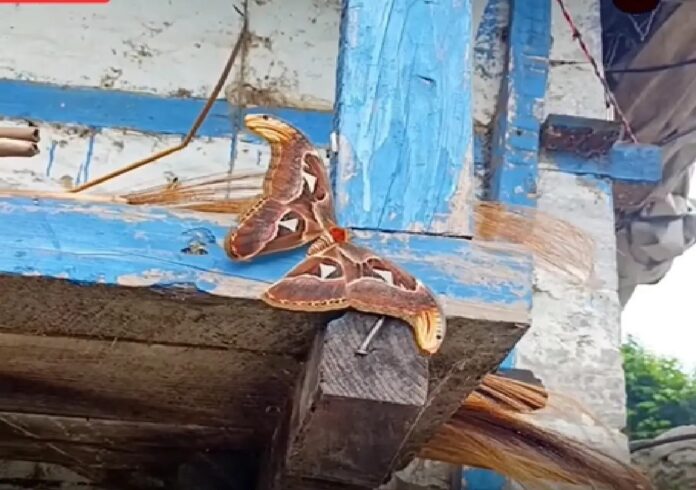
Nepal: A remarkable video of a giant butterfly-like insect resembling a two-headed snake has left social media users and residents of a rural village in Nepal astonished, drawing attention to one of nature’s most extraordinary examples of mimicry.
The insect, initially mistaken for a venomous reptile because of the striking patterns on its wings, was later identified as the giant Atlas Moth, one of the largest moth species in the world. The unusual creature’s wings feature markings that closely resemble the heads of two cobras, creating a visual illusion that is designed to frighten away predators.
The video, which has been widely shared online, has sparked fascination among wildlife enthusiasts and highlighted the incredible adaptations found in the natural world.
Villagers initially feared it was a snake
The incident reportedly occurred in a rural part of Nepal, where locals spotted the unusual creature resting on a wooden beam.
At first glance, many believed they were looking at a dangerous snake. The wing patterns appeared so realistic that some onlookers hesitated to approach the insect.
As people gathered around the creature, curiosity gradually replaced fear. A closer examination revealed that the apparent snake heads were, in fact, part of the moth’s intricate wing design.
The discovery surprised both residents and viewers online, many of whom described the insect as one of the most unusual creatures they had ever seen.
Atlas Moth’s remarkable defence mechanism
The insect was identified as the Atlas Moth, a giant moth species found across parts of South and Southeast Asia.
The Atlas Moth is renowned for its enormous wingspan, which can measure up to 24 centimetres, making it one of the largest moths in the world by wing surface area.
One of its most fascinating features is the shape and colouring of its wing tips. The ends of the wings resemble the heads of snakes, complete with markings that mimic eyes and scales.
Scientists believe this extraordinary adaptation evolved as a defence mechanism. Predators such as birds and small mammals may avoid attacking the moth after mistaking it for a snake.
This form of protective disguise, known as mimicry, is commonly observed in nature and plays a vital role in helping vulnerable species survive.
A master of deception in the natural world
Wildlife experts say the Atlas Moth’s appearance is an excellent example of how species adapt to their environments through evolution.
Unlike venomous snakes, the Atlas Moth is completely harmless and does not pose any threat to humans.
Adult Atlas Moths have a relatively short lifespan and survive only for a few days after emerging from their cocoons. Since they do not possess functional mouthparts, they are unable to feed during adulthood and rely entirely on energy stored during their caterpillar stage.
The moths are primarily active at night and are rarely seen by people, making sightings of the species particularly special.
Viral video sparks fascination
The Nepal video has generated widespread interest on social media, with many users expressing amazement at the insect’s deceptive appearance.
Several viewers initially believed the creature was a genuine two-headed snake, while others praised the wonders of evolution and the diversity of wildlife.
The incident has also renewed interest in the Atlas Moth and the many remarkable survival strategies found in the animal kingdom.
Nature often produces extraordinary illusions, and the giant Atlas Moth serves as a reminder that some of the world’s most fascinating creatures rely not on strength or venom but on clever deception to survive.
The viral sighting from Nepal has once again demonstrated that the natural world continues to surprise and captivate people with its endless mysteries.