
Encourage Tourism to promote Indian Culture & Revenue Earning
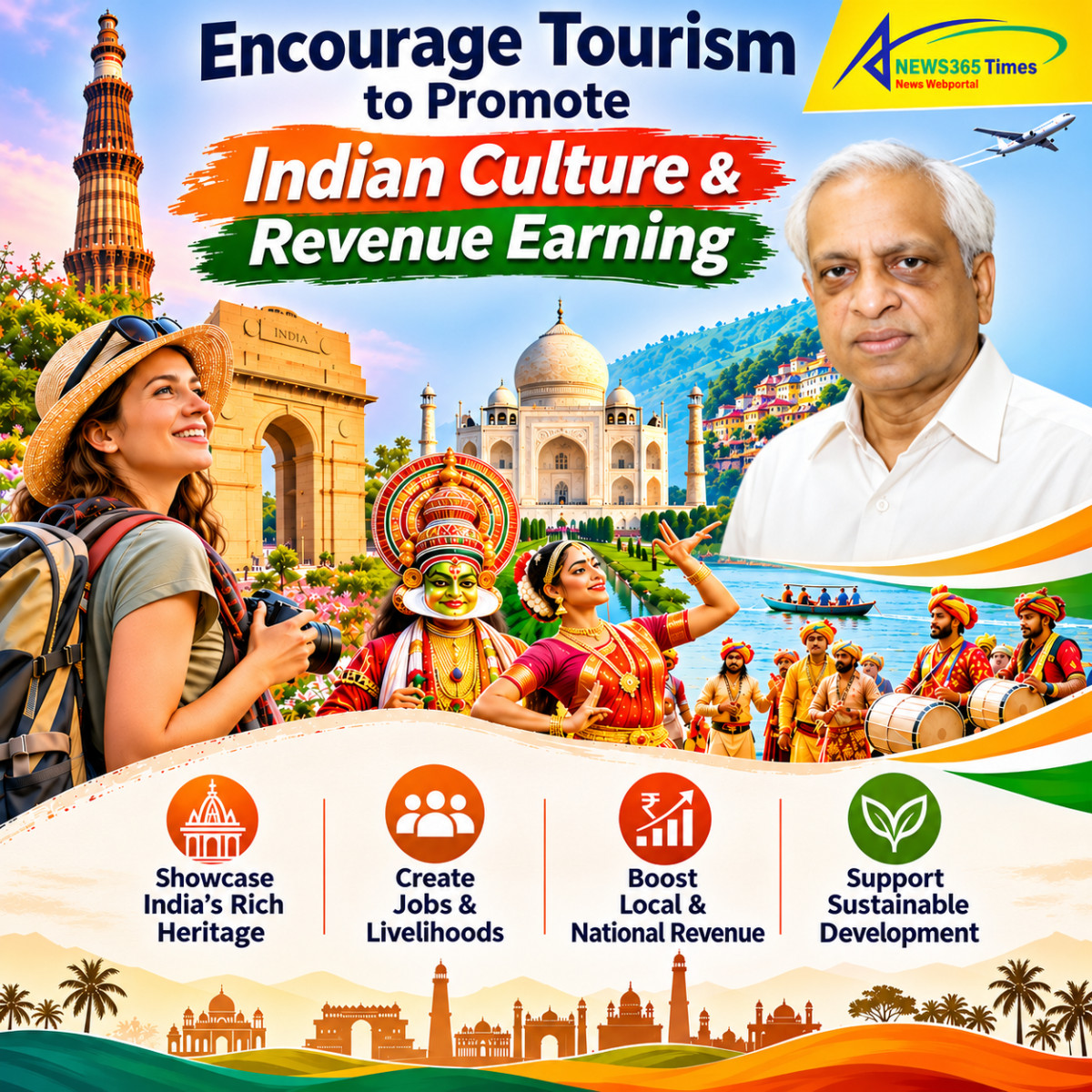
India stands at a pivotal moment in global travel. Combining ancient heritage, rapid digital growth, and diverse landscapes, the country offers experiences few destinations can match. While domestic travel remains the backbone of India’s hospitality sector—with over 303 crore domestic visits recorded—attracting more international visitors offers massive economic and cultural upside. International visitors come to India for depth, contrast, and authenticity: Heritage and Architecture: From Mughal landmarks in Delhi and Agra to ancient temples in Hampi, Mahabalipuram, and Konark, India preserves thousands of years of living history.
Promote Medical Tourism in India
Already India has become a hub for Medical Tourism where foreigners prefer India for medical treatment because it is far more economical in India than in their own countries. It is time tha Union Ministry for External Affairs through Indian Missions abroad makes efforts to promote Medical Tourism in India on a large scale to earn extra revenue in foreign exchange.
India’s rich heritage of ancient monuments of Ramayana and Mahabharata era and later monuments built in Mughal era can be utilized to attract more and more foreign tourists especially when stay in five-starred hotels in different Indian cities is comparatively cheaper than in other countries. Foreign tourists can be attracted to India with under-mentioned salient features:
Spirituality and Wellness: As the birthplace of yoga, Ayurveda, and major world religions—including Buddhism in Bodh Gaya—India appeals to travelers seeking mindfulness, healing, and pilgrimage.
Diverse Landscapes: Travelers can move from Himalayan trekking and skiing in Ladakh and Himachal Pradesh to Kerala’s backwaters, Goa’s beaches, and wildlife reserves like Kaziranga, Gir, and Kanha.
Cuisine and Living Culture: Regional food trails, seasonal festivals, and rural traditions across hundreds of thousands of villages turn every trip into a cultural immersion.
Medical Value: Cities like Chennai and major metro hubs draw international patients seeking quality healthcare alongside recovery stays.
How to Attract More Foreign Tourists
Turning India’s potential into higher foreign tourist arrivals requires removing friction and broadening what gets promoted worldwide
Look Beyond the Golden Triangle: Promote emerging circuits—such as Northeast India, coastal belts, rural homestays, and Buddhist trails—so international travelers return for repeat visits.
Make Arrival and Movement Effortless: Keep expanding smooth e-Visa processes, clear multilingual signage, digital payments, and reliable last-mile transport from airports and stations to hotels and sites.
Prioritize Safety, Cleanliness, and Hospitality: Clean public spaces, transparent pricing, visible tourist assistance, and warm service rooted in Atithi Devo Bhava build trust and positive word-of-mouth.
Tell Stories That Resonated Globally: Pair digital campaigns and creator storytelling with targeted outreach in key source markets, highlighting wellness, sustainable travel, and film-friendly destinations.
Shared Growth for Communities and the Nation
Tourism works best when local communities share in the rewards. Supporting artisans, local guides, homestay hosts, and small businesses creates jobs while encouraging travelers to respect local customs and environments. With the right mix of access, care, and storytelling, India can welcome the world not just as a bucket-list stop, but as a place to return to again and again.
India as a Tourism Hub: The country's unparalleled cultural heritage, diverse landscapes, spirituality, wellness traditions and experiential offerings pro...
How can India realize its potential as a tourism hotspot: Take advantage of 600,000 villages, each with their own cultures and heritage; eco-tourism; and cruise tourism to create unique.
ITDC should devise more and more “Sound & Light” programmes: ‘Sound & Light’ shows revealing history of historical Red Fort in Delhi is an attractive and educative show for one-hour each in Hindi and English at Red Fort daily. Tourists from different parts of India and the world come to see the beautiful presentation from government-owned India Tourism Development Corporation (ITDC). Such shows should be arranged at different historical places in India.
Promote Religious Tourism in India
Indian government should accept long pending suggestion of the then Tamilnadu Chief Minister Jaylalita’s to declare Ramsetu as national monument. Ramsetu is of great historical and religious values for masses. Existence of Ramayana era has since been established by many evidences, and Ramsetu is an important aspect of that era which also remains a place of pilgrimage for Hindus of not only India but also for Pakistan, Bangladesh and other countries. Otherwise also, it is an ancient wonder to find a rather impossible phenomenon of floating stones on sea-water.
Neighbouring island-country Shrilanka has been exploring all means to trace evidences of Ramayan era for promoting religious tourism in that country. Indian government should also work on similar lines not only for tourism but also as saviour of heritage culture. Matter should also be taken up with Pakistan to preserve evidences of historic era of Ramayan in that country. It is significantly interesting that Pakistan government has officially acknowledged through literature of government-owned Pakistan Tourism Development Corporation that Lahore is named after Luv, son of Lord Ram. UNESCO should also be approached for assistance to preserve historical evidences of Ramayan era not only in India but also in other concerned countries including also Pakistan, Shrilanka etc.
Likewise, Shree Mahavirji is a renowned pilgrimage town in Rajasthan where large number of Jain devotees visit daily from Delhi and other parts of the country. Shortest route to this town from Delhi is through Mathura in UP. Major portion of the road connecting Shree Mahavirji and Mathura which lies in Rajasthan has already been widened and even Bharatpur-bypass has been developed to cut travel-time to the holy town. Already Delhi-Mathura highway is amongst the best roads of the country. Development of remaining small stretch of road in UP connecting Mathura and Bharatpur will cut travel-time for a comfortable journey to this important pilgrimage town fulfilling dreams of large number of religious people visiting Shree Mahavirji. Union and UP government should also develop this and other important religious towns in the state as tourist-spots to provide modern and adequate facilities for large number of devotees visiting these holy towns round the year. In the same manner, holy Gurudwaras in the country should be brought on tourist-map of the country with special trains with all facilities in different classes of travel be run from different cities.
Encourage destination-marriages at religious places in different parts of the country
There has been a growing fashion of destination-marriages at different tourist places not only in the country itself but also in foreign countries. For divine god-blessings, destination-marriages should be encouraged in holy religious cities like is presently promoted by Uttarakhand Government. There should be an extra-ordinary dose of taxes on destination-marriages equivalent to total marriage-expenses in a foreign country for Destination-marriages in a foreign country to effectively discourage Destination-Marriages in foreign countries. Already a small country like Maldives is making all efforts to attract Indians to perform Destination-Marriages in that country.
Reduce government-expenses on promoting Tourism in India
Centaur Hotels at New Delhi and Srinagar were set up by public-sector The Hotel Corporation of India, a subsidiary of Air India in the year 1971 with an aim to set up five-starred hotels near airports. Both these two hotels which at one time were very popular for their fine hospitality, now look deserted with nearly negligible occupancy and dining capacity thus putting a heavy recurring loss every year to Air India already under deep financial crisis. The Hotel Corporation of India Limited with its two Centaur Hotels should be merged with India Tourism Development Corporation Limited (ITDC), another public-sector undertaking. With lapse of over so many decades, advantageous concept of setting up of its own hotels by Air India in vicinity of airport has lost all relevance with civic population now expanding near the airports. In the year 1971, airports used to be far away from cities thus Centaur Hotels being very popular with full occupancy and dining capacity mainly because of all foreign airliners finding these to be ideal choice for their crew. Another suggestion given at Parliamentary committee set up for looking into losses of Centaur Hotels to rent these on annual lease to private parties is also noteworthy worth considering because even public-sector ITDC hotels are not working to expectations. For example, while new private-sector hotels are fast emerging in Delhi/New Delhi, ITDC’s Samrat Hotel had to lease out its several floors to various institutions because of falling occupancy-rate. Even several ITDC hotels like Lodhi Hotel and Ranjit Hotel in New Delhi had to be disinvested at throw-up prices. Annual leasing out of public-sector hotels to private sector through open tender is a better idea to earn the most from these hotels. Public-sector is not necessary requirement for luxury hotels.
Use Tongas and Bugghi rides for promoting tourism
Municipal Corporation of Delhi (MCD) some decades ago phased out remaining just 232 tongas out of thousands which came as a big blow to heritage-culture of walled city of Delhi. It is really shocking that the decision comes from a civic body ruled by a political party which talks big about ‘swadeshi’. Instead MCD should have done something extra to finance existing tongawallahas to refurnish and beautifully paint their tongas as part of tourist attraction. Pakistan has done a lot to save its ancient culture by retaining ancient beauty and cultural heritage in Lahore and elsewhere. Even buses painted and inserted with decorative pictures like were even in India also after independence, can even now been seen plying on Pakistani roads. Even Mumbai’s famous victoria-bugghies were retained as part of tourist-attraction and joy-rides. Likewise tongas in Delhi should be used at selected routes/roads for joy rides and tourist attraction. Even in Agra, only tongas used to be allowed under park-and-ride system to go near Taj Mahal.
What's Your Reaction?
 Like
0
 Dislike
0
 Love
0
 Funny
0
 Wow
0
 Sad
0
 Angry
0

English Daily News Platform #News #Latestupdates #Tech #Business #Politics #Indianews #India. Regd No : JMAGC/HR/00072 (JMAGC ), MIB ,Govt of India



Comments (0)