
Chalo Delhi Chalo !! But who sufferes the most ???
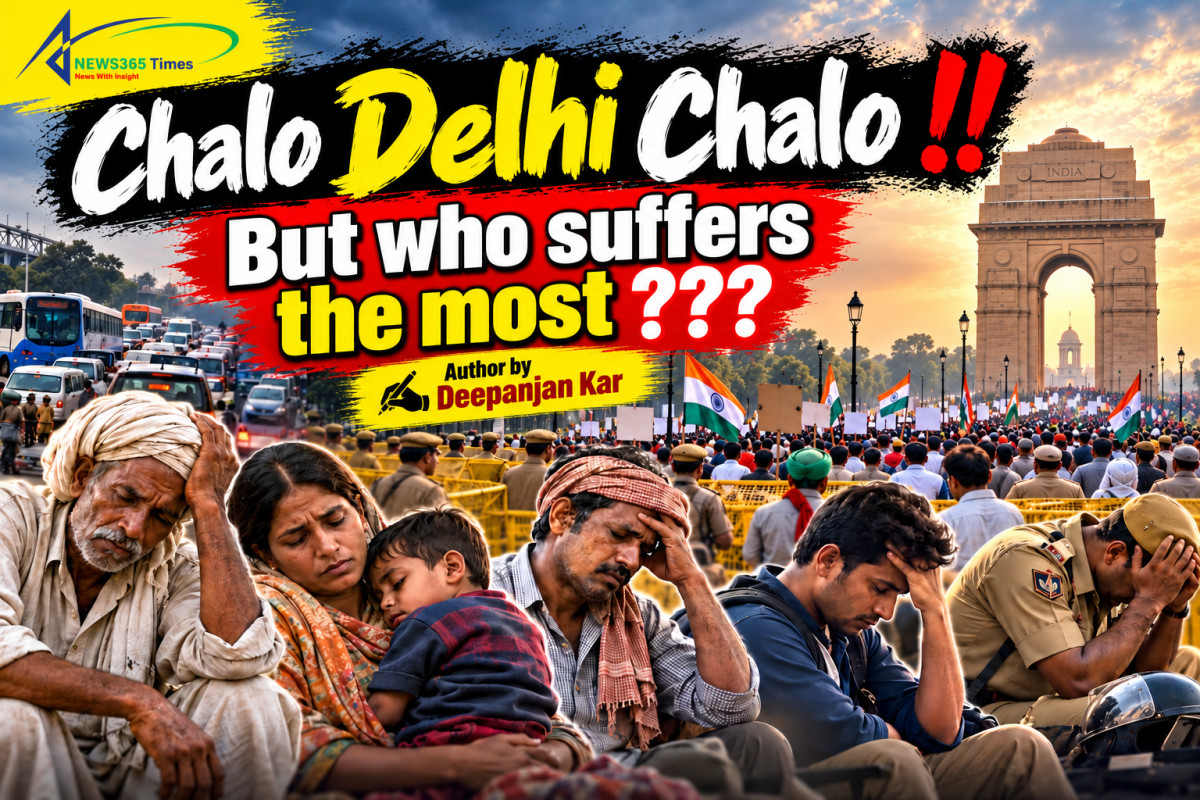
The National Capital Territory of Delhi functions under a structural paradox: it is simultaneously the sovereign command center of the world's most populous democracy and a hyper-dense, landlocked metropolis of over 30 million people.
When these two identities collide, small operational disruptions trigger outsized strategic and civic consequences.
1. Why New Delhi Is Structurally Critical
New Delhi concentrates an extraordinary number of vital national functions within a single geographical node:
- Sovereign Nerve Center: It houses the absolute leadership of the Indian state, the President, the Prime Minister, the Union Cabinet, Parliament, and the Supreme Court. An administrative paralysis in New Delhi stalls legislative, executive, and judicial functions across the country.
- Diplomatic & Global Hub: As the permanent home to over 150 foreign embassies, high commissions, and international multilateral bodies (UN, World Bank), New Delhi is India’s international face. Continuous bilateral summits, state guest visits, and multilateral conclaves require flawless, round-the-clock protocol, high security, and clear transit.
- National Security & Strategic Command: The apex leadership of the Armed Forces Integrated Defence Staff, Army, Air Force, and Navy Headquarters (Sena Bhavan, Vayu Bhavan, South Block) is located in the urban core. Instant, unhindered operational mobility for defense chiefs and the National Security Advisor is essential during national security contingencies.
- Critical Lifeline of Northern India: The capital is the primary transit gateway and logistics conduit linking Punjab, Haryana, Himachal Pradesh, Jammu & Kashmir, Uttarakhand, Rajasthan, and Uttar Pradesh. Furthermore, Delhi hosts premier tertiary health institutions primarily AIIMS and Safdarjung Hospital which treat thousands of critically ill emergency patients arriving daily from across the subcontinent.
The economic damage inflicted on New Delhi extends far beyond government delays and street-level traffic. When the capital faces sudden border seals, section-wide barricades, and VIP lockouts, it strikes the core engine of NCR’s commercial economy: hospitality, corporate operations, the MICE industry, and tourism.
The NCR houses the regional and India headquarters for hundreds of Fortune 500 corporations, top management consultancies, technology giants, and venture capital firms, clustered across Connaught Place, Barakhamba Road, Aerocity, Gurugram (Cyber City), and Noida.
New Delhi is India's prime destination for multi-tier conferences, public policy symposiums, corporate shareholder meetings, and international trade summits. This sector relies entirely on precise schedules and seamless mobility.
2. Why the Capital Stands Highly Vulnerable
Despite its power, New Delhi’s physical, administrative, and logistical layout makes it fragile against mass mobilizations and targeted blockades:
Targeting Central Vista Maximizes Instant Global Leverage
- Chokepoint Arterial Topography: Delhi is naturally constricted by the Yamuna River on the east and Ridge forests to the west and south. Traffic into the city relies on a handful of bridges and arterial highways (NH-44, NH-48, NH-24). Blocking just 2 or 3 border toll gates (e.g., Singhu, Tikri, or Ghazipur) severs supply chains for the entire city.
- Extreme Commuter Density: The city's public transport runs near capacity daily the Delhi Metro alone caters to 6.5 to 7 million passenger journeys each weekday. Even marginal surface-road barricading cascades into systemic gridlock across the entire NCR.
- High Publicity Payoff: Because the national media, international press corps, and central ministries are located in Central Delhi, organizers know that holding a rally in a regional capital yields minimal leverage, whereas marching to Delhi guarantees global headlines within hours.
- Multi-Jurisdictional Friction: The fractured administrative setup involving the Delhi Police (Union Ministry of Home Affairs), the elected Delhi Government (MCD, health, local transport), and border police forces of Haryana and Uttar Pradesh creates complex operational hurdles during large-scale security operations.
3. How the Capital Gets Affected
When mass rallies, "Chalo Delhi Chalo" calls, and continuous VIP security deployments converge, the fallout ripples through every layer of the city:
A. Civic Life and Article 21 Rights of Residents
- The "Fortress Mentality": Routine security responses involve multi-tier concrete barricades, concertina wire, spike strips, and preemptive internet curbs at state borders. The city feels under siege, disrupting ordinary movement and daily routines.
- Emergency Medical Failures: Ambulances attempting to reach AIIMS, Safdarjung, or RML Hospital are frequently caught in multi-kilometer gridlocks caused by road closures or VIP route sanitizations, directly endangering lives.
- Disruption to Education and Livelihoods: School buses face sudden route cancellations, universities are closed, and daily wage workers and private employees lose working hours idling in traffic on the Ring Road, Outer Ring Road, and DND Flyway.
B. Economic and Supply Chain Shocks
- Perishable Logistics Paralysis: Delhi consumes thousands of tons of fresh milk, fruits, and vegetables trucked overnight from neighboring agricultural belts (Punjab, Haryana, Western UP, Rajasthan). Highway blockades strand transport trucks, leading to spoiled produce and immediate inflation in local retail markets.
- Interstate Trade Bottlenecks: Industrial hubs in Kundli, Manesar, Noida, and Greater Noida depend on smooth, seamless cross-border freight transit. Long-term border standoffs cost regional logistics, warehousing, and trade associations thousands of crores in delayed deliveries and fuel burn.
C. International Image and Sovereign Costs
- Diplomatic Inconvenience: When visiting world leaders or ministerial delegations navigate a city choked with diversions, tear gas smoke, or barricaded ring roads, India’s reputation as an orderly, global investment and convention hub is dented.
- Enormous Security Expenditure: Mobilizing dozens of companies of Central Armed Police Forces (CRPF, RAF, CISF), maintaining border barricades, deploying water cannons, and managing continuous drone surveillance drains hundreds of crores in public funds that could otherwise go toward civic development and standard policing.
Where a Real Solution Lies: Peripheral Open Grounds
The state already has two inner-city designated sites that fulfill this purpose under tight regulations:
- Jantar Mantar: For small, symbolic, media-facing sit-ins (capped by police at a few hundred to 1,000 participants).
- Ramlila Maidan: A dedicated open-air ground buffered with historic boundary walls, designed specifically to absorb large political rallies without damaging permanent indoor structures.
If New Delhi is to be kept completely free of disruption, the viable model is not repurposing world-class convention centres, but institutionalizing dedicated peripheral open arenas along the National Capital Region (NCR) borders such as the Burari / Nirankari Grounds in North Delhi, or designated open expanses along the Kundli Manesar Palwal (KMP) corridor.
These sites can provide open dirt/grass staging grounds, water and sanitation facilities, parking for buses and tractors, and press briefing enclosures, while keeping transit lines to Central Vista, embassies, and the airport completely unobstructed.
LET’S SAVE THE FACE OF THE NATION !!
What's Your Reaction?
 Like
1
Like
1
 Dislike
0
Dislike
0
 Love
0
Love
0
 Funny
0
Funny
0
 Wow
0
Wow
0
 Sad
0
Sad
0
 Angry
0
Angry
0

English Daily News Platform #News #Latestupdates #Tech #Business #Politics #Indianews #India. Regd No : JMAGC/HR/00072 (JMAGC ), MIB ,Govt of India








Comments (0)