
Car-policy needs drastic changes to save oil apart from enforcing present car policy
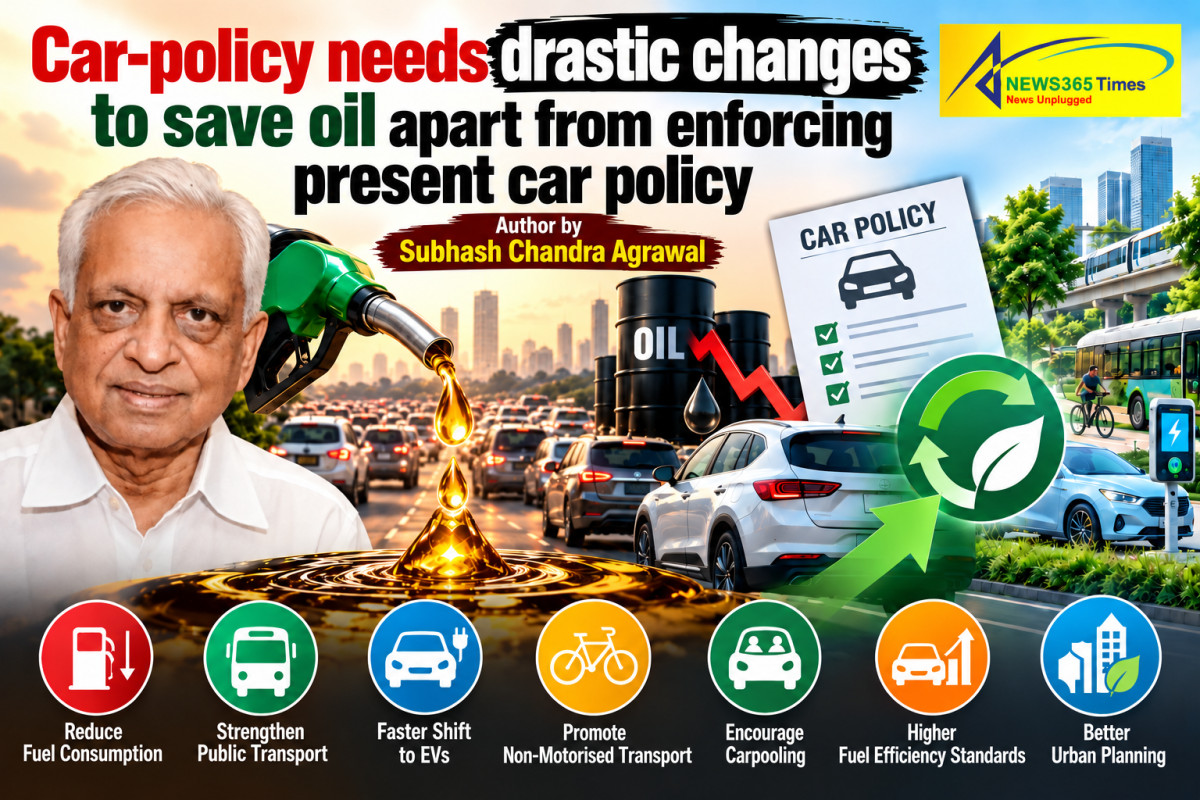
Prime Minister’s appeal to general public for saving oil in national interest is welcome, but necessary steps are required to be taken also by government itself. There should be a total ban on road-shows and election rallies. Security agencies should study if convoy of cars of top government functionaries can be reduced without affecting security of concerned ones.
All government-purchases of cars (central, states and their undertakings) may be compulsorily from economy-range of cars. Exception may be for cars used by President, Vice President, Prime Minister and foreign dignitaries coming to India. Telangana government in the year 2021 was in criticism, and rightly too, for purchase of a fleet of 32 new luxury cars priced at rupees 30 lakhs each for use of Additional Collectors. The then Maharashtra government approved purchase of six luxury cars each costing of rupees 22.83 lakhs with total expenditure of rupees 1.37 crores for its Education Department during the corona-period in the year 2020 that too with state facing financial crunch when state-government should have concentrated more on fighting corona. Cars must not be sold with GST-subsidy through Canteen Stores Departments for army-personnel.
It is time that improved version of auto-rickshaws with provision of air-conditioning may be introduced in the market so that at least middle-class people may like to switch to such air-conditioned auto-rickshaws which will occupy less road and parking space apart from being eco-friendly because auto-rickshaws are now either electric-charged or having CNG-engines. It may be recalled that once Mexican Ambassador to India in Delhi preferred private luxurious auto-rickshaw rather than any luxury car. If such air-conditioned auto-rickshaws are started being manufactured, even cars in government departments/ministries and undertakings can be largely replaced by such air-conditioned auto-rickshaws.
Already car-parking charges were doubled in Delhi to discourage use of cars in the city. But on the contrary GST on small cars was slashed down from earlier 28-perecent to now at 18-percent perhaps due to influential lobby of car-manufacturers. However, it was good that GST on costlier cars was rightly increased to 40-percent.
The then Union Environment Minister Jairam Ramesh (UPA regime) had once rightly termed SUVs as ‘Socially Useless Vehicles’ misusing diesel-subsidy for elite rich capable to purchase these luxury vehicles. The then Delhi Chief Minister Shiela Dixit had also insisted on discouraging big cars which occupy more parking space and road-traffic share. India needs an altogether new car-policy whereby production of big and costly cars may be practically discouraged.
It is beyond understanding why and how authorities and certain individuals prefer promoting car-manufacture in India as if cars are basic necessities rather than luxury. There are so many other sectors of use for commoners where production should be increased like laying down metro-network in more and more cities. Car-manufacturers then can switch over to produce metro-coaches for which efforts should be made for getting export-orders also. They can also utilise their production capacity for manufacture of three-wheeler air-conditioned auto-rickshaws All such steps may be taken to discourage manufacture of costly cars with ex-showroom price above rupees ten lakhs (inclusive of all taxes) in the country. Road-tax, insurance-premium and all other levies may be doubled on costly cars than cars with ex-showroom price less than rupees ten lakhs. Categorisation of cars should be based on ex-showroom price rather than length and engine-capacity. There should be a complete ban on loans for cars having ex-showrooms price above rupees ten lakhs. Costlier cars are nothing but status-symbol, and status-conscious persons must be paying heavily for their show of status in society. Also import-duty on imported cars should be quite high to discourage import of foreign-made cars. There are tax-disputes on paying import-duty on imported cars gifted to Indian celebrities who are otherwise extremely rich. Complete import-duty should be charged on imported cars received as gift from foreign elements by Indians.
Diesel engines must not be allowed in cars of any category. With petrol and diesel having procurement-price almost same, diesel is deliberately priced lower because it is used for public transport and goods-carriers. It is misuse of lower-priced diesel to allow it to be used for cars. Supreme Court appointed Environment-Pollution-
Already US-giant Ford has also been compelled to discontinue manufacture of cars due to mounting losses. Idea should be to discourage other foreign car-manufacturers in India also to shut down production so as to save Indian money going to foreign countries. Instead every step should be taken to encourage export of cars manufactured by Indian companies to other countries.
Car-scrapping policy to compulsorily abandon 10-years old diesel cars and 15-years old petrol cars in cities like Delhi in name of curbing pollution is indirectly for promoting car-industry in India. Pollution can and should be controlled by making it mandatory for each registered workshop for every type of vehicles to compulsorily install pollution-checking machines where every vehicle going out of workshops must be given check-out with pollution-certificate. Rather such pollution-checking-service and certificate should be provided free-of-cost by automobile-workshops because it is not very costly. Presently if a vehicle fails in pollution-checking at pollution-checking-centre, then it has to be first taken to some automobile-workshop, and then again driven to pollution-checking-centre with cycle repeated till vehicle passes pollution-checking test.
It should be made compulsory for each vehicle to be computerised checked for fitness by authorised workshops of car-manufacturers after every ten years. Cars failing to tests and not fit for necessary modification can be ordered to be scrapped. Present scrapping-policy of compulsorily scrapping cars after 10 years in respect of diesel-cars and 15 years for petrol-cars is very harmful for those especially senior citizens sparingly using their cars. Different-coloured number-plates can be introduced for cars found fit for use after initial ten years.
Too many variants of any car-model confuse customers. There may be just two variants apart from the third with automatic gears, one basic Lx for economy customers and the other Vx with all company-fitted extra accessories and luxuries for affording customers. There is no sense in having too many confusing variants like Lx, Lxi, Vx, Vxi for same model. India being biggest consumer-market amongst nations with free economy, it has certainly power to dictate its consumer-friendly terms for global market-leaders collaborating car-manufacture in India.
Union government should induce standardization of common accessories like tyres and batteries so that same parts may be used in different models of cars produced by various car-manufacturers. It will heavily bring down cost of consumables through their bumper production in extra large numbers in some limited sizes and specifications. It can be achieved by merging some nearing sizes and specifications. Such guidelines though also mentioned in auto-policy of Union government, are never followed in actual practice.
Extra-ordinary heavy prices of car-spares provides heavy profit to car-manufacturers for which they monopolies. Study can prove that a new car assembled from new spare parts purchased at maximum-retail-price will cost much-much higher than the price of new car purchased from car-dealer at ex-showroom price. National Anti-Profiteering Committee under Department of Revenue of Central Government should ensure that car-manufacturers may lower prices of car-spares with some reasonable margin only. Spare parts of cars should bear same GST-rates. Earlier clutch-plate and clutch-bearing had different GST-rates.
What's Your Reaction?
 Like
0
Like
0
 Dislike
0
Dislike
0
 Love
0
Love
0
 Funny
0
Funny
0
 Wow
0
Wow
0
 Sad
0
Sad
0
 Angry
0
Angry
0

English Daily News Platform #News #Latestupdates #Tech #Business #Politics #Indianews #India. Regd No : JMAGC/HR/00072 (JMAGC ), MIB ,Govt of India




Comments (0)