

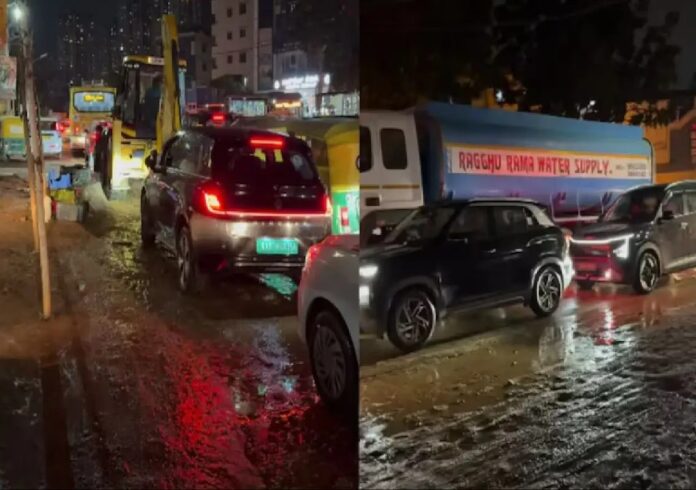
Bengaluru: A Bengaluru-based tech entrepreneur has sparked a fresh discussion about the city’s worsening traffic and road conditions after claiming that it took him around 90 minutes to cover a distance of just 3 km.
Soveek Ray, a founder who has lived in Bengaluru for around 10 years, shared his frustration in an Instagram video titled “The hidden cost of building a business in India, especially Bangalore”. He questioned how businesses, employees, delivery partners and customers can function efficiently when short journeys routinely turn into lengthy commutes.
Ray said he had planned what should have been a quick trip to a store in Varthur to drop off some products. What he expected to be a 10-20 minute task instead turned into a journey lasting about one-and-a-half hours.
Three-kilometre journey turns into 90-minute ordeal
According to Ray, the traffic congestion became so severe that he eventually decided to abandon the car at the store and walk back home.
Describing the situation as “unbelievable”, he said the poor condition of the road added to the difficulty.
The entrepreneur said the experience demonstrated what he described as a less visible cost of operating a business in Bengaluru. While entrepreneurs often focus on expenses such as salaries, rent, logistics and infrastructure, he argued that time lost in traffic also has a direct impact on productivity and business operations.
Ray said the journey was particularly frustrating because the distance involved was only around 3 km.
He also shared footage showing the condition of the road and questioned whether the city’s infrastructure was keeping pace with its position as one of India’s major technology and business centres.
‘How are businesses supposed to operate like this?’
Ray said the problem was not limited to business owners.
He pointed out that delivery partners, retailers, employees and customers are all affected when traffic congestion and damaged roads make routine travel difficult.
“How can delivery partners, retailers, employees, and customers deal with this every single day?” he asked, highlighting the broader impact of Bengaluru’s transport problems on everyday economic activity.
For businesses that depend on timely deliveries and movement of people and goods, unpredictable travel times can create additional operational challenges. Delivery personnel may have to spend more time completing fewer orders, while employees travelling between offices, stores and homes can lose significant portions of their working day.
Retailers and small businesses may also face difficulties when customers find it inconvenient to travel to their establishments.
Ray’s comments therefore touched on an issue that extends beyond individual commuter frustration, linking Bengaluru’s traffic problems to the city’s business environment.
Founder says he has lived in Bengaluru for 10 years
Ray also responded to a common criticism directed at people who complain about Bengaluru’s infrastructure.
He said he has lived in the city for the past 10 years and that his concerns should not be dismissed as those of someone unfamiliar with Bengaluru.
He urged people not to respond to criticism by simply asking residents to leave the city.
Instead, he called on politicians and authorities to improve civic infrastructure and pay greater attention to the challenges faced by residents.
Despite his frustration, Ray made it clear that he remains positive about Bengaluru’s potential.
He said people like him continue to be bullish on the city despite the difficulties, suggesting that the criticism comes from a desire to see Bengaluru function better rather than from a rejection of the city.
Social media users share similar experiences
Ray’s post prompted several social media users to share their own experiences of Bengaluru’s traffic.
Some users said they could relate to the frustration of spending hours travelling relatively short distances.
One user said that stepping out of the house had become difficult because of the city’s traffic conditions. Another claimed to have spent around 3.5 hours covering 10 km.
A user who said they had lived in Bengaluru for 15 years said they eventually left the city, citing the daily commute as one of the major reasons. While appreciating Bengaluru’s weather, the user described the city’s commuting experience as a major drawback.
Another commenter offered a different perspective, saying the traffic jam in the stretch mentioned by Ray was caused partly by vehicles piling up in the opposite lane and bottlenecks. The user also blamed a lack of lane discipline among motorists.
The range of reactions showed that Bengaluru’s traffic problem is experienced differently by residents, commuters and motorists, although long travel times have become a recurring concern.
Traffic and infrastructure remain major challenges
Bengaluru’s rapid expansion has placed considerable pressure on its road network and transport infrastructure. The city’s growth as a technology and startup hub has brought a large working population, increased vehicle ownership and rapid development in several peripheral areas.
Areas such as Varthur and the eastern parts of Bengaluru have witnessed significant residential and commercial growth. However, infrastructure in some stretches has struggled to keep pace with this expansion.
Traffic congestion is also influenced by road bottlenecks, construction activity, poor road surfaces, encroachments, drainage works, vehicle breakdowns and lane discipline.
For residents, the result can be unpredictable journey times, even when the distance between two locations is relatively short.
Ray’s experience has once again brought attention to the question of whether Bengaluru can maintain its position as a major technology and business destination without addressing its basic urban infrastructure challenges.
A problem that affects productivity
The debate over Bengaluru’s traffic is increasingly about more than inconvenience.
For businesses, time spent travelling can translate into lost productivity and higher logistics costs. For delivery workers, delays can affect the number of orders completed in a day. For employees, long commutes can reduce time available for work, family and rest.
For customers, poor accessibility can influence where they shop and which services they use.
Ray’s experience may have been a single incident, but the reactions to his post suggest that many Bengaluru residents see it as part of a much larger problem.
The challenge for civic authorities is to ensure that road improvements, traffic management and urban planning keep pace with the city’s rapid growth.
For a city that continues to attract entrepreneurs, technology companies and professionals from across India and beyond, reliable mobility is increasingly an essential part of its economic infrastructure.
Ray’s message, therefore, was not simply a complaint about being stuck in traffic. It was a call for Bengaluru to address the everyday infrastructure problems that can affect businesses and residents alike while preserving the city’s appeal as one of India’s leading economic and technology centres.