

Paromita Das
GG News Bureau
New Delhi, 1st November. The Delhi High Court recently dismissed a Public Interest Litigation (PIL) filed by the advocacy group Social Jurist, which sought to grant school admissions to Rohingya refugee children residing in Bharat. The plea argued that these children faced barriers in accessing education due to their non-citizen status, and highlighted that those already admitted faced challenges accessing resources like school uniforms and study materials. Despite recognizing the needs of children in terms of education, the High Court declined the plea, emphasizing that matters related to foreign refugees and asylum seekers are ultimately national security and policy issues under the Union Government’s jurisdiction.
In its ruling, the Bench of Chief Justice Manmohan and Justice Tushar Rao Gedela remarked that such issues require a “policy decision” by the central government, not judicial intervention. The court further underscored the security and international ramifications of intervening in matters involving undocumented immigrants, particularly given the sensitive context of the Rohingya population in Bharat. In addressing this decision, this article examines the legal, social, and political dimensions of the Rohingya issue in Bharat, the intersection of security concerns and human rights, and the implications of the High Court’s ruling on Bharat’s broader immigration policy.
Background: The Rohingya Crisis and Bharat’s Response
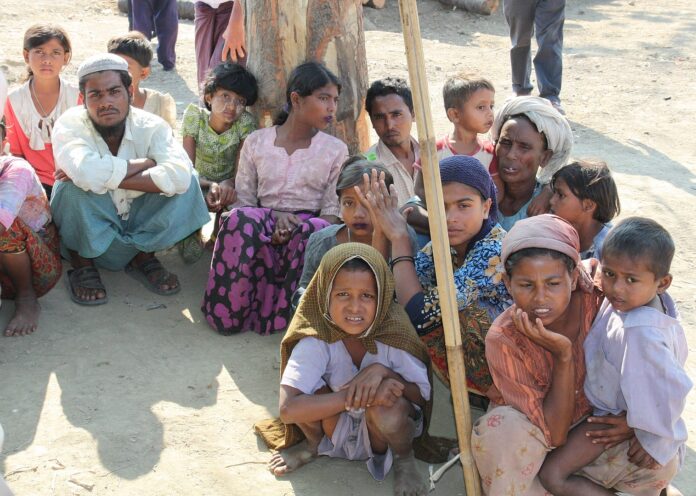
The Rohingya, a Muslim minority group from Myanmar, have faced long-standing persecution, culminating in a mass exodus following violent crackdowns in 2017. Seeking refuge across borders, many Rohingya fled to neighboring countries, including Bangladesh, which absorbed the majority, and Bharat. The Rohingya refugees in Bharat are classified as illegal immigrants, and their legal status remains contentious. Bharat, not being a signatory to the 1951 UN Refugee Convention, is not obligated to provide formal refugee protections to the Rohingya population, leaving them vulnerable and often in limbo.
Given their status, Rohingya refugees have faced challenges accessing essential services such as healthcare, education, and employment. With limited options, many live in makeshift camps with minimal resources. Although Bharat has provided support on humanitarian grounds, legal and bureaucratic obstacles frequently hinder access to public resources.
The High Court’s Rationale: Balancing Security and Human Rights
The High Court’s rejection of the plea highlighted that the issue of school admissions for Rohingya children is intertwined with matters of national security, sovereignty, and policy. In dismissing the plea, the court conveyed concerns that accommodating non-citizens’ requests for public resources could have far-reaching effects on Bharat’s sovereignty and international relations. The Bench referenced the Supreme Court’s recent ruling on Section 6A of the Citizenship Act of 1955, reinforcing the principle that decisions regarding citizenship and the rights associated with it are the purview of the government rather than the judiciary.
A critical argument from the High Court was that admitting and providing resources to non-citizens could encourage further migration, posing challenges to Bharat’s ability to control its borders and manage domestic resources. “Child doesn’t mean the whole world will come over here,” the court noted, suggesting that while the rights of children are important, they must be viewed within the broader framework of immigration policy and national security.
Legal Implications and the Role of Judiciary in Immigration Policy
In its dismissal, the Delhi High Court emphasized that the judicial system should not serve as a substitute for policy-making, especially in matters as complex as immigration. Immigration policy and citizenship laws fall under the jurisdiction of the Ministry of Home Affairs, which is tasked with developing coherent policies that balance security concerns with humanitarian obligations. By directing the petitioners to approach the Ministry of Home Affairs, the court underscored that immigration issues require comprehensive policymaking rather than case-by-case judicial orders.
This decision aligns with previous court rulings emphasizing a limited role for the judiciary in immigration matters. Courts have long maintained that defining citizenship and associated rights are functions of the executive branch, especially in complex cases with potential national security ramifications. Moreover, since Bharat has not signed international conventions specifically recognizing refugee rights, the judiciary has limited jurisdiction over such cases, ultimately deferring to the legislative and executive branches to define and regulate immigration policy.
The Human Rights Perspective: Education and Welfare of Refugee Children
Education is recognized as a fundamental right globally, enshrined in the United Nations Convention on the Rights of the Child, which calls for inclusive education regardless of nationality. For Rohingya children, access to education can provide an escape from poverty, helping them integrate into society and equipping them with skills to support themselves. Denying them basic education contributes to a cycle of poverty and marginalization, affecting their long-term prospects and potentially impacting society.
Social Jurist’s PIL emphasized that Rohingya children face significant barriers in accessing education, as non-citizen status precludes them from receiving resources like school uniforms and study materials. This denial raises ethical and humanitarian concerns, given that refugee children’s rights to education are often limited by factors beyond their control. While courts have traditionally deferred to policy considerations in immigration matters, advocates argue that there must be a balance between protecting national security and upholding basic human rights, especially for vulnerable populations such as children.
The Government’s Role: Crafting Policy for Refugee Welfare and National Security
In light of the court’s directive, it is now the responsibility of the Union Ministry of Home Affairs to address this issue and potentially craft a policy that recognizes the unique needs of refugee children without compromising national security. There is a need for a more nuanced refugee policy in Bharat—one that could allow for education and other fundamental rights to be granted to children in a regulated manner, irrespective of their citizenship. Such policies are in place in many other countries, where governments balance humanitarian assistance with immigration control, allowing refugee children access to essential services within a structured framework.
The central government could also explore partnerships with international organizations, such as the UNHCR, to provide educational support for refugees. This would allow for humanitarian aid while ensuring that security measures remain intact. Ultimately, these policy decisions should take into account Bharat’s international image as a humanitarian state while prioritizing national security and resource management.
Conclusion: Finding a Balance between Security and Humanity
The Delhi High Court’s decision reflects the challenges Bharat faces in balancing national security with humanitarian obligations. While the court upheld the view that policy decisions on non-citizens should remain within the Union Government’s domain, the outcome leaves pressing questions about the welfare of vulnerable refugee populations unanswered. The implications of the decision are far-reaching, as it touches upon Bharat’s approach to immigration, refugee welfare, and the extent to which judicial bodies can intervene in immigration matters.
Bharat stands at a critical juncture in defining its approach to immigration and refugee policy. While national security is paramount, a well-rounded refugee policy could uphold Bharat’s humanitarian values while addressing practical concerns. A balanced approach, one that permits access to basic rights for refugee children without endangering national security, would reflect Bharat’s commitment to human rights on the international stage.
The High Court’s ruling places the onus on the government to develop and implement a nuanced refugee policy, underscoring the need for a coherent framework that integrates human rights with national security interests. If Bharat wishes to be recognized as a compassionate and progressive nation, it must take steps to ensure that its immigration policies align with these values, allowing room for empathy while protecting its borders and sovereignty. The Rohingya children deserve an education, and with the right policies, Bharat can help build a more inclusive and secure future.
The post Balancing Borders and Humanity: The Delhi High Court’s Stance on Rohingya Children’s Education Rights appeared first on Global Governance News- Asia's First Bilingual News portal for Global News and Updates.