

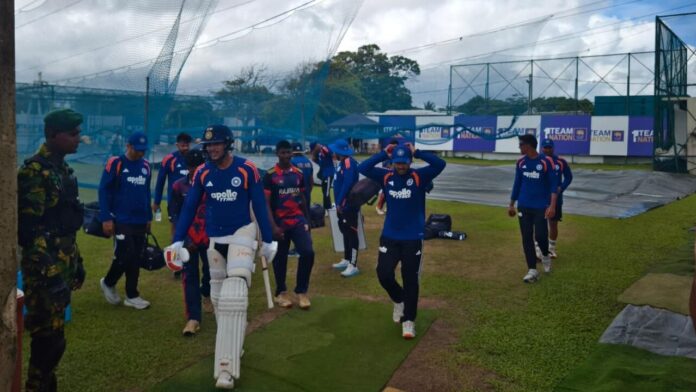
On the eve of the opening Test in Galle, the Indian cricket team found themselves locked in a frustrating game of cat-and-mouse with the weather. Despite multiple rain interruptions threatening to derail their final preparations, eight squad members, accompanied by four net bowlers and the support staff, displayed sheer persistence in their quest for a final hit in the nets.
The session was defined by an erratic rhythm that deeply tested the team’s patience. Ravindra Jadeja, KL Rahul and Shubman Gill were deep into their batting drills when a sudden shower forced a frantic 50-metre sprint back to the dressing room to shield their gear.
Ten minutes later, the sun briefly re-emerged, coaxing the players back to the crease. However, the respite was short-lived. A second drizzle immediately halted play again, prompting a visibly frustrated Jadeja to pack up and call it a day.
While some players retreated indoors, others, including Gill, Rahul and Gurnoor Brar, opted to wait out the passing showers under a nearby tent. By the time a third downpour arrived, the support staff did not even bother seeking shelter, well aware that the passing cloud would empty itself in minutes. Nevertheless, the constant disruptions proved highly irritating for players desperately trying to fine-tune their mechanics.
Huddled under the tent, conversations among the players and staff naturally shifted to a grim reality: this unpredictable weather is forecast to persist throughout the five-day Test match.
In cricket, brief rain breaks are arguably the most agonising disruptions. They place players in a psychological and physical limbo, unable to fully relax yet unable to maintain the intense focus required for the game. Once the umpires call for play to resume, athletes are essentially forced to start from scratch.
The impact of these start-stop delays extends far beyond mere annoyance, directly affecting the flow and safety of the game. Loss of momentum is the most immediate casualty. Batters lose their hard-fought rhythm and focus at the crease, while bowlers fall out of their run-up groove and directional accuracy.
Furthermore, the elements dictate altered playing conditions. Even a brief shower fundamentally changes the pitch dynamics. Surface moisture can cause the ball to skid or bounce unpredictably, while a wet, slippery ball becomes a nightmare for bowlers trying to maintain grip, spin or swing.
Perhaps most concerning are the elevated injury risks. The erratic nature of these delays forces muscles to cool down rapidly. Repeatedly warming up and cooling down tightens the body, significantly increasing the risk of muscle strains. Coupled with a damp outfield, the danger of slipping is drastically magnified for both fielders and bowlers.
As the first ball approaches, Team India faces a formidable dual challenge in Galle. To emerge victorious, they will not only need to outmanoeuvre Sri Lanka’s tactical threats but also demonstrate immense mental fortitude to keep their composure during the inevitable, momentum-killing rain breaks.
The post Battling the Elements: Team India Navigates Frustrating Rain Delays Ahead of Galle Test appeared first on Sports News Portal | Revsportz.