

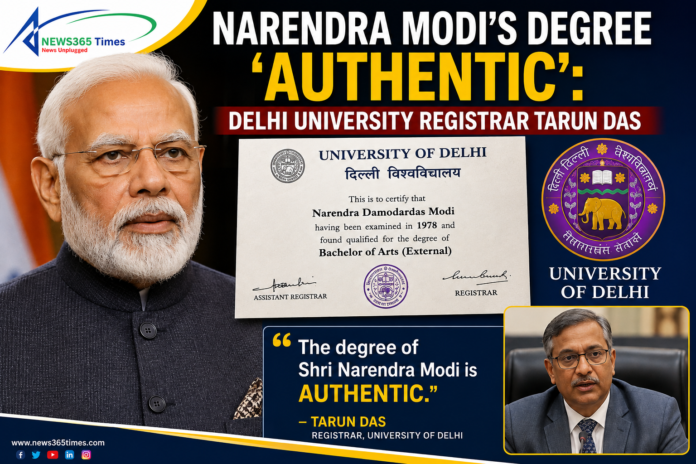
A fresh political debate has emerged over the public disclosure and verification of the educational qualifications of prominent Indian political leaders. The discussion follows renewed claims that Prime Minister Narendra Modi’s academic qualifications are publicly available and can be examined by citizens.
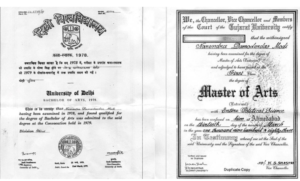
The Digital Sansad profile of Prime Minister Narendra Modi lists his educational qualification as B.A. and M.A. (Political Science), with Delhi University and Gujarat University mentioned in his academic record. An official PMO RTI response has also stated that the Prime Minister’s highest qualification, an M.A. in Political Science, is recorded on the PMO website.
Against this backdrop, questions are being raised on social media about the educational records of other prominent political figures, including Sonia Gandhi, Rahul Gandhi, Akhilesh Yadav and Tejashwi Yadav. The issue has become part of a wider political argument over transparency, public records and the verification of claims made by public representatives.
Available election-affidavit records already contain educational details for several of these leaders. Sonia Gandhi’s election affidavits list a three-year foreign-language course in English and French at Istituto Santa Teresa in Turin and an English certificate from Lennox Cook School, Cambridge.
Rahul Gandhi’s 2024 election affidavit lists a B.A. from Rollins College, Florida, and an M.Phil. in Development Studies from Trinity College, University of Cambridge. Akhilesh Yadav’s 2024 affidavit lists a B.E. in Civil and Environmental Engineering from Mysore University.
Tejashwi Prasad Yadav’s available election-affidavit record lists his educational qualification as 8th Pass and states that he studied at Delhi Public School, R.K. Puram.
The controversy therefore raises a broader question: Should the educational qualifications of all elected representatives and major political leaders be presented in a clear, easily accessible and uniformly verifiable public database?
Supporters of greater disclosure argue that transparency should apply equally across the political spectrum. Critics, however, point out that educational qualifications alone should not become a substitute for evaluating a politician’s public record, policies or performance.
The social-media post that triggered the discussion also refers to a person described as having a “Boston degree” and makes allegations about foreign influence. Such characterisations are political claims and should not be treated as established facts without credible evidence and independent verification.
Ultimately, the debate is less about individual degrees and more about consistent standards of transparency and verification in public life. If educational credentials are placed before voters as part of a political leader’s public profile, citizens should have access to reliable records and the opportunity to verify those claims through official or institutional sources.