

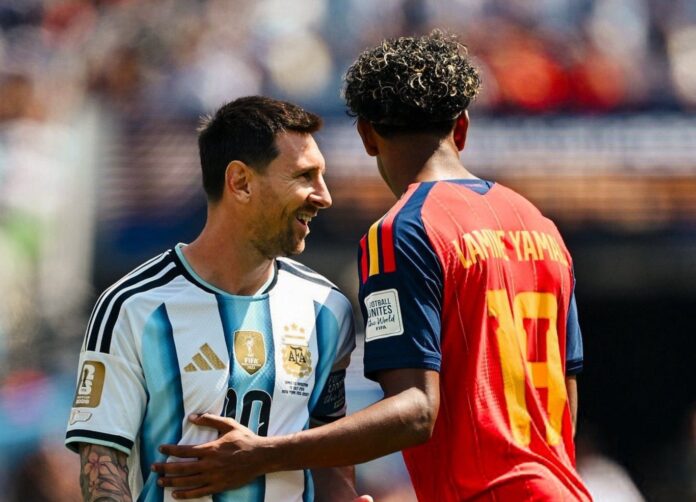
Not quietly. It happened with all the noise and symbolism the occasion deserved. At MetLife Stadium, the baton of world football appeared to pass from 39-year-old Lionel Messi to 19-year-old Lamine Yamal.
Did you notice Messi on the podium after the final whistle?
Standing at one end, exhausted and expressionless, his eyes fixed on the future of the game. There was disappointment, perhaps even tears. His legs looked heavy. His shoulders seemed to sag. For the last 21 years, those shoulders had carried the hopes of millions of Argentina supporters across the globe. On this night, it felt as though he had finally set that burden down. Leaving behind countless heartbroken fans, the man many consider football’s greatest seemed to take his first steps towards retirement.
Argentina’s hope was simple, somehow survive until the second half, then let the “Messi system” take over. But Spain were coached by Luis de la Fuente, a manager who continues to rewrite football’s tactical playbook. The baton of world football moved, unmistakably, from Messi to Yamal.
As Spanish players embraced Yamal one after another on the podium, the giant screens inside the stadium showed Messi staring silently in their direction. Spain, world champions once again. Their second World Cup title since 2010.
It had rained continuously across New York and New Jersey since the previous night. The morning brought clear skies and bright sunshine, but by kick-off dark clouds had returned over MetLife Stadium. Perhaps fittingly so. One of football’s greatest chapters was reaching its conclusion.
From this moment on, Lionel Messi belongs to history. The World Cup will never again witness that magical left foot gliding across its biggest stage. What generations have admired in real time will now exist only in memory.
People often say great men sense the moment when their journey is nearing its end. Perhaps that is why Messi wrote on social media a day before the final:
“Whatever happens tomorrow, this team has created a history that nobody will ever forget, and nobody will ever erase.”
He was right. His legacy stretches far beyond Argentine football. It is woven into the history of the sport itself.
After the match, did you notice the tears in Messi’s eyes?
He looked towards the sky with both hands raised, quietly murmuring something. Perhaps it was for his grandmother, Celia Oliveira Cuccittini, the woman who convinced coach Salvador Aparicio to let four-year-old Lionel play for Grandoli. The journey she began had finally come full circle. At 43, another World Cup is no longer realistic. Maybe this was Messi’s final conversation with the person who started it all.
An era had come to an end.
The Messi era.
But football has always moved this way.
The baton once passed from Diego Maradona to Lionel Messi. Now it belongs to Spain and a new generation led by Lamine Yamal, Ferran Torres and their teammates. After conquering Europe, Spain have conquered the world again.
It is not unfamiliar territory. Before winning the 2010 World Cup, Spain had lifted the European Championship in 2008. That team mesmerised the world with tiki-taka.
De la Fuente has evolved that philosophy.
Possession remains important, but it is now combined with relentless pace, vertical passing and an organised defensive structure. This is no longer football built around endless sideways passes. Every movement has purpose. Every pass looks forward.
The numbers tell the story. Throughout the knockout rounds, Spain conceded only one goal.
The final followed exactly the script De la Fuente wanted.
Messi’s first touch came only after 12 minutes. The same tactical blueprint that neutralised France in the semi-final by isolating Kylian Mbappe was repeated perfectly against Argentina.
Without Messi influencing the game, Argentina struggled to progress.
Oyarzabal tested Emiliano Martinez early from outside the box. Normally, Argentina’s supporters would respond by singing Muchachos in deafening unison.
This time, they fell silent.
Instead, the Spanish end of the stadium erupted into La Roja Baila, Spain’s official anthem introduced before Euro 2016. Sung originally by singer Niña Pastori alongside then-captain Sergio Ramos, the chorus echoed around MetLife as Yamal and his teammates tore through Argentina’s defence.
Scaloni quickly lost faith in Lisandro Martinez, already booked, replacing him with Nicolas Otamendi.
By then, it had become possible to count exactly how many times Messi had touched the ball.
If Messi wasn’t involved, how could Muchachos return?
Even the halftime entertainment featuring global music stars failed to lift Argentina.
The match had become Spain versus Emiliano Martinez.
Statistics underlined Spain’s dominance. By the 62nd minute, Argentina had not managed a single shot on target. Spain had already tested Martinez six times.
Yamal repeatedly burst down the right flank. Ferran Torres forced another outstanding save from Martinez with a header before Nico Williams also found the goalkeeper in inspired form.
Martinez’s display in this final surpassed everything he had produced throughout the tournament.
It felt as though the hero of Qatar 2022 had returned.
Yet even he could only delay the inevitable.
Argentina’s normally passionate supporters watched in near silence, gripped by a growing sense of dread.
Whether De la Fuente had ever shared this particular coaching lesson with Scaloni remains unknown, but Argentina increasingly resorted to breaking Spain’s rhythm through physical challenges.
It backfired.
Enzo Fernandez received his second yellow card and was sent off in the 90th minute.
Down to ten men, Argentina’s only remaining plan during extra time was survival. Hold on somehow, then trust Martinez in a penalty shootout, just as they had in Qatar.
But this Spain side is different.
No sterile tiki-taka. No possession for possession’s sake.
Everything is direct. Everything is progressive.
Early in the second half of extra time, Ferran Torres finally beat Martinez to score the goal that secured Spain’s second World Cup title.
One record remained intact.
Argentina still have never retained the World Cup, something Diego Maradona himself could not achieve either.
Messi also surrendered the Golden Boot race to Kylian Mbappe after the final.
At the medal ceremony, United States President Donald Trump presented the awards. When Yamal stepped forward to receive his medal, Trump paused for a brief conversation before placing it around his neck.
Perhaps a White House invitation will follow in the months ahead.
World football never stands still.
From Pelé to Maradona.
From Maradona to Messi.
And now, from Messi to Lamine Yamal.
Follow RevSportz for latest sports news
The post From Messi to Yamal: The Night World Football Turned a New Page appeared first on Sports News Portal | Revsportz.