

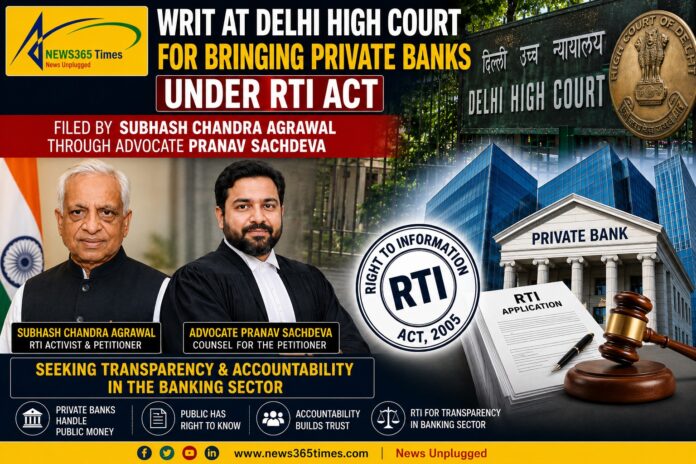
New Delhi: A writ petition has been filed before the Delhi High Court seeking to bring private sector banks within the ambit of the Right to Information (RTI) Act, 2005. The petition has been filed by RTI activist Subhash Chandra Agrawal through Advocate Pranav Sachdeva, challenging the exclusion of private banks from the definition of “public authority” under the Act.
The petition is registered as W.P.(C) 15479/2025 — Subhash Chandra Agrawal vs Union of India & Others. Delhi High Court records show Agrawal was represented by Advocate Pranav Sachdeva in the matter. The case was also listed before the court on February 11, 2026.
Demand for Greater Transparency
The petition raises a larger question over whether private sector banks, which handle substantial deposits from the public and operate under the regulatory supervision of the Reserve Bank of India (RBI), should be subject to greater transparency obligations under the RTI framework.
Agrawal’s challenge follows an RTI dispute involving City Union Bank. According to the petition, the bank had declined to provide information on the ground that private banks are not covered by Section 2(h) of the RTI Act. The Central Information Commission (CIC) subsequently maintained that private banks do not fall within the definition of a “public authority” under the existing framework.
Agrawal has argued that both public and private sector banks are scheduled commercial banks regulated by the RBI and are subject to periodic inspections under the Banking Regulation Act, 1949. His petition contends that the public nature of banking functions and the large amounts of citizens’ money handled by banks justify greater accountability and transparency.
Public Money and Accountability
The petitioner has also relied on Supreme Court judgments concerning the treatment of private bank officials as public servants for certain legal purposes. The petition cites the Supreme Court’s decision in CBI v. Ramesh Gelli, among other legal precedents, to support its argument that private banks perform functions having significant public implications.
The Central Information Commission, however, has previously taken the position that private banks do not qualify as public authorities under Section 2(h) because they are not owned, controlled or substantially financed by the government. In a 2024 case involving City Union Bank, the CIC rejected the argument that public deposits and regulatory oversight alone bring a private bank within the RTI definition.
The Delhi High Court petition therefore puts the question of private-bank transparency before the judiciary. The outcome could have wider implications for the relationship between the RTI Act, banking regulation and citizens’ right to seek information from institutions that manage large amounts of public deposits.
For now, the petition represents a significant challenge to the existing position that private sector banks are outside the direct ambit of the RTI Act, with the final legal position depending on the court’s consideration of the issues raised.