

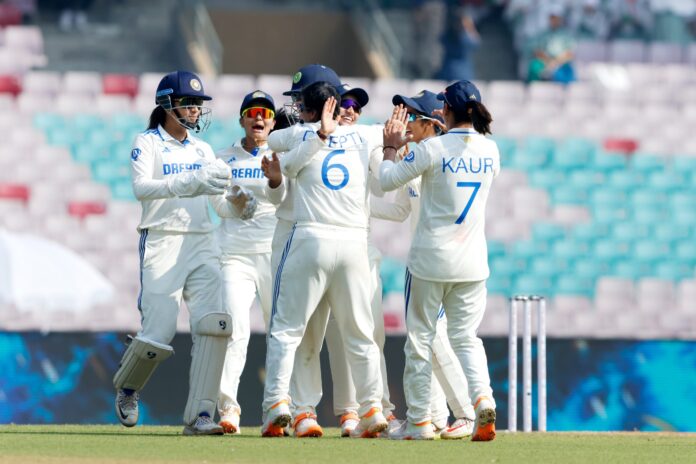
Test cricket has always been regarded as the purest and most demanding format of the game. It is where patience, technique, temperament and tactical awareness are tested over multiple days. It is also the format by which cricketing greatness has traditionally been measured. But if Test cricket is truly the pinnacle of the sport, why are women given so few opportunities to play it?
The numbers tell a compelling story. In 2025, men’s cricket featured 42 Test matches across seven series, driven by the World Test Championship cycle, ensuring every series carried context and significance. Women’s cricket, however, had just one Test-the Ashes Test in January. In 2026, six months into the calendar, only one women’s Test has been played, with England and India set to contest just the second from July 10.
For the first time in history, Lord’s, the Home of Cricket will host a women’s Test match. Almost 50 years after Lord’s welcomed women for its first international fixture in 1976, the iconic venue will finally stage the longest format of the women’s game. England captain Nat Sciver-Brunt will also become the first English woman to captain a Test side at Lord’s, making it another historic milestone.
But while the occasion deserves celebration, it also highlights a larger problem.
Unlike their male counterparts, women do not have a robust red-ball pathway. Male cricketers spend years playing domestic first-class competitions such as the Ranji Trophy, County Championship or Sheffield Shield before earning a Test cap. Those tournaments help them master the unique demands of red-ball cricket-leaving deliveries outside the off stump, batting through sessions, managing changing pitch conditions and building long innings. Women, on the other hand, have almost no comparable domestic structure. Many make their Test debut with little or no multi-day experience.
In fact, of the 12 ICC Full Member nations, Afghanistan, Bangladesh and Zimbabwe do not play women’s Test cricket at all, while New Zealand has not played a women’s Test since 2004, with its focus shifting almost entirely to white-ball cricket. As a result, most women cricketers grow up playing only T20s and ODIs, leaving them with very little experience of the red-ball game.
Yet, they are still judged by the same standards.
When batting collapses occur or matches end in draws, criticism often focuses on quality rather than exposure. But technical excellence cannot be developed in isolation. With women’s cricket increasingly centred around T20 leagues, bilateral ODIs and ICC events, players are conditioned for white-ball cricket. The patience, defensive technique and tactical depth that Test cricket demands simply cannot be developed through occasional one-off matches.
The absence of regular Test cricket also means the women’s game has been denied the traditions that define the format. Men’s cricket is built around iconic contests such as the Border-Gavaskar Trophy, the Ashes and the Anderson-Tendulkar Trophy, rivalries that have grown over decades and become part of cricket’s identity. But there is no Goswami-Clarke Trophy, no Raj-Edwards Trophy, no equivalent contests that fans eagerly anticipate. Not because women’s cricket lacks legends worthy of such recognition, but because the format has never been given enough continuity to create those traditions. Without regular bilateral Test series, there is little opportunity for rivalries, legacies and history to take shape.
Every time a women’s Test is scheduled, it is celebrated as a historic occasion. While these moments deserve recognition, one match every year or two is not enough to help the format grow. A single Test cannot create rivalries, build experience or help players develop into red-ball specialists. It creates excitement for a few days, but not a strong future for the format.
If Test cricket is truly considered the highest form of the game, then women deserve more than occasional opportunities to wear the whites. They need a proper domestic red-ball structure, regular Test series and an international calendar that gives Test cricket the importance it deserves.
Until that happens, calling Test cricket the pinnacle of cricket while giving women so few chances to play it remains one of the biggest contradictions in the sport.
Follow REVSPORTZ for more updates.
The post Women’s Test Cricket: The Pinnacle or Just Tokenism? appeared first on Sports News Portal | Revsportz.