

By Raghav Shukla
New Delhi: The recent concerns emerging around Tata Consultancy Services (TCS) are not merely about an isolated lapse—they represent a systemic breakdown of multi-layered governance mechanisms that are designed to prevent precisely such occurrences.
This is not a story of a single failure. It is a story of collective institutional silence.
The Illusion of Strong Governance
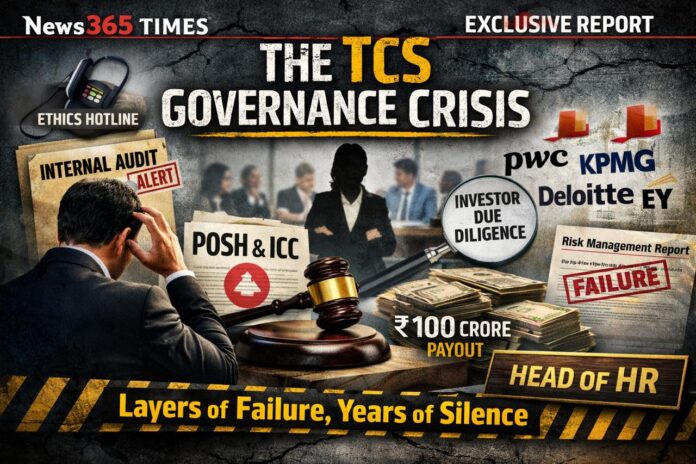
On paper, large corporations like TCS boast one of the most robust governance frameworks in the corporate world. Consider the extensive institutional architecture:
Internal Audit Systems
Vigil Mechanism & Ethics Hotline
POSH & ICC Committees
Presence of a Women Director on the Board
Legal Department Oversight
Those Charged With Governance (TCWG)
Risk Management Committee
Fraud Reporting Framework
Statutory Auditors (often Big 4 firms)
Investor Due Diligence Processes
CEO-Level Oversight
Each of these is a layer of control, a checkpoint meant to detect, deter, and correct deviations.
Yet, when a situation allegedly persists over years, the inevitable question arises:
Did these mechanisms fail—or were they rendered ineffective?
Secondary Controls vs Primary Responsibility
From a legal and governance standpoint, it is critical to understand one fundamental principle:
All these mechanisms are secondary controls.
They are designed to act as safeguards, not substitutes for primary accountability.
The primary responsibility, unequivocally, rests with:
The Head of Human Resources (HR)
HR is not merely an administrative function—it is the custodian of organizational culture, ethics enforcement, and employee grievance redressal.
If irregularities, misconduct, or ethical breaches persist for years, it indicates:
A breakdown in internal reporting culture
A failure in grievance escalation mechanisms
Possible suppression or dilution of complaints
Lack of timely intervention and corrective action
A Failure That Compounds Over Time
What makes this case particularly concerning is duration.
This was not a one-off anomaly. It reportedly continued over an extended period, which transforms the issue from:
An incident → to a pattern
A lapse → to a systemic failure
In governance terms, time amplifies accountability.
The longer a failure persists, the wider the circle of responsibility becomes.
The Cost of Silence
When institutions at multiple levels fail to act, the consequences are not just reputational—they are financial and fiduciary.
Senior leadership and governance structures in such organizations collectively command compensation running into ₹100 crores annually.
This raises a fundamental question:
Can such compensation be justified without corresponding accountability?
Corporate governance is not merely about frameworks—it is about enforcement with integrity.
Where Did the System Break?
A layered analysis suggests possible points of breakdown:
Internal Audit may have failed to flag or escalate red flags
Ethics Hotline may not have ensured anonymity or trust
POSH/ICC mechanisms may have lacked independence or urgency
Legal teams may have been reactive rather than proactive
Board-level committees may not have exercised deep oversight
Auditors and due diligence frameworks may have focused more on financials than culture.
This convergence of failures suggests not weakness—but institutional complacency.
News365 Times Legal View
At News365 Times, we believe this case must serve as a wake-up call for corporate India.
Governance cannot be reduced to:
Checklists
Committees
Compliance reports
It must translate into real-time accountability, ethical courage, and decisive action.
The Way Forward: From Compliance to Conscience
To prevent such systemic failures, organizations must:
Strengthen independent oversight of HR functions
Ensure true autonomy of ethics and POSH mechanisms
Introduce real-time escalation dashboards to Boards
Link executive compensation to governance outcomes
Foster a culture where speaking up is protected and encouraged
Conclusion: Accountability Cannot Be Delegated
The TCS case is not just about one company—it is a reflection of a broader truth:
Governance frameworks are only as strong as the people who enforce them. Ultimately, responsibility cannot be diffused across committees and departments. It must be owned, enforced, and demonstrated—starting from the top, and most critically, at the HR leadership level.