

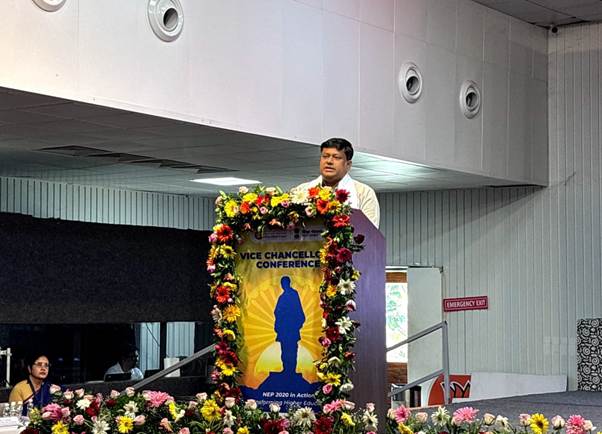
The Ministry of Education, Government of India, successfully concluded a two-day Vice Ch768ancellors’ Conference of Central Universities on July 10–11, 2025, in Kevadia, Gujarat. The event, attended by Union Minister for Education Shri Dharmendra Pradhan, Minister of State for Education Dr. Sukanta Majumdar, senior ministry officials, and Vice Chancellors of Central Universities, served as a pivotal platform for aligning India’s higher education ecosystem with the transformative vision of the National Education Policy (NEP) 2020. The conference, themed around strategic alignment with NEP 2020, peer learning, knowledge exchange, and forward planning, underscored the critical role of Central Universities in shaping India’s intellectual and developmental trajectory toward Viksit Bharat by 2047.
A Vision Rooted in Unity and Transformation
Dr. Sukanta Majumdar, in his address at the concluding session, drew inspiration from Sardar Patel’s vision of unity, discipline, and education, emphasizing that these principles form the bedrock of NEP 2020. He described the policy as a “renaissance in Indian education,” designed to make Indian higher education globally competitive while staying rooted in Indian values. Highlighting the policy’s achievements, Dr. Majumdar noted a remarkable 32% increase in female enrollment in higher education, from 1.57 crore in 2014–15 to 2.07 crore in 2021–22, reflecting NEP 2020’s commitment to equity and inclusion.
The integration of technology was a key focus, with platforms like SWAYAM revolutionizing access to education. Over 295 universities now allow up to 40% of academic credits through SWAYAM courses, issuing nearly 9 lakh certificates annually. The Academic Bank of Credits (ABC), a cornerstone of student-centric learning, has registered over 2.75 crore students and includes 1,667 higher education institutions (HEIs). Additionally, NEP 2020’s promotion of multilingualism has enabled examinations like JEE, NEET, and CUET to be conducted in 13 regional languages, fostering inclusivity. These efforts have propelled India’s global standing, with 54 institutions featured in the QS World University Rankings 2026—a five-fold increase since 2015.
Dr. Maj Pundar called upon Vice Chancellors to accelerate NEP 2020 implementation, strengthen research and innovation ecosystems, foster industry-institution collaboration, and champion equity and excellence. He emphasized that Vice Chancellors are the “torchbearers of India’s intellectual destiny,” tasked with mainstreaming the policy’s Panch Sankalpa (five resolutions) as guiding principles for HEIs.
Key Takeaways and Strategic Priorities
Dr. Vineet Joshi, Secretary (Higher Education), outlined the conference’s key takeaways, stressing the urgent need to institutionalize structural reforms like the National Higher Education Qualification Framework (NHEQF), National Credit Framework (NCrF), and the Four-Year Undergraduate Programme (FYUP). These frameworks aim to foster flexible, multidisciplinary education and seamless academic mobility. Dr. Joshi emphasized aligning curricula, pedagogy, and internships with real-world skill demands to prepare students for the future of work. Platforms like SWAYAM, SWAYAM Plus, and APAAR were highlighted as critical tools for enabling flexible learning, multilingual e-content, and credit portability.
The adoption of the SAMARTH e-governance system was identified as a priority for making university operations agile, data-driven, and citizen-centric. Dr. Joshi urged Vice Chancellors to lead in embedding digital tools into the teaching-learning ecosystem and ensuring measurable inclusivity in admissions, faculty diversity, and campus environments. He also underscored the importance of the Indian Knowledge System (IKS) and Bharatiya Bhashas as sources of academic strength and cultural identity, advocating for their strategic integration through knowledge clubs, language labs, and IKS-enriched libraries.
A key outcome of the conference was the directive for Central Universities to prepare strategy papers for Viksit Bharat 2047. These papers will focus on multidisciplinary integration, mainstreaming IKS, tech-driven education for skilling, and campus initiatives blending innovation with traditional values. The conference also encouraged universities to host similar discussions on their campuses to foster localized innovation and peer learning.
Day 1: Laying the Foundation for NEP 2020 Reforms
The first day of the conference focused on core structural and academic reforms under NEP D2020. Discussions on NHEQF, NCrF, and FYUP highlighted the shift toward flexible, multidisciplinary education, enabling students to pursue diverse academic pathways. The session on the Future of Work emphasized realigning curricula with emerging global job roles and technological advancements to enhance employability. Digital education was a major theme, with SWAYAM, SWAYAM Plus, and APAAR recognized as transformative tools for flexible learning and credit portability.
The SAMARTH e-governance system was discussed as a means to enhance transparency and efficiency in university operations. Equity in HEIs was another critical focus, with strategies to bridge regional and socio-cultural disparities. The session on Education in Bhartiya Bhasha and Indian Knowledge Systems explored how Central Universities can integrate indigenous languages and knowledge systems into mainstream education, aligning with NEP 2020’s vision of culturally rooted learning.
Day 2: Innovation, Global Engagement, and Capacity Building
The second day shifted focus to innovation, quality assurance, global engagement, and faculty development. The session on Research and Innovation highlighted the role of the Anusandhan National Research Foundation (ANRF), Centres of Excellence (CoEs), and the Prime Minister’s Research Fellowship (PMRF) in strengthening research ecosystems. Discussions on Ranking and Accreditation explored how frameworks like NIRF and NAAC can elevate institutional quality and global standing.
The Internationalisation session focused on the Study in India programme and regulations enabling Foreign Higher Educational Institutions (FHEIs) to establish campuses in India, positioning the country as a global education hub. The Faculty Development session underscored the Malaviya Mission Teacher Training Programme (MMTTP), which equips educators with future-ready pedagogies and supports continuous professional development.
A Collaborative and Inclusive Ecosystem
The conference brought together leaders from prominent institutions, including the University of Delhi, Jawaharlal Nehru JNU), Visva-Bharati, Jamia Millia Islamia, Assam University, Banaras Hindu University (BHU), IGNOU, Nalanda University, Tripura University, Central University of Jharkhand, Central University of Kashmir, Hemvati Nandan Bahuguna Garhwal University, Tata Institute of Social Sciences, South Asian University, and Kendriya Hindi Sansthan. This diversity underscored the strength of India’s higher education ecosystem and the collective commitment to NEP 2020’s goals.
The event commenced with a yoga session on July 10, aligning with NEP 2020’s emphasis on holistic education that integrates body, mind, and spirit. This reflective tone set the stage for discussions grounded in the policy’s Panch Sankalpa—access, equity, quality, affordability, and accountability.
Toward Viksit Bharat 2047
The Vice Chancellors’ Conference in Kevadia marked a significant step toward realizing NEP 2020’s transformative vision. By fostering dialogue, collaboration, and strategic planning, the event empowered Central Universities to lead India’s journey toward becoming a global knowledge superpower. The directive to prepare strategy papers for Viksit Bharat 2047 reflects a forward-looking approach, ensuring that higher education aligns with national development goals while embracing innovation, inclusivity, and cultural heritage.
As Dr. Majumdar aptly stated, Vice Chancellors are the torchbearers of India’s intellectual destiny. Their leadership, coupled with NEP 2020’s visionary framework, will shape an education system that empowers learners to think globally while remaining rooted in India’s civilizational ethos, paving the way for a developed and inclusive India by 2047.