

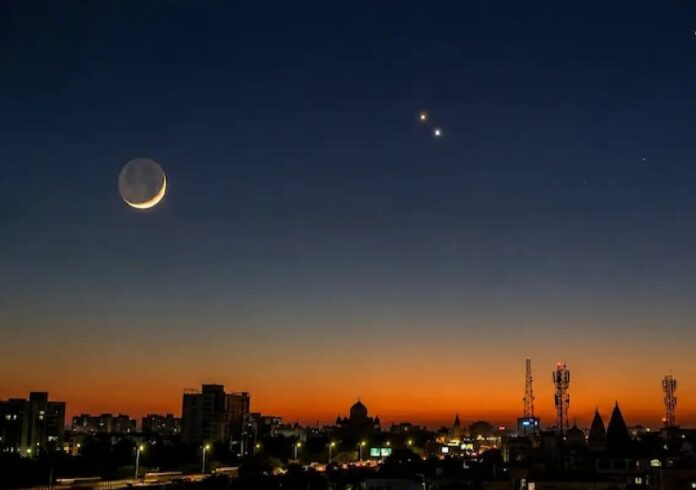
New Delhi: Skywatchers are in for a rare astronomical treat as the planets Venus and Jupiter appear to draw exceptionally close together in the evening sky. The two brightest planets visible from Earth will reach their closest apparent approach on the nights of June 8 and 9, creating a striking celestial display that can be enjoyed without any special equipment.
Astronomy enthusiasts and casual observers alike will be able to witness the event shortly after sunset by looking towards the western horizon.
Rare planetary pairing visible to naked eye
The astronomical event is known as a conjunction, which occurs when two celestial objects appear close together in the sky as viewed from Earth.
During this conjunction, Venus and Jupiter will appear separated by only 1.6 degrees.
To put that into perspective, the apparent width of a full Moon is about half a degree. This means the two planets will appear roughly three full Moon widths apart in the evening sky.
Their brightness will make them easy to identify even in areas affected by moderate light pollution.
Observers using binoculars will be able to view both planets within the same field of vision, although no equipment is necessary to enjoy the spectacle.
Why the conjunction occurs
Despite appearing close together, Venus and Jupiter remain separated by hundreds of millions of kilometres in space.
The visual effect is caused by perspective rather than physical proximity.
All the planets in the Solar System orbit the Sun along roughly the same flat plane. As they travel at different speeds and distances from the Sun, their positions occasionally align from Earth’s viewpoint.
When this happens, two or more planets appear to converge in the sky, creating what astronomers call a conjunction.
Such alignments provide some of the most visually impressive astronomical events visible without telescopes.
A visually striking event
Planetary conjunctions occur from time to time, but particularly bright pairings involving Venus and Jupiter attract significant attention because of their visibility.
Both planets outshine nearly every other object in the night sky except the Moon.
Their combined brilliance makes the conjunction one of the most accessible skywatching events of the year.
Astronomy enthusiasts note that these encounters offer an excellent opportunity for people unfamiliar with stargazing to connect with the night sky.
Mercury and Moon to join the display
The conjunction is expected to be only the beginning of a broader celestial showcase.
Over the coming days, Mercury will become visible low on the western horizon after sunset, joining Venus and Jupiter in the twilight sky.
Mercury is often difficult to observe because it remains close to the Sun from Earth’s perspective.
In addition, a slender crescent Moon will soon appear in the same region of the sky, creating a striking grouping of bright celestial objects.
The gathering of Venus, Jupiter, Mercury and the Moon is expected to offer one of the most rewarding skywatching opportunities of the year.
Best time and place to watch
Astronomers recommend heading outdoors within an hour after sunset to catch the best view.
A location with a clear and unobstructed view of the western horizon will provide the ideal vantage point.
Weather conditions will play a crucial role, and clear skies will be necessary for optimal viewing.
Unlike many astronomical events that require telescopes or specialised equipment, this conjunction can be appreciated with the naked eye, making it accessible to people of all ages.
A reminder of the Solar System’s dynamics
Events such as planetary conjunctions offer a reminder of the constant motion of celestial bodies within the Solar System.
While the planets follow their own independent orbits around the Sun, their changing positions occasionally create stunning alignments when viewed from Earth.
These brief moments allow observers to witness the geometry of the Solar System in action and appreciate the scale and beauty of the cosmos.
Conclusion
The Venus-Jupiter conjunction promises to be one of the most eye-catching astronomical events of the year. With the two brightest planets appearing unusually close together and Mercury and the crescent Moon set to join the scene in the coming days, skywatchers have a rare opportunity to enjoy a spectacular celestial display simply by stepping outside and looking towards the western horizon after sunset.