

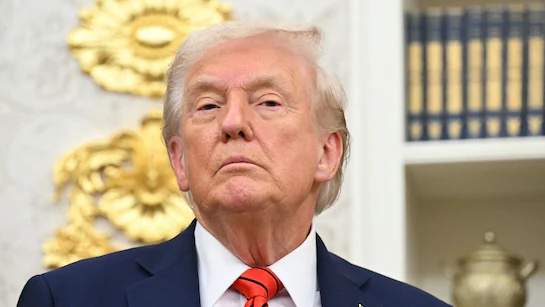
Former U.S. President Donald Trump has once again stirred diplomatic and political circles with his latest claim that he “nearly settled” the long-standing India-Pakistan conflict during his tenure — asserting that his aggressive trade tactics, including a threat to impose “200 per cent tariffs”, played a decisive role in bringing both nations to the table.
The statement, typical of Trump’s dramatic style, has reignited debate about the extent of his administration’s actual influence on South Asian geopolitics and the complex nature of Indo-Pak relations.
Trump’s Assertion
Speaking at a recent campaign event in the United States, Trump boasted that his “tough and unpredictable approach” had helped cool tensions between India and Pakistan during a period of heightened hostility. Referring to his meeting with leaders from both countries, Trump claimed, “I told them — if you don’t calm down, you’ll face 200 per cent tariffs on your goods. Believe me, they listened.”
He suggested that this threat was part of his broader “America First” trade strategy, which he believes earned the U.S. leverage in international conflicts. Trump also hinted that his administration was “closer than anyone realizes” to brokering a peace framework between New Delhi and Islamabad before his presidency ended.
India-Pakistan Context During Trump Era
During Trump’s time in office (2017–2021), relations between India and Pakistan saw several flashpoints, including the 2019 Pulwama terror attack, India’s Balakot airstrikes, and the subsequent border tensions. Trump’s offer to “mediate” between the two countries made headlines in 2019 when he claimed that Prime Minister Narendra Modi had requested his help — a statement swiftly denied by India’s Ministry of External Affairs, which maintained that no third-party mediation was acceptable in bilateral matters.
While the U.S. did urge restraint during escalations, Washington’s role remained largely that of a concerned observer rather than an active mediator. India consistently held that all issues with Pakistan, including those related to Kashmir, must be resolved bilaterally under the 1972 Simla Agreement.
A Characteristic Trump Move
Analysts see Trump’s latest claim as in keeping with his penchant for exaggerating diplomatic victories to emphasize his “deal-making” persona. His statement about threatening tariffs fits his well-known pattern of using economic pressure as a tool of negotiation, seen previously in his trade standoffs with China, the European Union, and even NATO allies.
However, experts also note that such claims tend to oversimplify the complex realities of South Asia’s geopolitics. The India-Pakistan conflict, rooted in decades of territorial and ideological disputes, is unlikely to be influenced solely by trade leverage from a foreign power — even one as influential as the United States.
Mixed Reactions and Diplomatic Silence
So far, neither the Indian nor the Pakistani government has officially commented on Trump’s remarks. In diplomatic circles, such statements are often viewed as rhetorical or campaign-oriented rather than factual. However, the comment has drawn mixed reactions among political observers and social media users in both countries.
Some in the U.S. political establishment have dismissed Trump’s remarks as an attempt to bolster his foreign policy credentials ahead of the 2024 election. Supporters, however, argue that his “tough stance” helped maintain relative peace in several conflict zones, crediting his leadership style for preventing escalations.
Trump’s South Asia Legacy
Trump’s approach to South Asia was marked by strategic pragmatism. He maintained a strong personal rapport with Prime Minister Modi, evident during events like the “Howdy Modi” rally in Houston and the “Namaste Trump” event in Ahmedabad. At the same time, his administration reduced military aid to Pakistan, accusing it of harboring terror networks, which strained Islamabad’s relations with Washington.
Despite these dynamics, there is little recorded evidence to suggest that Trump’s administration directly intervened in any meaningful India-Pakistan peace process. His government’s primary focus in the region remained counterterrorism and managing the U.S. exit from Afghanistan.
Conclusion: The Politics of Grand Claims
Donald Trump’s bold assertion that he “settled” or influenced the India-Pakistan conflict through tariff threats is the latest in a series of statements designed to highlight his self-proclaimed prowess in deal-making. While his claim may lack factual backing, it underscores his continued attempt to frame himself as a global power broker capable of resolving complex disputes through sheer will and economic pressure.
In reality, the India-Pakistan conflict remains deeply entrenched in historical, political, and security complexities that extend far beyond tariff threats or trade diplomacy. Trump’s comments may play well in a campaign speech, but in the corridors of diplomacy, they are likely to be taken with a familiar mix of amusement and skepticism.