
The Great Indian Debate: North Indians vs South Indians
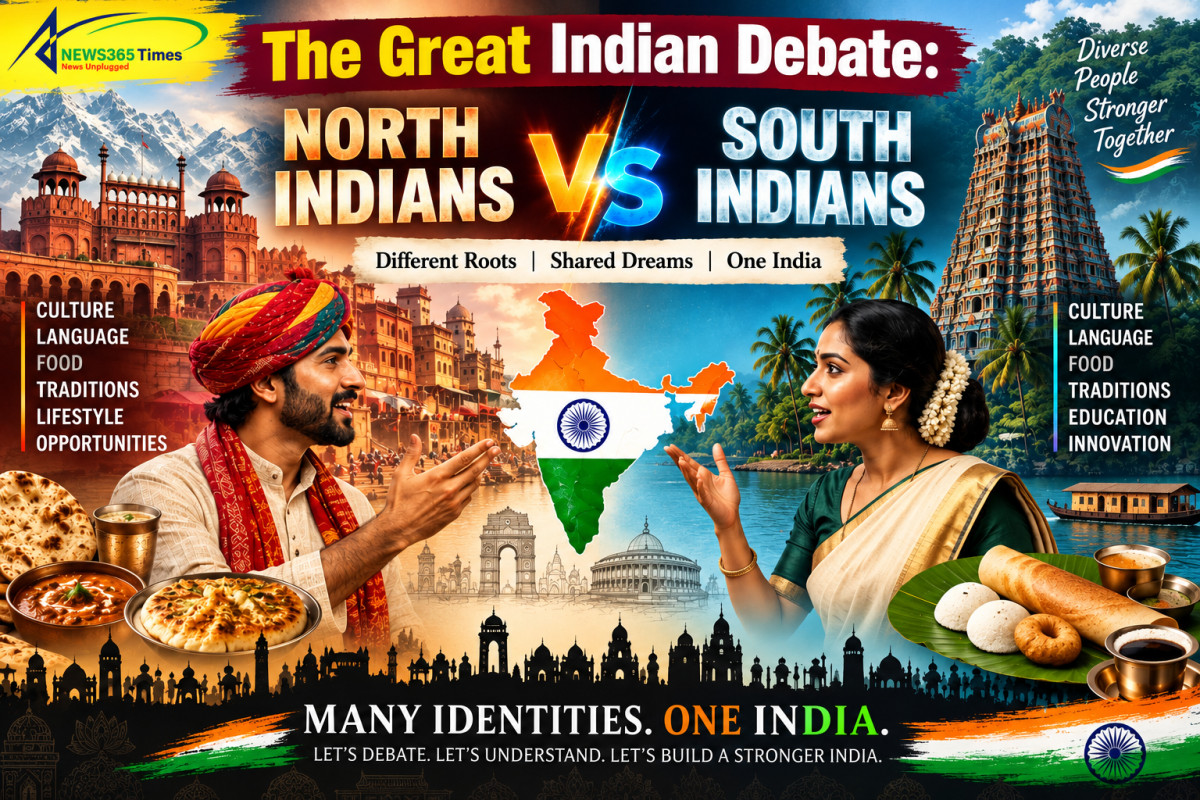
Who are the more real Indians?
Neither North Indians nor South Indians are “more Indian”. India is not the inheritance of whichever population arrived first, fought the most invasions, preserved the oldest language, built the greatest temples, or retained the oldest customs. Indian civilisation was produced by the interaction of all these historical experiences. There is perhaps no more seductive, and ultimately misleading, question in the Indian debate about identity than this: Who are the real Indians?
Is it the people of the South, heirs to the ancient Dravidian languages, monumental temple traditions, Tamil's extraordinary antiquity, classical music, philosophy and religious continuity? Or is it the peoples of northern and western India, whose historical geography repeatedly placed them closer to the great landward corridors through which conquerors, migrants and political movements entered the subcontinent, and whose societies consequently endured centuries of warfare, political upheaval and cultural transformation?
The temptation of two Indias
At first sight, India can indeed appear divided into two enormous cultural worlds. Travel southwards and gradually the linguistic landscape changes. Tamil, Telugu, Kannada and Malayalam belong to the Dravidian language family, distinct from the Indo-Aryan family dominant across much of northern India. Dravidian languages are not confined absolutely to the South, however; speakers are also found in parts of central and eastern India. Dravidian languages Food changes. Architecture changes. Music changes. Marriage practices and local rituals can change. Even the visual experience of written language becomes markedly different.
It becomes tempting to take this genuine cultural geography and convert it into racial history:
Dravidian versus Aryan.
Indigenous versus migrant.
South versus North.
Original versus later arrival.
That is precisely where history becomes considerably less accommodating. The first myth: “South Indians are the original Indians”. The proposition carries emotional force because southern India possesses extraordinary civilisational antiquity. Tamil unquestionably has an ancient and independent literary tradition. The earliest attested Tamil writing is dated to approximately the fifth century BCE, and Tamil was recognised by India as a classical language. Tamil language Southern pride in that inheritance is therefore entirely understandable.
But linguistic antiquity cannot be converted into racial ownership of India. Modern genetics has complicated the old Aryan-Dravidian racial picture considerably.
The landmark Reconstructing Indian population history study found evidence for two ancient ancestry components conventionally called Ancestral North Indian and Ancestral South Indian, with substantial mixture underlying most Indian populations studied. Later ancient-DNA research produced an even richer reconstruction. The Formation of Human Populations in South and Central Asia described modern South Asian ancestry in terms of several prehistoric population movements and mixtures, including ancestry related to ancient South Asians, ancient Iranian-related populations and later Steppe-associated groups. The modern Indian is therefore more convincingly understood as the descendant of layers of prehistoric mixture than as the surviving representative of one pure primordial population.
So the provocative question: “Are South Indians the original Indians?” has a better response:
They are descendants of ancient Indians, certainly. But so are North Indians, through different proportions and historical combinations of ancient ancestries. There is no scientifically meaningful racial certificate of “original Indianness”. The second myth: “North Indians are less Indian because they are more mixed”
This argument contains an even more fundamental philosophical problem. If mixture makes somebody less Indian, then much of Indian civilisation itself becomes “un-Indian”. India has always absorbed. It absorbed languages. It absorbed populations. It absorbed artistic conventions. It absorbed foreign technologies. It absorbed gods and gave familiar gods new regional forms. It absorbed conquerors, while conquerors themselves became culturally transformed by India.
Indeed, even Indo-Aryan and Dravidian languages reveal the consequences of extraordinarily long contact. Linguistic scholarship describes important convergent characteristics arising from their proximity. Dravidian and Indo-Aryan Mixture is therefore not the corruption of Indian civilisation. One might argue that mixture is one of its defining historical processes. But the North can make a different claim: “We bore the invasions” Here the debate becomes more serious.
India's geography did produce a genuine historical asymmetry. The subcontinent's principal easier land approaches included its northwestern sector; the northern Indus-Ganges plains and southern Deccan form different great geographical systems. India: History Northern and particularly north-western India consequently faced repeated political and military movements arriving through continental routes.
The establishment of the Delhi Sultanate, for example, followed Ghurid campaigns and victories in northern India, while later rulers also had to contend with pressure from Mongol armies. There is therefore a legitimate historical memory behind the northern frontier.
But it should not become: “The North fought while the South hid safely behind it.” Because history immediately disproves that simplification.
The Deccan and South experienced formidable warfare themselves. Vijayanagara arose in the fourteenth century amid the political consequences of Tughluq penetration of the Deccan and became the dominant southern power. In 1565, Vijayanagara's army was defeated at Talikota by the combined forces of Bijapur, Ahmadnagar and Golconda, after which its capital was destroyed. Vijayanagar The South therefore possesses histories of resistance, war, destruction and reconstruction of its own.
The shield of India kept moving. At different moments, different regions became India's military and political frontier. At one stage the pressure might fall upon the northwest. At another upon Rajasthan and the Gangetic world. At another upon the Deccan. At another upon Vijayanagara. Then history produces an extraordinary reversal. Instead of northern power moving southwards, Maratha power rises from the Deccan and moves northwards. The Maratha political order founded by Shivaji challenged Mughal power; in the eighteenth century the Maratha confederacy extended its authority over considerable areas of western, central, northern and eastern India.
Sanskritic and Vedic traditions travelled into southern India.
But South India did not merely receive Indian civilisation. It helped remake it.
Early Tamil devotional traditions associated with the Alvars and Nayanars became enormously important in the history of Bhakti, which subsequently developed powerfully across many regions of India. Bhakti movement The Cholas demonstrate another dimension of southern dynamism.
Far from being simply custodians hiding behind the protection of the North, the Chola dynasty developed into a military and maritime power. Rajaraja I conquered Kerala and northern Sri Lanka, while Rajendra I completed the conquest of Sri Lanka, campaigned towards the Ganges and projected Chola power towards parts of maritime Southeast Asia. The arrows of Indian civilisation therefore run both ways:
Then who preserved Indian civilisation?
Southern India preserved magnificent temple cultures and ancient linguistic traditions. Northwestern regions repeatedly endured the consequences of their frontier geography. The Gangetic world remained an enormously influential religious and political geography. The Deccan repeatedly became the bridge between them. And different regions generated new religious, philosophical, artistic and political movements in different centuries.
Therefore Indian civilisation was not stored in one geographical vault. It was distributed. This may be one of the reasons it proved so resilient. When one political centre collapsed, another survived. When one region suffered invasion, another could flourish. When one dynasty vanished, another inherited, reinterpreted and transmitted elements of the civilisation.
So, who are the “more real Indians”? Let us return to the question with which we began.
It is: “unity in diversity”. It allows the northern argument about frontier warfare and the southern argument about antiquity and cultural continuity to be heard seriously before testing both against history.
What's Your Reaction?
 Like
0
Like
0
 Dislike
0
Dislike
0
 Love
0
Love
0
 Funny
0
Funny
0
 Wow
0
Wow
0
 Sad
0
Sad
0
 Angry
0
Angry
0

English Daily News Platform #News #Latestupdates #Tech #Business #Politics #Indianews #India. Regd No : JMAGC/HR/00072 (JMAGC ), MIB ,Govt of India





Comments (0)