
The Andaman and Nicobar Islands - the Bolster on which India rests upon.
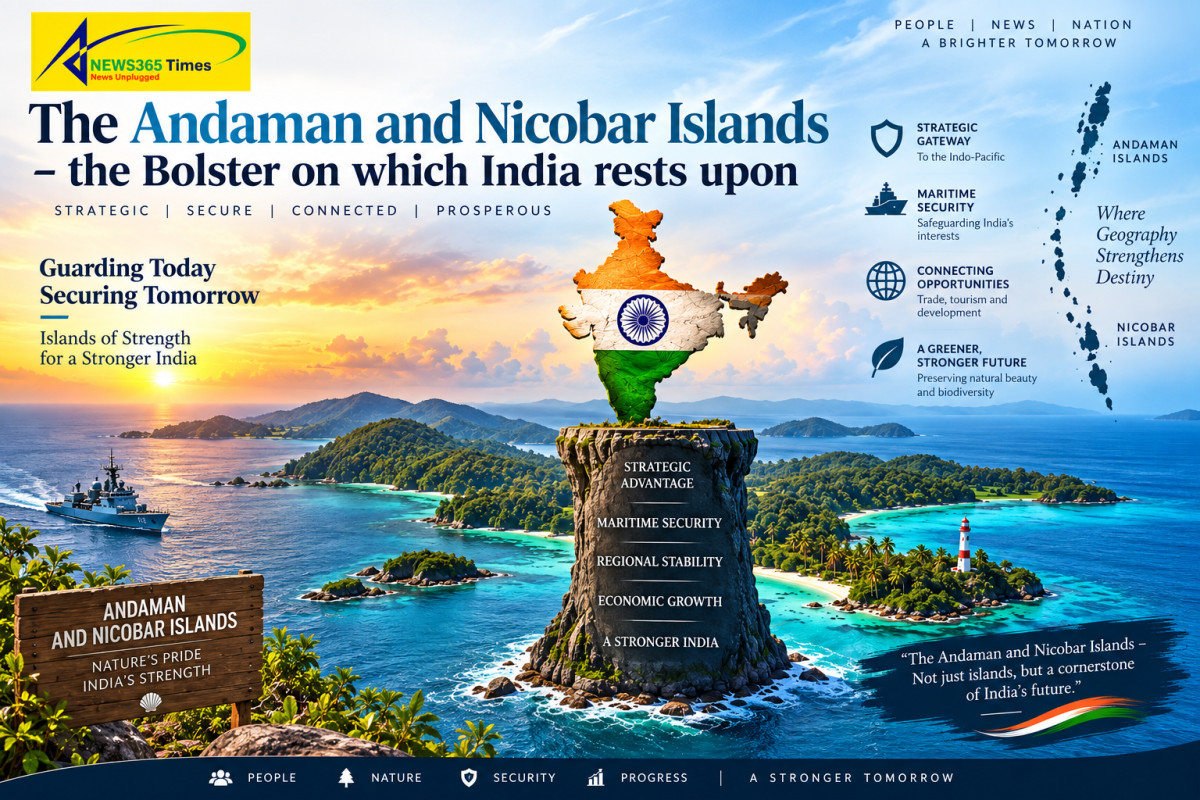
The Andaman and Nicobar Islands, lying at the juncture of the Bay of Bengal and the Andaman Sea, have always carried a mystique that blends mythology, indigenous heritage, colonial history, and strategic importance. Their story unfolds across distinct stages, each marking a transformation in how these islands were perceived and utilized.
Mythological and Early Cultural Associations
Though the Vedas and Puranas do not explicitly mention the islands, they are symbolically tied to the Ramayana. The name Andaman is derived from Handuman "Hanuman" reflecting Southeast Asian traditions that associated the archipelago with the monkey‑god’s leap across the ocean to Lanka where his entire army relentlessly searched for Sita. This cultural memory gave the islands a mythological aura.
Pre‑Colonial Era (2000–3000 years ago)
The islands were inhabited by indigenous tribes, the Great Andamanese, Jarwa, Onge, and Sentinelese in the Andamans, and the Nicobarese and Shompen in the Nicobars. Archaeological and linguistic evidence suggests their presence stretches back tens of thousands of years, with Nicobarese linked to Mon‑Khmer languages of Southeast Asia.
By the early centuries, the islands began appearing in global records. Ptolemy (2nd century) referred to them as Angademan. Chinese monks like Faxian and I‑Tsing described them as the “Kingdom of Naked People.” Arab traders noted barter exchanges, while Marco Polo (13th century) chronicled them as Angamanain and Necuverann. Indian empires also recognized their strategic value: the Cholas in the 11th century used Nicobar as a naval base against Srivijaya, and later the Marathas leveraged them for maritime dominance.
From the 16th century onwards, European powers attempted to step in. The Portuguese visited as missionaries and traders, but failed to establish control. The Danes formally claimed Nicobar in 1755, but repeated attempts at settlement collapsed due to disease and tribal resistance; they eventually sold their rights to Britain in 1869. The French and Spanish showed interest but never secured lasting influence. The Japanese, however, briefly occupied the islands during World War II (1942–45), handing them symbolically to Subhas Chandra Bose’s Azad Hind government. This marked the only non‑European occupation of the islands in modern history.
The British first attempted settlement in 1789 under Archibald Blair, but abandoned it in 1796. After the 1857 revolt, they revived Port Blair as a penal colony. Thousands of rebels and convicts were transported, and the infamous Cellular Jail "Kala Pani" was constructed in the early 20th century to house political prisoners like Veer Savarkar. Administratively, the islands were initially managed under Bengal, later upgraded to a Chief Commissionership in 1872. The assassination of Lord Mayo by a convict in 1872 underscored the harsh realities of the penal colony. Strategically, the islands served as a naval outpost to secure British dominance in the Bay of Bengal.
After independence, the islands were briefly administered under West Bengal before being declared a Union Territory in 1956. Port Blair became the capital, and by 1982, a Lieutenant Governor was appointed. The most significant development came in 2001 with the creation of the Andaman and Nicobar Command (ANC) — India’s only tri‑service command, integrating the Army, Navy, and Air Force. The 2004 tsunami devastated Nicobar, but India’s rapid humanitarian response reinforced the islands’ role as both a strategic and compassionate outpost.
In the 21st century, the islands have become central to India’s Indo‑Pacific vision. Their proximity to the Malacca Strait, through which nearly 40% of global trade and most of energy imports pass makes it a natural surveillance and deterrence hub. Infrastructure has expanded, airstrips at Campbell Bay, Car Nicobar, and Shibpur, radar chains, naval bases and digital connectivity through the 2020 submarine optical fiber cable. Eco‑tourism and civilian development have grown, balanced against strict protections for indigenous tribes and fragile ecosystems.
Looking ahead, India envisions the islands as fully self‑reliant. Small modular nuclear reactors will provide uninterrupted power, ensuring military installations and civilian infrastructure operate at peak capacity. The ANC will evolve into a multinational hub, coordinating with Quad allies — the U.S., Japan, and Australia — and extending outreach to ASEAN nations. Maritime surveillance grids, drones, and satellite systems will make the islands a nerve center of Indo‑Pacific security. Civilian life will be transformed by sustainable energy, desalination and smart city projects, turning the archipelago into a model of resilience. By 2050, the Andaman and Nicobar Islands will stand as India’s unsinkable aircraft carrier, a bastion of deterrence against opposition “String of Pearls” a platform for allied cooperation, and a symbol of India’s leadership in Southeast Asia.
What's Your Reaction?
 Like
0
Like
0
 Dislike
0
Dislike
0
 Love
0
Love
0
 Funny
0
Funny
0
 Wow
0
Wow
0
 Sad
0
Sad
0
 Angry
0
Angry
0

English Daily News Platform #News #Latestupdates #Tech #Business #Politics #Indianews #India. Regd No : JMAGC/HR/00072 (JMAGC ), MIB ,Govt of India








Comments (0)