

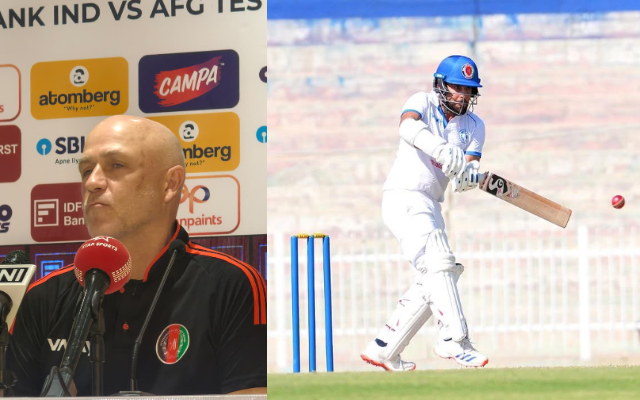
On the eve of Afghanistan’s one-off Test match against India in Mullanpur, newly appointed head coach Richard Pybus did not hold back. In a candid, wide-ranging pre-match press conference, Pybus firmly placed the responsibility for the survival and growth of Afghanistan’s red-ball cricket on the shoulders of the International Cricket Council (ICC).
While expressing immense pride in his new squad and marveling at the unique grassroots passion for the sport in Afghanistan, Pybus spent a significant portion of his media address critiquing the current international scheduling landscape. For the veteran coach, a Full Member nation playing sporadic, isolated one-off Tests is an unsustainable model for genuine development.
When asked whether stopgap arrangements – such as scheduling one-off matches whenever major teams tour the subcontinent – are the right way forward for developing sides, Pybus pushed back, calling for a complete structural overhaul from the sport’s global governing body.
“I think that the onus is with the ICC, you know,” Pybus told reporters. “When a country gets granted full membership, it’s one thing to get full membership, but then you need to get a full fixture list. And it can’t be that the development historically of teams is just based on what the exposure they get at World Cups.”
Pybus pointed out that expecting a team to improve in cricket’s most demanding format without a predictable, built-out bilateral calendar is an unrealistic expectation. While he expressed gratitude to the local board for securing matches, he emphasized that systemic change must happen at the top.
“Credit to the BCCI, you know, they’ve given us plenty of cricket this year, which is fantastic for us to be able to develop,” he said. ” I’d like to see going forward that the other senior full members also start to build out the list. We need to be in a situation now where there’s a proper fixture list.”
Pybus was particularly vocal about the tactical and developmental limitations of playing standalone matches or abbreviated two-Test series. In his eyes, short series stifle a team’s evolutionary curve, as players are denied the chance to immediately rectify mistakes in subsequent matches.
“To play one Test and have a four or five-month break before you play your next Test match, you know, if whatever you’re going to learn, there needs to be a concentration of learning. So, you know, if we’re playing a three-Test series, you can back that up, Test after Test after Test. If you’re playing five Tests, that’s even better,” the Afghanistan head coach said.
The coach went as far as to question the broader modern trend of shrinking bilateral Test series down to two matches, noting that the format fundamentally undermines the competitive nature of the sport.
“When series started to become two-Test series, to me it made absolutely no sense because you don’t want a series which is a tie. You know, there needs to be a three or a five-Test series so that you can actually win the series.”
Acknowledging that his current squad, much like his former side, the West Indies, boasts an abundance of highly sought-after global T20 league stars, Pybus stressed that protecting Test cricket requires deliberate context and protection within the international calendar.
“Wherever you go in the world, you know, T20 is king,” Pybus noted. “I think it’s very important that those who regard Test cricket as the highest form of the game, that it’s nurtured and protected. And again, that comes back to making sure that there is time in the calendar for all the countries to be able to have proper series.”
Despite the lack of long-form fixtures, Pybus noted that the hunger for red-ball cricket exists within the country. He cited his recent travels from Kabul to Jalalabad, where he observed a vibrant domestic four-day competition and children playing passionate cricket on stone-strewn grounds with concrete slabs for pitches.
Ultimately, however, translating that raw passion and domestic success into international pedigree remains a matter of global scheduling.
Stripping away the local complexities, Pybus concluded with a sharp reminder to the sport’s administrator. “Really it’s about being able to transition from the players who’ve done really well in four-day cricket to have a volume of Tests and series to be able to continue to build the team… So that is the challenge. You know, that’s not an Afghanistan question, that’s an ICC question, really.”
For More Exciting Articles: Follow RevSportz
The post “That’s an ICC Question, Really”: Richard Pybus Demands Structural Reform and Proper Fixture Lists for Afghanistan Test Cricket appeared first on Sports News Portal | Revsportz.