

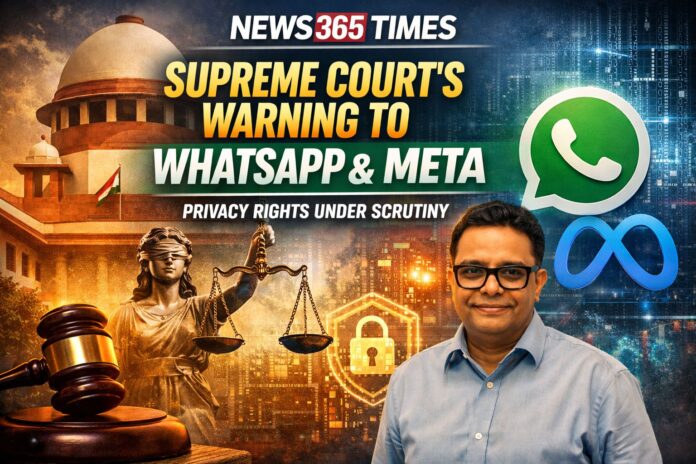
In a significant development that could reshape digital privacy jurisprudence in India, the Supreme Court of India has delivered a stern warning to WhatsApp and its parent company Meta Platforms over controversial aspects of its privacy policy. The Bench, led by Chief Justice Surya Kant, reprimanded the tech giant for its “take-it-or-leave-it” approach to user consent — a practice the Court said undermines the fundamental right to privacy guaranteed by the Indian Constitution.
What Happened in Court
On February 3, 2026, the top court heard appeals by Meta and WhatsApp challenging the ₹213.14 crore penalty imposed by the Competition Commission of India (CCI) for abuse of dominance linked to WhatsApp’s privacy terms. The Court emphasized that Indian citizens’ privacy cannot be treated as a bargaining chip in data collection or monetisation strategies.
Delivering a firm message, the Bench observed that companies cannot play with the right to privacy of citizens and warned that unless WhatsApp gives a clear legal undertaking to safeguard user data, the Court may issue directives restricting current practices. “This privacy policy is so cleverly crafted that the average person can’t understand it,” the Bench remarked, underscoring serious judicial concern over the complexity and implied coercion in the policy structure.
Constitutional Backdrop: Right to Privacy
The apex Court’s warnings are rooted in its landmark 2017 judgment in Puttaswamy v. Union of India, which unequivocally held that the right to privacy is a fundamental right protected under Articles 14, 19 and 21 of the Constitution. This ruling means that any policy — public or private — impacting personal data must pass stringent constitutional tests of legality, necessity and proportionality.
Expert Perspective: Mr. Raghav Shukla
Mr. Raghav Shukla, Senior Legal Counsel , New Delhi, provides his legal take on this watershed moment:
“The Supreme Court’s intervention reflects a paradigm shift in digital rights jurisprudence in India. The right to privacy — once considered an abstract concept — has now become a tangible legal standard that private platforms must respect in clear, enforceable ways. This case is not just about WhatsApp or Meta; it is about setting norms for how multinational platforms operate within Indian digital space.”
“This Court has rightly questioned the idea that consent buried in complex terms and conditions can be treated as meaningful. Consent must be — and now will be — informed, explicit, and non-coercive. Anything less undermines the constitutional dignity of users.”
“Moreover, the reference to data sharing with parent or affiliate companies implicates both competition law and data protection principles. The Supreme Court’s reply signals that dominance in digital markets does not exempt compliance with fundamental rights and statutory frameworks like the Digital Personal Data Protection Act, 2023.”
What This Means Going Forward
- Interim Orders: The Supreme Court has indicated it may issue interim directions as early as February 9, 2026, signaling that temporary safeguards may be enforced pending final judgment.
- Industry Impact: This decision could influence how global platforms draft consent frameworks and approach data sharing in India, setting precedents for transparency and user autonomy.
- Legal Thresholds: Courts will likely require stronger evidence that data practices are within the constitutional ambit, especially against the backdrop of India’s Digital Personal Data Protection Act, 2023.
The Bigger Picture
This case underscores the judiciary’s proactive role in protecting digital liberties. As India’s digital ecosystem expands, this judgment may become a cornerstone for evaluating how private entities balance business models with constitutional rights — starting with the right to privacy itself.
Stay tuned to News365 Times for updates and legal analyses as this landmark case unfolds.