

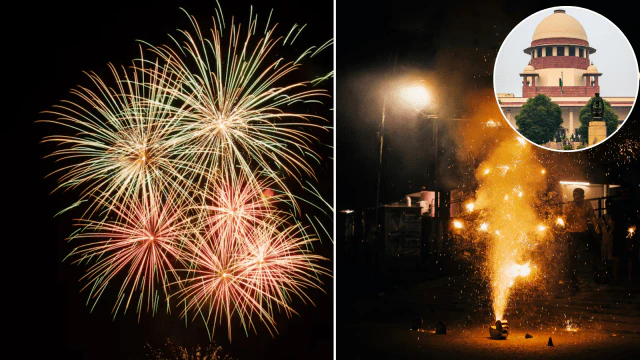
In a significant development ahead of the festive season, the Supreme Court has permitted the offline sale of green crackers in Delhi-NCR, provided they carry mandatory QR codes for traceability and verification. The decision comes as a relief to licensed firecracker traders and manufacturers, who had expressed concerns over blanket restrictions imposed in recent years due to air pollution worries in the region.
The apex court clarified that the intent is not to ban celebrations but to strike a balance between tradition, livelihood, and environmental protection. The bench emphasized that only eco-friendly crackers—those certified by the Petroleum and Explosives Safety Organisation (PESO)—would be allowed for sale and bursting. These green crackers are designed to reduce emissions by up to 30%, contain no harmful metals such as barium or lead, and emit less particulate matter compared to conventional ones.
To ensure compliance, the Court has mandated the use of QR codes on every packet, which will enable authorities and consumers to verify the authenticity and environmental certification of the product. This measure is expected to curb the sale of counterfeit or banned firecrackers, a recurring issue during the festive period.
The ruling also stated that local authorities must strictly monitor storage and sales points to ensure that only authorized vendors deal in certified green crackers. The Delhi Police, pollution control boards, and district administrations have been instructed to coordinate for smooth enforcement and prevent illegal online or street-side sales.
While the order brings cheer to traders and manufacturers who had faced economic setbacks in the last few years, the Supreme Court reiterated that public health and air quality remain a top priority. The bench urged citizens to celebrate Diwali responsibly, confining the use of crackers to designated hours and ensuring minimal pollution impact.
Environmental experts have welcomed the QR code verification step as a forward-thinking move toward accountability and cleaner festivities. However, they also cautioned that even green crackers contribute to temporary air quality dips, especially in regions already struggling with smog during winter months.
For Delhi-NCR—where air pollution typically spikes after Diwali—this judgment is seen as an attempt to balance environmental responsibility with cultural expression. The emphasis now lies on awareness, enforcement, and citizen cooperation to ensure that this Diwali is not only bright but also clean and safe for all.