

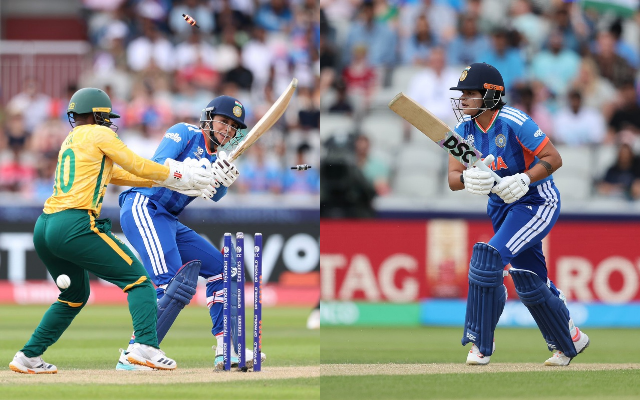
Team India’s perfect run in the ongoing ICC Women’s T20 World Cup came to an end in Manchester as they suffered a six-wicket defeat on June 21, their first loss in three group-stage games. However, with two matches still to go, the Women in Blue remain in contention for a semi-final spot. That said, their path has become a little tougher after this defeat.
Be it the two costly drops from arguably India’s best fielder, Radha Yadav, or the inability to control South Africa’s innings in the middle overs, India fell short in several areas. As a batting unit too, they looked around 15-20 runs short.
Despite getting off to a strong start and reaching 59/2 in the powerplay and 82/3 after 10 overs, the Women in Blue failed to capitalise. They added only 76 runs in the final 10 overs while losing four wickets.
After opting to bat, it looked a good surface for strokeplay. Both Shafali Verma and Smriti Mandhana played a few delightful shots and looked set for substantial scores. However, India kept losing wickets at regular intervals throughout the innings, and that eventually cost them the extra 10-15 runs that could have given their bowlers a bit more cushion.
Heading into this tournament, one of the biggest positives for India was their settled batting unit. However, in three games so far, the batters have struggled to show consistency, not only in terms of runs but also game awareness.
For example, India had a flying start in Manchester against Shabnim Ismail and Marizanne Kapp. They raced to 30 in just three overs, but on the final delivery of the third, Smriti (17 off 12) attempted an audacious scoop, completely missed it, and saw her stumps shattered. From an experienced batter like her, it was unexpected at that stage of the innings.

The Indian opener had also gone into the match on the back of two consecutive fifties. Still, the shot selection, game awareness and timing of that dismissal all went badly wrong.
Then came Shafali Verma. Once again, she got a solid start but failed to convert it. Her 31 off 15 balls gave India momentum, but in hindsight, it did not help the team as much as it could have. The well-directed short ball produced the only wicketkeeping dismissal of the innings, with credit also going to South Africa wicketkeeper Sinalo Jafta for convincing her captain to take the DRS review.
Then came Jemimah Rodrigues. Three games into the tournament and she is yet to make a significant contribution with the bat. She has not crossed the 20-run mark even once, scoring one against Pakistan at No. 3, 19 against the Netherlands at No. 3, and 12 against South Africa at No. 4. Poor shot selection has cost her in every game so far.
Yastika Bhatia, despite getting consecutive opportunities, has not been able to make them count. Richa Ghosh, meanwhile, once again fell to a slower delivery against South Africa as the pitch appeared to get slightly slower towards the back end of the innings. There was a clear pattern to the bowling against her, with bowlers keeping the ball wide and away from her hitting arc.
Interestingly, in both practice sessions in Leeds and Manchester, she was seen working on that aspect, but once again failed to execute when it mattered.
Against the Proteas Women, all of India’s top seven got starts but failed to convert them.

South Africa, too, lost two wickets inside the powerplay but rebuilt through a 97-run partnership between Marizanne Kapp and Tazmin Brits.
For India, the highest partnership was the 33-run stand between Harmanpreet Kaur and Deepti Sharma for the fifth wicket. There were several phases when it seemed India could accelerate, but wickets kept falling at regular intervals.
In fact, India have produced only two fifty-plus partnerships so far in the tournament. One came against Pakistan between Smriti and Harmanpreet — a 91-run stand for the third wicket — while the other was the 115-run opening stand between Smriti and Shafali.
Looking at the phases of the game, India won both the batting and bowling powerplays but lost control in the middle overs. With the bat, they scored 63/3 in that phase, while with the ball they conceded 97/0.
Hence, heading into their next match against Bangladesh in Manchester, followed by a clash against Australia at Lord’s, India would like to see their batters click together as a unit. That could help them either set up or chase competitive totals as they look to secure a semi-final berth.

For More Exciting Articles: Follow RevSportz
The post Starts and stumbles: India’s batting comes undone in Manchester appeared first on Sports News Portal | Revsportz.