

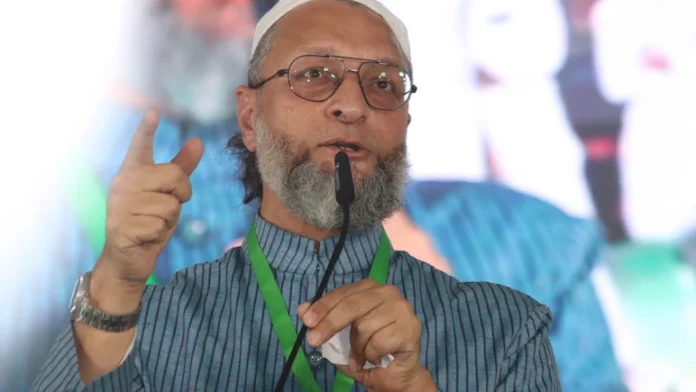
In a bold political move, All India Majlis-e-Ittehadul Muslimeen (AIMIM) chief Asaduddin Owaisi announced that his party will contest 100 seats in the upcoming Bihar Assembly elections, following a complete breakdown in talks with the INDIA bloc. The decision marks the Hyderabad MP’s sharp response to what he called “deliberate exclusion” by the opposition alliance, setting the stage for a multi-cornered electoral battle in one of India’s most politically complex states.
Owaisi’s Announcement
Speaking at a press conference in Patna, Owaisi said his party had made “sincere attempts” to join hands with the INDIA bloc to defeat the Bharatiya Janata Party (BJP), but was “continuously sidelined” by both the Rashtriya Janata Dal (RJD) and the Congress. “If they do not consider AIMIM a part of their secular politics, we will chart our own course. AIMIM will contest 100 seats in Bihar and fight for the rights and representation of marginalized communities,” Owaisi declared.
He also accused the INDIA bloc leadership of practicing “selective secularism,” alleging that Muslim voters were being treated as “vote banks, not stakeholders.”
AIMIM’s Strategy in Bihar
AIMIM, which has pockets of influence in Bihar’s Seemanchal region — particularly in Kishanganj, Araria, Purnea, and Katihar — is expected to field candidates in constituencies with significant minority and Dalit populations. Party insiders suggest that Owaisi has been working on a grassroots expansion plan for several months, strengthening local units and identifying strong regional candidates.
Owaisi emphasized that AIMIM’s candidates would represent “those ignored by both the ruling NDA and the opposition bloc.” He said, “Our candidates will be the voice of the voiceless — backward classes, Muslims, Dalits, and youth who have been betrayed by every alliance in the name of secularism and development.”
Rift with INDIA Bloc
The fallout with the INDIA bloc, a coalition of opposition parties including the RJD, Congress, and Left parties, reportedly stemmed from disagreements over seat-sharing and political messaging. Sources close to AIMIM claim that despite several rounds of informal talks, the RJD leadership was reluctant to allocate even a symbolic number of seats to Owaisi’s party, fearing a split in the minority vote base.
Political analysts view the decision as a potential spoiler for the opposition alliance. “Even if AIMIM wins a few seats, it can impact close contests in at least two dozen constituencies, especially in Seemanchal,” said one Patna-based political observer.
Political Reactions
The announcement has triggered varied reactions across party lines. While RJD leaders dismissed Owaisi’s move as an “attempt to help the BJP by dividing the secular vote,” AIMIM countered that it is the only party that “truly represents ground realities.”
Congress leaders in Bihar called Owaisi’s decision “unfortunate” and urged voters not to fall for “divisive politics.” However, several young voters on social media voiced support for AIMIM’s independent stand, arguing that it offers “an alternative voice beyond traditional caste equations.”
Owaisi’s Broader Message
Owaisi’s declaration comes at a time when the political landscape in Bihar is already tense, with shifting alliances and leadership tussles ahead of the polls. His move also appears to be a part of AIMIM’s larger strategy to expand its footprint beyond its traditional strongholds in Hyderabad and Maharashtra to the Hindi heartland.
“The people of Bihar are politically conscious. They understand who has delivered and who has deceived. AIMIM will contest with full strength — not for symbolism, but for real representation,” Owaisi said, reaffirming his commitment to independent politics.
What Lies Ahead
With AIMIM entering the fray independently, the Bihar Assembly election is likely to see a four-cornered contest among the NDA, INDIA bloc, AIMIM, and smaller regional outfits. The development adds a new layer of complexity to seat arithmetic and coalition strategies, particularly in minority-dominated regions.
As Bihar gears up for elections, Owaisi’s move may reshape the state’s political dynamics — potentially influencing not just the outcome in specific constituencies but also the broader narrative of representation, secularism, and identity politics in one of India’s most politically vibrant states.