

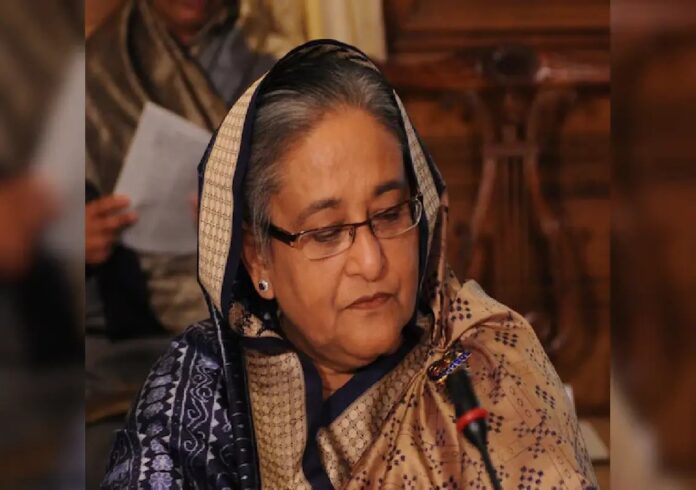
New Delhi: Former Bangladesh Prime Minister Sheikh Hasina has said she and several senior leaders of the now-banned Awami League plan to return to Bangladesh around December and surrender before the courts despite the death sentence handed down against her by the country’s International Crimes Tribunal.
Hasina, who has been living in India since August 2024 after leaving Bangladesh amid violent anti-government protests, said she was aware of the risks involved in returning but remained determined to go back to her homeland.
In an interview with Reuters, the former Prime Minister said she was prepared to face arrest or even death, adding that she wanted to return because she believed the legal process would expose what she described as politically motivated cases against her.
Hasina announces plan to return
Speaking in a nearly hour-long telephone interview with Reuters, Hasina said she intended to return to Bangladesh around December along with senior leaders of the Awami League.
She said they planned to surrender before the courts after returning to the country.
“They may arrest me on my return, they may even kill me,” the 78-year-old leader said.
“Still, I have to go. My party leaders and workers are being subjected to tremendous repression. If death comes, I want it to come on my own soil, where my parents are buried and where their blood was shed,” she added.
Hasina did not specify an exact date for her return or identify the court before which she intends to surrender.
According to Reuters, this is the first time she has publicly outlined a timeline for returning to Bangladesh and indicated that other senior Awami League leaders would accompany her.
Living in India since August 2024
Hasina has been residing in India since August 5, 2024, after leaving Bangladesh following weeks of violent student-led protests that escalated into nationwide unrest.
The demonstrations, which were supported by various opposition groups, turned deadly and eventually led to the end of her government.
According to earlier accounts, Bangladesh’s military leadership advised Hasina to leave the country because of security concerns.
Her departure marked the end of nearly two decades of political dominance across multiple terms as Prime Minister.
The decision by India to provide her refuge subsequently became a point of discussion in India-Bangladesh diplomatic relations.
Death sentence and extradition request
In November 2025, Bangladesh’s International Crimes Tribunal sentenced Hasina to death in absentia over allegations relating to the government’s handling of the 2024 anti-government protests.
Hasina has consistently denied the allegations and maintains that the charges are politically motivated.
Bangladesh has repeatedly sought her extradition from India.
Following the interim administration led by Muhammad Yunus, the current government under Prime Minister Tarique Rahman has continued efforts to secure her return through official channels.
Hasina told Reuters that Dhaka had repeatedly written to India seeking her extradition.
“The authorities in Dhaka want to take me back, they are repeatedly sending letters to India seeking to have me sent back,” she said.
“I will go myself,” she added.
India examining extradition request
India has not announced any decision regarding Bangladesh’s extradition request.
Earlier, Ministry of External Affairs spokesperson Randhir Jaiswal said the request was being examined through appropriate legal and judicial processes.
He also reiterated India’s intention to continue engaging constructively with Bangladesh while strengthening bilateral ties.
The Ministry has indicated that discussions between the two countries on bilateral and regional issues are expected to continue through official channels.
Hasina questions legal proceedings
Hasina said she intended to surrender voluntarily because she believed the legal proceedings would eventually demonstrate that the cases against her lacked merit.
“I believe in justice, and I feel that once proceedings start, it will be clear to the people how farcical the court is — and that I want to prove it,” she said.
She also referred to an earlier investigation in which Bangladesh’s Police Bureau of Investigation reportedly recommended dropping an attempted murder case against her and 112 others after finding inconsistencies in the complaint.
The investigators had reportedly concluded that the alleged victim could not be traced and that aspects of the complaint appeared fabricated.
Reorganising Awami League
Hasina also revealed that she has been conducting online meetings covering 125 of Bangladesh’s 300 parliamentary constituencies as part of efforts to reorganise the Awami League, which has been banned by the interim administration.
Reflecting on her years in office, she acknowledged that mistakes may have occurred during her tenure but said it was ultimately for the people of Bangladesh to judge her government’s legacy.
“When a government works for a long time, mistakes can happen. No government is above error,” she said.
“But the right to judge the good and bad, the right and wrong of a government belongs to the people. I leave that judgment to the people.”
Political developments remain under watch
Hasina’s announcement comes amid continuing political uncertainty in Bangladesh and ongoing legal proceedings involving several former Awami League leaders.
Whether she will return as planned in December remains to be seen, particularly as extradition proceedings, legal processes and political developments continue to unfold in both Bangladesh and India.
The proposed return is expected to draw significant international attention given Hasina’s long political career, the charges against her and the implications for Bangladesh’s domestic politics and bilateral relations with India.