

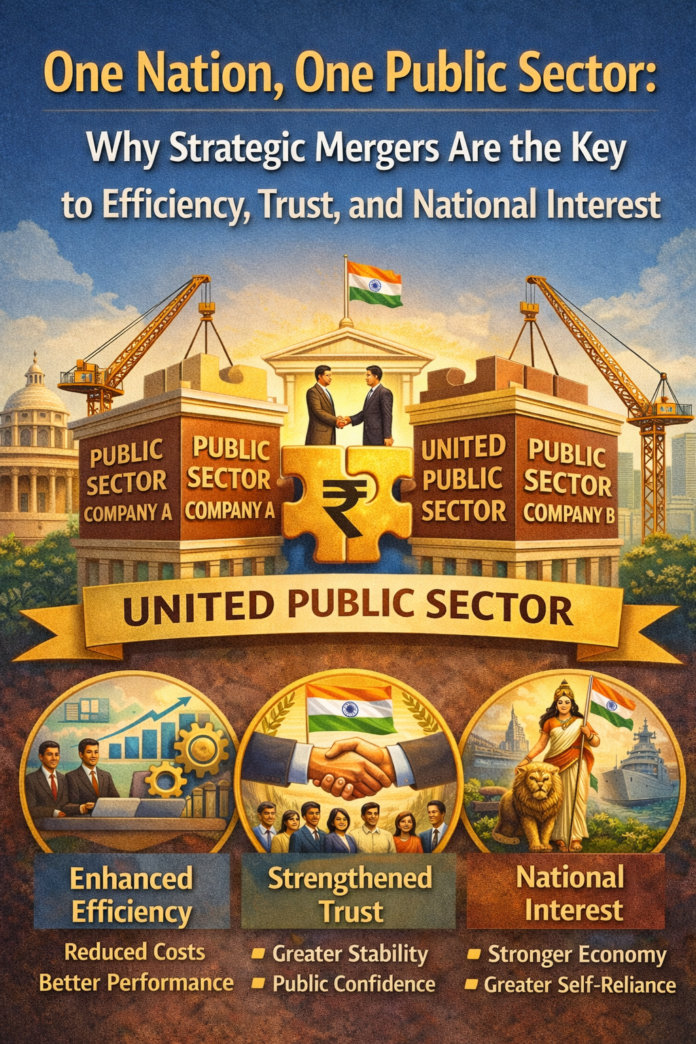
India’s public sector was conceived not merely as an economic participant, but as a custodian of public trust, financial inclusion, and long-term national stability. At a time when fiscal prudence, efficiency, and citizen confidence are paramount, it is imperative to revisit how public-sector enterprises function—and how they can be strengthened through strategic consolidation, alignment, and simplification.
Public-Sector Banks Must Champion Public-Sector Insurance
The Life Insurance Corporation of India was constituted on 1 September 1956 by merging 245 private insurance companies. Over nearly seven decades, LIC has built unmatched trust, reach, and stability.
Yet today, a growing share of life-insurance business is being diverted to private insurers—many promoted by private banks—through bancassurance alliances that prioritise commissions over consumer interest.
It is deeply concerning that public-sector banks are increasingly collaborating with private insurers instead of promoting LIC. This practice neither serves public interest nor protects customers, many of whom are lured into complex, gimmick-laden products with hidden clauses and high agent commissions.
Policy imperative:
The Department of Financial Services should mandate all public-sector banks to partner exclusively with LIC of India for life-insurance distribution. Each bank branch should be formally aligned with a nearby LIC unit, supported by transparent incentive structures to encourage ethical, volume-based growth.
This would:
- Strengthen a trusted public institution
- Protect citizens from mis-selling
- Create a genuine single-window banking + insurance ecosystem
Merge LIC Units to Cut Redundancy and Costs
Despite LIC itself being a product of consolidation, its internal structure still reflects inefficiencies. In cities like Delhi’s Daryaganj, multiple LIC units operate from the same or adjacent buildings, while high-potential commercial areas like Chandni Chowk have lost LIC presence altogether.
What’s needed:
- Immediate merger of nearby LIC units to reduce overheads
- Re-deployment of offices to underserved but commercially significant locations
- Preferential use of government-owned vacant buildings
Such rationalisation would significantly reduce administrative costs while improving service reach.
Reward Public-Sector Performance, Not Private Gimmicks
Healthy competition within the public sector can be fostered by performance-linked appreciation for bank branch managers who mobilise higher insurance business for public insurers.
This approach would:
- Increase public-sector insurance profits
- Reduce dependency on high-commission agents
- Eliminate unethical “commission pay-back” practices (often reaching 2–3%)
Abolish Outdated and Useless Formalities
LIC currently requires annuitants under pension schemes like Jeevan Akshay to submit attested Life Certificates annually—an archaic and unnecessary burden.
Given that:
- Jeevan Akshay does not involve risk cover
- Payments are automated
- Death only triggers return of purchase price
This formality should be abolished, except in cases where payments bounce or anomalies arise. Simplification builds trust and reduces harassment, especially for senior citizens.
Rename IDBI Bank as ‘LIC Bank of India’
The public-sector IDBI Bank, now majority-owned by LIC, should be rechristened “LIC Bank of India.”
This would enable:
- A true single-window model for banking and insurance
- Strong brand synergy
- Greater customer confidence and clarity
Merge Public-Sector General Insurance Companies
India’s four public-sector general insurance companies should be merged into a single national entity, mirroring LIC’s structure in life insurance.
Benefits include:
- Sharp reduction in overheads and branch duplication
- Elimination of unhealthy inter-PSU competition
- Strong counterweight to unethical private insurers
Private insurers have repeatedly penalised policyholders through arbitrary deductions and procedural excuses—often without corrective action from the Insurance Regulatory and Development Authority of India.
A unified public-sector general insurer would restore fairness, transparency, and accountability.
Uniform Charges and Rates Across Public-Sector Banks
Until further bank mergers are implemented:
- Interest rates (loans and deposits) must be uniform across all public-sector banks
- Bank charges should be standardised
- Forms and documentation must be simplified and fully digitised, on the lines of passport applications
This would reduce confusion, errors, and manpower wastage—while improving customer experience.
Extend the Merger Logic to Other Sectors: Oil and Energy
Public-sector oil companies should also be consolidated to eliminate redundancy and unhealthy competition.
Additionally:
- All petroleum products must be brought under GST, with suitable cess
- Pricing should shift to weekly revision, with rounded-off rates
- LPG cylinders should move to durable, transparent plastic cylinders in standard 10 kg or 20 kg packs
Rationalise LPG Subsidy and Fuel Pricing Policy
LPG subsidy should be:
- Gradually phased out
- Retained only for genuinely needy households via income-based affidavits
Fuel prices, once increased, should not be reduced with temporary global crude dips. Savings should instead be buffered to manage future shocks—since downstream prices of goods never fall symmetrically.
Conclusion: Consolidation Is Not Shrinkage—It Is Strength
Strategic mergers, uniform policies, and simplified procedures do not weaken the public sector—they restore its purpose.
A leaner, unified, and ethically aligned public sector will:
- Save public money
- Protect citizens
- Strengthen national institutions
- Rebuild trust in governance
The time has come to move decisively from fragmentation to focused national stewardship.