

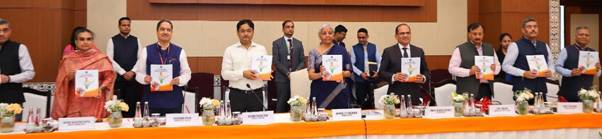
Union Minister for Finance and Corporate Affairs Smt. Nirmala Sitharaman today unveiled the fifth edition of the National Time Release Study (NTRS) at the CBIC Conclave in the national capital. The study is a critical tool in assessing the performance and efficiency of India’s cargo clearance system, and plays a key role in the government’s ongoing trade facilitation efforts.
What is the Time Release Study?
The Time Release Study (TRS) is a performance measurement tool that quantifies the time taken to release goods at various customs points in India. It is designed to evaluate the efficiency, bottlenecks, and improvements in cargo clearance procedures at major entry and exit points, including seaports, Air Cargo Complexes (ACCs), Inland Container Depots (ICDs), and Integrated Check Posts (ICPs).
Since its inception in 2019, the TRS has become central to India’s efforts to streamline cross-border trade and reduce transaction costs.
Key Highlights of the 5th Edition
-
The 2025 edition expanded its coverage to include three additional ports: Kochi Seaport, Garhi Harsaru ICD, and Jaigaon Land Customs Station (LCS).
-
Advanced methodologies were adopted to evaluate each stage and process in the cargo release cycle.
-
Reliable data sourced from the Customs Automated System, managed by CBIC’s Directorate General of Systems and Data Management, ensured accuracy.
Performance Overview: Import Segment
-
Seaports saw an average release time drop by approximately 6 hours.
-
Air Cargo Complexes recorded a reduction of around 5 hours.
-
ICPs improved by 18 hours.
-
ICDs, however, experienced a rise of 12 hours in average release time.
Against the NTFAP 3.0 targets:
-
93.33% of import cargo at ICPs met the 48-hour target.
-
55.03% at air cargo complexes were cleared within 24 hours.
-
51.76% at seaports met the goal.
-
43.70% at ICDs achieved the desired timelines.
Contributing Factors & Challenges
The report credits the improvement to initiatives under the “Path to Promptness” framework, including:
-
Advance filing of documents
-
Risk Management System (RMS)
-
Accredited Economic Operator (AEO) scheme
-
Direct Port Delivery (DPD)
However, delays still persist in certain areas such as:
-
Duty payments
-
Amendment and query resolution
-
Post-clearance logistics
-
Interventions by Participating Government Agencies (PGAs)
Export Cargo Performance
-
Air cargo complexes achieved the fastest regulatory clearance at under 4 hours.
-
ICPs followed with a clearance time of 6 hours and 10 minutes.
-
Seaports averaged 29 hours and 36 minutes for clearance, with logistics post-clearance extending to over 157 hours.
-
At ICDs, export clearance was completed in 30 hours, and post-clearance logistics improved to around 99 hours.
Cargo-Specific Observations
-
Refrigerated goods moved significantly faster, particularly via air cargo routes.
-
Factory-stuffed containers experienced quicker clearance than those stuffed at ICDs.
-
High levels of facilitation (87–93%) were consistently recorded across port categories.
The release of the fifth National Time Release Study reflects India’s ongoing commitment to simplifying trade procedures and enhancing logistical efficiency. With insights into cargo movement patterns and clearance timelines, the report provides actionable data for policymakers and stakeholders to further reduce delays and transaction costs.