

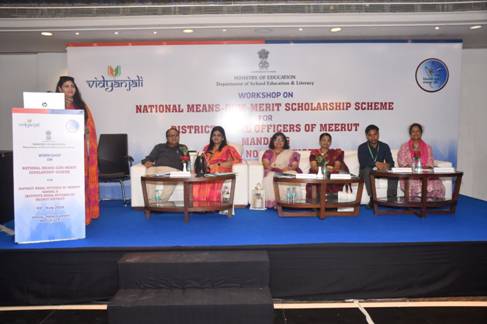
Department of School Education and Literacy (DoSEL), Ministry of Education, organized a pivotal awareness session in Meerut, Uttar Pradesh, to promote the National Means cum Merit Scholarship Scheme (NMMSS). Held under the chairmanship of Smt. A. Srija, Economic Advisor, DoSEL, the session engaged District Nodal Officers (DNOs), school heads, and teachers from nine districts in the Meerut Mandal: Baghpat, Bulandshahr, Gautam Buddh Nagar, Ghaziabad, Hapur, Meerut, Muzaffarnagar, Saharanpur, and Shamli. With 210 participants, the workshop aimed to streamline the implementation of NMMSS, a central sector scholarship designed to support meritorious students from economically weaker sections in completing secondary education (Classes IX to XII). This article explores the objectives, processes, and broader initiatives discussed during the session, highlighting its significance for educational equity in India.
The National Means cum Merit Scholarship Scheme: An Overview
Launched to reduce dropout rates among economically disadvantaged students at the secondary level, the NMMSS provides an annual scholarship of Rs 12,000 to meritorious students from government and government-aided schools (excluding Kendriya Vidyalayas, Navodaya Vidyalayas, and other government residential schools). The scheme targets students who excel in a state-conducted selection exam after Class VIII, supporting them from Class IX through XII. Uttar Pradesh, with the highest annual quota of 15,000 fresh scholarships, plays a critical role in the scheme’s nationwide impact.
The NMMSS, onboarded onto the National Scholarship Portal (NSP) since 2018–19, leverages digital infrastructure for application, verification, and disbursement processes. Students register on the NSP using their own or their parent’s Aadhaar card, completing a One Time Registration (OTR) introduced in 2024–25 to prevent duplication of scholarship benefits across schemes. The scholarship amount is disbursed via Direct Benefit Transfer (DBT) through the Aadhaar Payment Bridge, requiring the student’s or parent’s bank account to be Aadhaar-linked and seeded.
Key Features of NMMSS
-
Eligibility: Open to students from economically weaker sections studying in government or government-aided schools, selected based on merit in a Class VIII exam.
-
Application Process: Students apply for fresh scholarships in Class IX and renewals in Classes X, XI, and XII, requiring 60% marks for promotion to the next class.
-
Verification: Involves two levels—school-level verification by nodal officers (teachers) and district-level verification by DNOs, both using Aadhaar-based biometric authentication.
-
Disbursement: Rs 12,000 per annum is transferred directly to Aadhaar-linked bank accounts.
The Meerut Awareness Session: Objectives and Outcomes
The Meerut session, held on August 2, 2025, aimed to familiarize stakeholders with the NMMSS application and verification processes on the NSP, addressing common errors and ensuring timely scholarship disbursement. Smt. A. Srija, in her welcome address, emphasized Uttar Pradesh’s critical role due to its large scholarship quota and urged officials to prioritize timely verification to benefit deserving students. The session covered:
-
NSP Registration and Application: DoSEL demonstrated the OTR process, guiding students on using Aadhaar for registration and avoiding errors like incorrect data entry or mismatched Aadhaar details.
-
Verification Protocols: School-level nodal officers and DNOs were trained on their roles in verifying applications using biometric authentication, ensuring accuracy and preventing fraud.
-
Common Challenges: The session highlighted issues like incomplete Aadhaar seeding, unlinked bank accounts, and delays in verification, offering solutions to streamline the process.
With 210 participants, including key DoSEL officials like Ms. Sreekala P. Venugopal (Director), Ms. Hema Malini (Under Secretary), Mr. Ram Singh (Deputy Director), and Prof. Bharti Kaushik (CIET, NCERT), the workshop marked significant representation from Meerut Mandal, fostering collaboration among educational stakeholders.
Broader Educational Initiatives Highlighted
Beyond NMMSS, the session provided orientation on three additional DoSEL initiatives aimed at strengthening India’s education system:
-
Vidyanjali – The School Volunteer Initiative: This program encourages community mobilization and corporate social responsibility (CSR) participation to enhance school infrastructure and learning outcomes. Volunteers, including alumni and professionals, contribute resources, mentorship, and services to schools, bridging gaps in facilities and teaching quality.
-
School Challenge Initiative: Hosted on the MyGov portal, this initiative raises awareness about the ill effects of tobacco consumption among students. Schools participate in campaigns to educate communities, aligning with public health goals.
-
Universal Design of Learning (UDL) Textbooks: Developed by the National Council of Educational Research and Training (NCERT), UDL textbooks cater to diverse learning needs, ensuring accessibility for students with disabilities and varied learning styles. The session highlighted their integration into school curricula.
These initiatives reflect DoSEL’s holistic approach to education, combining financial support (NMMSS), community engagement (Vidyanjali), public health awareness (School Challenge), and inclusive learning (UDL).
Significance of the NMMSS and the Awareness Session
The NMMSS is a critical tool for promoting educational equity, particularly in states like Uttar Pradesh, where economic barriers contribute to high dropout rates at the secondary level (13% as per UDISE+ 2021–22). By providing Rs 12,000 annually, the scheme alleviates financial burdens, enabling students to pursue education and improve their socio-economic prospects. Uttar Pradesh’s large quota underscores its potential to impact lakhs of students, with the state disbursing scholarships to 45,000 students (fresh and renewals) annually when fully implemented.
The Meerut session addressed key implementation challenges:
-
Timely Verification: Delays in school and district-level verification have historically hindered disbursements. The session’s focus on training nodal officers aims to expedite this process.
-
Digital Literacy: Many students and teachers in rural areas struggle with NSP navigation. Demonstrations and error-avoidance guidance empower stakeholders to use the portal effectively.
-
Aadhaar Integration: The mandatory use of Aadhaar for registration and DBT ensures transparency but requires robust infrastructure for biometric authentication, which the session addressed through orientation.
Challenges and Opportunities
Challenges
-
Digital Divide: Rural schools in districts like Muzaffarnagar and Shamli face connectivity issues, complicating NSP registration and verification.
-
Aadhaar Compliance: Incomplete Aadhaar seeding or unlinked bank accounts can delay disbursements, disproportionately affecting marginalized students.
-
Awareness Gaps: Low awareness among parents and students about NMMSS eligibility and processes limits applications, particularly in remote areas.
Opportunities
-
Scalable Model: The Meerut session’s success, with 210 participants, can be replicated across other mandals in Uttar Pradesh and beyond, maximizing outreach.
-
Technology Integration: The NSP’s OTR system and Aadhaar-based DBT streamline processes, reducing fraud and ensuring funds reach deserving students.
-
Community Engagement: Initiatives like Vidyanjali can complement NMMSS by mobilizing local resources to support scholarship recipients, enhancing school retention.
Future Outlook
The Meerut awareness session is part of DoSEL’s broader strategy to conduct orientation programs across states and Union Territories, ensuring seamless NMMSS implementation. With Uttar Pradesh’s 15,000 fresh scholarships annually, the state has the potential to transform secondary education for economically weaker students. Expanding such sessions to cover more districts, coupled with investments in digital infrastructure, will enhance the scheme’s reach and efficiency.
The integration of NMMSS with initiatives like Vidyanjali, the School Challenge, and UDL textbooks signals a comprehensive approach to education reform. By addressing financial, infrastructural, and pedagogical barriers, DoSEL is fostering an inclusive ecosystem that aligns with India’s National Education Policy (NEP) 2020 goals of equitable and quality education by 2030.