

NEWS365 TIMES SPECIAL REPORT
Is India’s Unaccountable Judicial System Fueling Corruption?
By Subhash Chandra Agrawal
Guinness World Record Holder, RTI Consultant
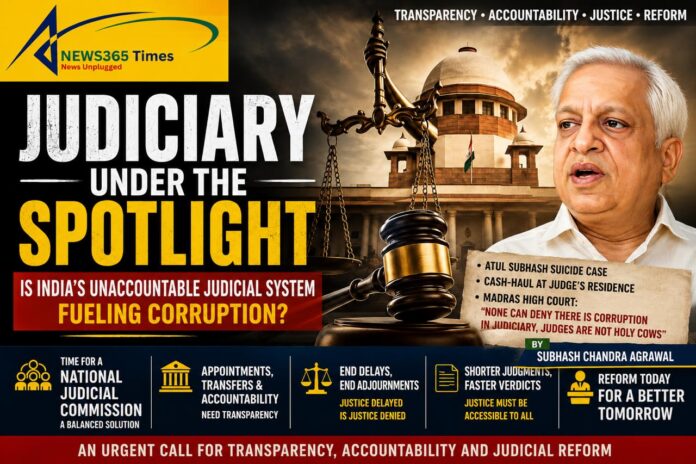
The tragic suicide of 34-year-old Atul Subhash on December 9, 2024, accompanied by a detailed 24-page suicide note and video recording alleging corruption in the lower judiciary, followed by the shocking cash-haul case linked to the New Delhi residence of a sitting High Court judge, Justice Yashwant Verma, has once again brought India’s judicial accountability crisis into sharp focus.
Even more significantly, the Madras High Court itself recently observed:
“None can deny there is corruption in judiciary; judges are not holy cows.”
These developments demand urgent action from lawmakers to bring transparency, accountability, and structural reform into India’s judicial system.
The concern becomes even more serious when viewed against India’s global rankings. The country stands at a disappointing 86th position among 143 nations in the World Justice Project Rule of Law Index.
QUESTIONS THAT REFUSE TO GO AWAY
Allegations involving higher judiciary are not new.
A letter dated March 15, 2010, issued by the Human Rights Division of the Ministry of Home Affairs reportedly stated:
“Because of the adverse media and other reports with regard to Mr Justice Y.K. Sabharwal, it was felt that the highly sensitive post of Chairperson NHRC may not be offered to him.”
The issue becomes more concerning when one notes India’s ranking at 96th position among 180 countries in the Corruption Perception Index and 118th among 147 countries in the World Happiness Report.
The decision by the government to challenge a CIC order seeking disclosure of file notings related to the above matter further raised questions regarding transparency.
THE COLLEGIUM DEBATE
India remains perhaps the only major democracy where judges effectively recommend appointments of judges in higher judiciary.
The Collegium System, responsible for appointments and transfers in the Supreme Court and High Courts, continues to attract criticism regarding lack of transparency and perceived dominance of certain judicial families.
At the same time, appointment powers cannot simply be transferred to political authorities.
A balanced solution may lie in establishing a National Judicial Commission comprising nominees of:
- President of India
- Prime Minister
- Leader of Opposition
- Chief Justice of India
- Bar Council of India
with the Chief Vigilance Commissioner serving ex-officio and the Union Law Secretary acting as Member Secretary.
Such a Commission, headed by the Chief Justice of India, could make final recommendations directly to the President of India.
REFORMING THE SYSTEM FROM WITHIN
Several structural reforms deserve consideration:
Raising Retirement Age
High Court judges should retire at 65 years, bringing parity with Supreme Court judges and reducing lobbying for elevation merely to gain additional years in office.
Indian Judicial Service
India should establish an Indian Judicial Service (IJS) on the lines of the IAS, creating a merit-based pipeline from district courts to the Supreme Court.
Judges Outside Home States
To minimize local influence and conflicts of interest, High Court judges should be appointed outside their home states.
Political Neutrality
No person with an active political background should be appointed as a judge.
Even post-retirement political entry should result in forfeiture of judicial retirement benefits.
Cooling-Off Period
Judges should not accept post-retirement appointments for at least two years after demitting office.
ACCOUNTABILITY WITHOUT IMPEACHMENT
The present impeachment process for removal of judges is cumbersome, impractical, and rarely effective.
A National Judicial Commission should be empowered to:
- Investigate complaints against judges
- Examine complaints against Chief Justices
- Recommend disciplinary action
- Withdraw post-retirement benefits where misconduct is established
Judges are human beings drawn from the same society that contains both honest and dishonest individuals. Judicial office alone cannot be assumed to guarantee integrity.
PAY, PERKS AND PRIVILEGES
Judicial salaries and pensions should be determined by Pay Commissions in the same manner as other public servants.
Extraordinary post-retirement privileges, including lifetime domestic assistance, should be reconsidered.
If pension reforms apply to government employees, similar principles should apply to judiciary and legislature alike.
TRANSPARENCY IN RECUSALS
Every judge—from trial courts to the Supreme Court—should be required to record reasons for recusal.
Such recusals should be declared immediately upon listing of a matter so that fresh benches may be constituted without unnecessary delays.
Mandatory disclosure of reasons would reduce the possibility of external influence and enhance public confidence.
SHORTER JUDGMENTS, FASTER JUSTICE
Many judicial verdicts today run into hundreds or even thousands of pages.
While academically valuable, such judgments often become inaccessible to ordinary litigants.
India should:
- Limit judgment length.
- Issue concise companion versions.
- Deliver verdicts within one month of completion of hearings.
- Refer matters to larger benches within a defined time frame.
THE PENDENCY CRISIS
The biggest weakness of India’s justice delivery system remains:
Ex-parte stay orders
Frequent adjournments
Endless delays
The result is a massive accumulation of pending cases and the continuing relevance of the old maxim:
“Justice Delayed is Justice Denied.”
Even the Supreme Court has repeatedly observed that litigants who secure interim relief often prolong proceedings only to ultimately lose their cases.
SHOULD COURTS HAVE LONG VACATIONS?
The system of extended summer vacations originated during British rule to enable British judges to escape India’s harsh climate and return to England.
More than seven decades after Independence, many argue that such prolonged vacations no longer serve public interest.
With pendency reaching alarming levels, courts may need to align more closely with normal government working calendars.
ENDING COLONIAL LEGACIES
Questions also arise regarding continued usage of colonial-era names for several High Courts.
While Bombay became Mumbai, Madras became Chennai and Allahabad became Prayagraj, corresponding High Court names have not automatically changed.
Future legislation could provide automatic renaming mechanisms linked to changes in state or city names.
THE BIGGER QUESTION
India’s judiciary remains one of the strongest pillars of democracy.
But independence without accountability risks eroding public confidence.
The challenge before lawmakers is not whether reforms are needed, but whether they possess the political will to introduce transparency while preserving judicial independence.
As allegations, controversies and public concerns continue to mount, the demand for meaningful judicial reform is becoming impossible to ignore.
The time for debate may be over. The time for action may have arrived.