

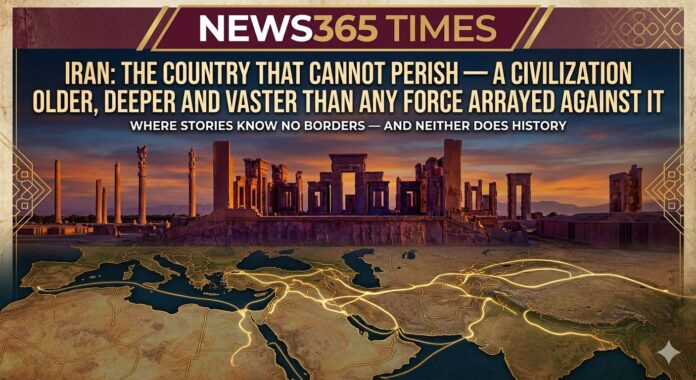
There is a profound arrogance in assuming that a nation born yesterday can extinguish one born at the dawn of recorded time.
To understand why Iran is indestructible — not as rhetoric, but as historical and civilizational fact — one must first grasp the staggering asymmetry between Iran’s age and the age of those who periodically challenge it. The United States of America is 250 years old. The State of Israel, in its modern form, is 77 years old. Iran — the civilization, the language, the people, the idea — is over 7,000 years old.
This is not a political statement. It is an arithmetic one.
I. The World’s Oldest Living Nation
In the latest figures released in 2025, Iran has been identified as the world’s oldest country — a designation based on historical antiquity, the emergence of the earliest organized governments, and the continuity of civilization over thousands of years. This ranking places Iran ahead of Egypt, Vietnam, Armenia, China, and Greece — nations whose civilizations we regard with the deepest reverence.
Many civilizations — such as Egypt or Rome — collapsed at certain points and vanished from the political stage for centuries. Iran, under different dynasties and names, persisted. Unlike those other civilizations, Iran has preserved its language, literature, and many ancient traditions continuously to this day.
The earliest evidence of human occupation on the Iranian plateau dates to approximately 100,000 BC. By the time the Elamites emerged as one of the world’s first organized states around 3200 BCE, they were already producing sophisticated art, architecture, and systems of governance. Some of the earliest open-air settlements in the world are found in Iran, dated to around 10,000 years ago — marking the beginning of the Neolithic revolution, characterized by the expansion of agricultural communities and innovations in material culture, particularly the development of pottery.
In the latest figures released in 2025, Iran has been identified as the world’s oldest country — a designation based on historical antiquity, the emergence of the earliest organized governments, and the continuity of civilization over thousands of years. This ranking places Iran ahead of Egypt, Vietnam, Armenia, China, and Greece — nations whose civilizations we regard with the deepest reverence.
Many civilizations — such as Egypt or Rome — collapsed at certain points and vanished from the political stage for centuries. Iran, under different dynasties and names, persisted. Unlike those other civilizations, Iran has preserved its language, literature, and many ancient traditions continuously to this day.
The earliest evidence of human occupation on the Iranian plateau dates to approximately 100,000 BC. By the time the Elamites emerged as one of the world’s first organized states around 3200 BCE, they were already producing sophisticated art, architecture, and systems of governance. Some of the earliest open-air settlements in the world are found in Iran, dated to around 10,000 years ago — marking the beginning of the Neolithic revolution, characterized by the expansion of agricultural communities and innovations in material culture, particularly the development of pottery.
When Persia’s Achaemenid Empire rose to its zenith under Cyrus the Great, the United States did not exist. The land now called America was a wilderness. The idea of Israel as a modern state lay 2,500 years in the future. Iran was already administering one of the largest and most sophisticated empires the world had ever seen — stretching from Egypt and Anatolia to what is now Pakistan, built on a foundation of religious tolerance, a developed road network, advanced administration, and a writing system.
II. The Cyrus Cylinder: Iran’s Gift to Humanity
Before the United Nations drafted its Universal Declaration of Human Rights in 1948, before Magna Carta, before any modern concept of individual freedom was articulated in legal form — there was the Cyrus Cylinder.
Before the United Nations drafted its Universal Declaration of Human Rights in 1948, before Magna Carta, before any modern concept of individual freedom was articulated in legal form — there was the Cyrus Cylinder.
The Achaemenid Empire was one of the largest in history, and the idea of human rights itself took shape in the Cyrus Cylinder. Issued around 539 BCE, this clay cylinder — now housed in the British Museum — proclaimed the freedom of enslaved peoples, the right of displaced populations to return home, and the abolition of forced labor. Cyrus set free the Jews when he took control of Babylon and even gave them material aid to help rebuild the Temple of Jerusalem.
Iran did not merely develop civilization. It invented mercy as a governing principle.
The civilization that gave the world its first human rights charter is not one that history — or geopolitics — can simply erase.
The civilization that gave the world its first human rights charter is not one that history — or geopolitics — can simply erase.
III. Scale and Geography: A Nation That Dwarfs Its Critics
The sheer physical scale of Iran renders the notion of its erasure almost geographically absurd. Iran is about one-sixth the size of Europe, about one-fifth the size of Australia, and approximately 80 times larger than Israel. It is a country of soaring mountain ranges — the Alborz and the Zagros — scorching deserts, lush Caspian forests, and fertile river valleys, all contained within a single national identity.
The sheer physical scale of Iran renders the notion of its erasure almost geographically absurd. Iran is about one-sixth the size of Europe, about one-fifth the size of Australia, and approximately 80 times larger than Israel. It is a country of soaring mountain ranges — the Alborz and the Zagros — scorching deserts, lush Caspian forests, and fertile river valleys, all contained within a single national identity.
Stretching from the Caspian Sea in the north to the Gulf of Oman in the south, Iran’s landscape is as varied as its history, with key access to critical waterways, including the Strait of Hormuz, through which 20 percent of the world’s oil flows. This single geographical fact — control over or proximity to the Strait of Hormuz — gives Iran a strategic leverage over the global economy that no sanctions regime, no matter how comprehensive, can fully neutralize. If the world’s oil supply is a circulatory system, the Strait of Hormuz is a major artery, and Iran’s heartbeat is felt against it every single day.
Iran holds the world’s second largest natural gas supply and third largest proven oil reserves, making it a middle power of significant geopolitical weight. Its natural wealth is not merely economic — it is civilizational fuel. Nations that sit atop such resources do not disappear. They adapt, they endure, and they wait.
IV. A Population of 92 Million — Young, Educated, and Proud
With a population of 92 million, Iran is the 17th-largest country in the world by population. Its adult literacy rate is 89 percent, with youth literacy nearing 99 percent. The country’s median age is 33–34 years, and about 77 percent of Iranians live in urban areas.
This is not a failing, backward state. This is a nation of tens of millions of highly educated, digitally connected, historically conscious young people who carry within them the memory of Rumi and Hafez alongside the ambitions of modernity.
With a population of 92 million, Iran is the 17th-largest country in the world by population. Its adult literacy rate is 89 percent, with youth literacy nearing 99 percent. The country’s median age is 33–34 years, and about 77 percent of Iranians live in urban areas.
This is not a failing, backward state. This is a nation of tens of millions of highly educated, digitally connected, historically conscious young people who carry within them the memory of Rumi and Hafez alongside the ambitions of modernity.
A civilization with a 99% youth literacy rate and a median age under 35 is a civilization with enormous generational energy — the kind that does not quietly surrender its identity to external pressure.
Iran is a highly diverse country, both ethnically and culturally — Persians make up approximately 61 percent of the population, with significant minorities including Azerbaijanis, Kurds, Lurs, Arabs, and Baloch. Yet through all this diversity, a common thread runs — the Persian language, the shared memory, the civilizational pride that says: we were here before your nations had names, and we will be here after your names are forgotten.
Iran is a highly diverse country, both ethnically and culturally — Persians make up approximately 61 percent of the population, with significant minorities including Azerbaijanis, Kurds, Lurs, Arabs, and Baloch. Yet through all this diversity, a common thread runs — the Persian language, the shared memory, the civilizational pride that says: we were here before your nations had names, and we will be here after your names are forgotten.
V. Science, Poetry and Philosophy: Iran’s Civilizational Software
Every great civilization is defined not only by its borders and armies but by its ideas. Here, Iran’s depth becomes almost overwhelming.
Medicine: Ibn Sina — known to the West as Avicenna — wrote The Canon of Medicine, which remained the standard textbook in European medical universities for six centuries after his death. He was Persian. Iran did not learn medicine from the world. The world learned medicine from Iran.
Mathematics and Astronomy: Al-Khwarizmi, the Persian mathematician, gave the world algebra — the word itself derives from his treatise Al-Kitāb al-mukhtaṣar fī ḥisāb al-jabr. The word “algorithm” derives from the Latinization of his own name.
Every great civilization is defined not only by its borders and armies but by its ideas. Here, Iran’s depth becomes almost overwhelming.
Medicine: Ibn Sina — known to the West as Avicenna — wrote The Canon of Medicine, which remained the standard textbook in European medical universities for six centuries after his death. He was Persian. Iran did not learn medicine from the world. The world learned medicine from Iran.
Mathematics and Astronomy: Al-Khwarizmi, the Persian mathematician, gave the world algebra — the word itself derives from his treatise Al-Kitāb al-mukhtaṣar fī ḥisāb al-jabr. The word “algorithm” derives from the Latinization of his own name.
Every time a computer runs a calculation, it is — in a small, unacknowledged way — paying tribute to a Persian scholar from 9th-century Tehran.
Poetry: Rumi, Hafez, Omar Khayyam, Ferdowsi — these are not merely poets of Iran. They are among the most widely translated and read poets in all of human history. Rumi’s Masnavi is today among the best-selling poetry books in the English-speaking world. A civilization that produces such literature does not merely survive — it colonizes the hearts of its conquerors.
The blossoming of Persian literature, philosophy, medicine and art became major elements of the newly forming Muslim civilization. Inheriting a heritage of thousands of years of civilization and being at the crossroads of the major cultural highways, Iran emerged as the core of what culminated into the Islamic Golden Age. During this period, hundreds of scholars and scientists vastly contributed to technology, science and medicine, later influencing the rise of European science during the Renaissance.
Iran did not merely participate in human intellectual history. It authored significant chapters of it.
Poetry: Rumi, Hafez, Omar Khayyam, Ferdowsi — these are not merely poets of Iran. They are among the most widely translated and read poets in all of human history. Rumi’s Masnavi is today among the best-selling poetry books in the English-speaking world. A civilization that produces such literature does not merely survive — it colonizes the hearts of its conquerors.
The blossoming of Persian literature, philosophy, medicine and art became major elements of the newly forming Muslim civilization. Inheriting a heritage of thousands of years of civilization and being at the crossroads of the major cultural highways, Iran emerged as the core of what culminated into the Islamic Golden Age. During this period, hundreds of scholars and scientists vastly contributed to technology, science and medicine, later influencing the rise of European science during the Renaissance.
Iran did not merely participate in human intellectual history. It authored significant chapters of it.
VI. What 7,000 Years Teaches About Survival
History does not record the death of Iran. It records, repeatedly, the failure of those who predicted it.
Darius III was certain Alexander would not prevail. Persia bent — but did not break. The Mongols were certain they had exterminated Persian civilization in 1258. Within decades, their own rulers were commissioning Persian poetry. Every power that has sought to define Iran from the outside has eventually had to reckon with the fact that Iran defines itself — from a source so ancient, so layered, and so internally coherent that external pressure, however fierce, cannot reach its root.
Iran’s distinction is not only historical — it remains culturally and civilizationally distinct compared with other ancient powers. These features show that Iran holds a unique place among ancient civilizations not only in the Middle East but across the globe.
History does not record the death of Iran. It records, repeatedly, the failure of those who predicted it.
Darius III was certain Alexander would not prevail. Persia bent — but did not break. The Mongols were certain they had exterminated Persian civilization in 1258. Within decades, their own rulers were commissioning Persian poetry. Every power that has sought to define Iran from the outside has eventually had to reckon with the fact that Iran defines itself — from a source so ancient, so layered, and so internally coherent that external pressure, however fierce, cannot reach its root.
Iran’s distinction is not only historical — it remains culturally and civilizationally distinct compared with other ancient powers. These features show that Iran holds a unique place among ancient civilizations not only in the Middle East but across the globe.
A nation with 100,000 years of human habitation, 7,000 years of civilization, 29 UNESCO World Heritage Sites, the world’s greatest poets, the inventor of algebra, the author of the world’s first human rights charter, and a strategic grip on 20% of the world’s oil supply — such a nation does not perish.
It outlasts.
It outlasts.
Epilogue: The River That Does Not End
When the great Persian poet Hafez wrote — “Even after all this time, the sun never says to the earth: ‘You owe me.’” — he was not merely writing about love. He was describing the nature of Iran itself: a civilization that gives and gives and gives — poetry, science, philosophy, statecraft, beauty — without demanding acknowledgment, without requiring permission, without waiting for the world’s approval.
When the great Persian poet Hafez wrote — “Even after all this time, the sun never says to the earth: ‘You owe me.’” — he was not merely writing about love. He was describing the nature of Iran itself: a civilization that gives and gives and gives — poetry, science, philosophy, statecraft, beauty — without demanding acknowledgment, without requiring permission, without waiting for the world’s approval.
Iran has been called many things by many powers across many centuries. It has been called conquered. It has been called defeated. It has been called dying.
And yet — here it stands. Older than almost every nation that has ever presumed to judge it. Deeper than any geopolitical crisis that surrounds it. Vaster in memory than any modern state can comprehend.
The country that cannot perish does not need to announce its resilience. Seven thousand years of unbroken presence does that quietly, permanently, and with the serene confidence of a civilization that has simply seen too much history to be frightened by any chapter of it.
And yet — here it stands. Older than almost every nation that has ever presumed to judge it. Deeper than any geopolitical crisis that surrounds it. Vaster in memory than any modern state can comprehend.
The country that cannot perish does not need to announce its resilience. Seven thousand years of unbroken presence does that quietly, permanently, and with the serene confidence of a civilization that has simply seen too much history to be frightened by any chapter of it.
“They tried to bury us. They didn’t know we were seeds.” — Persian Proverb