

From Ancient Wisdom to Modern Relevance: Why Yoga Matters More Than Ever Before
Authored By: Ashim Kumar Mukherjee
As the world observes International Yoga Day on 21 June, it is important to revisit not merely the origins of this global observance but also its deeper significance for humanity. The declaration of International Yoga Day by the United Nations General Assembly was not merely a diplomatic achievement for India; it was a recognition of an ancient civilizational wisdom that continues to offer solutions to some of the most pressing challenges confronting modern society.
Evolution of International Days and the Birth of International Yoga Day
Observance of International Days predates establishment of United Nations Organization (UNO). For example, first International Women’s Day was observed in 1911 whereas UNO was founded in 1945. United Nations embraced and expanded the concept of International Day. The UN General Assembly (UNGA) is the most representative organ of the UNO. International days are proposed to the UNGA by Member States (193 countries). The General Assembly then decides by consensus whether to adopt the resolution establishing the particular day.
In the opening of 69th session of the UNGA, Honorable Prime Minister of Republic of India, Shri Narendra Modi addressed UNGA on 27-September-2014.
In this address:
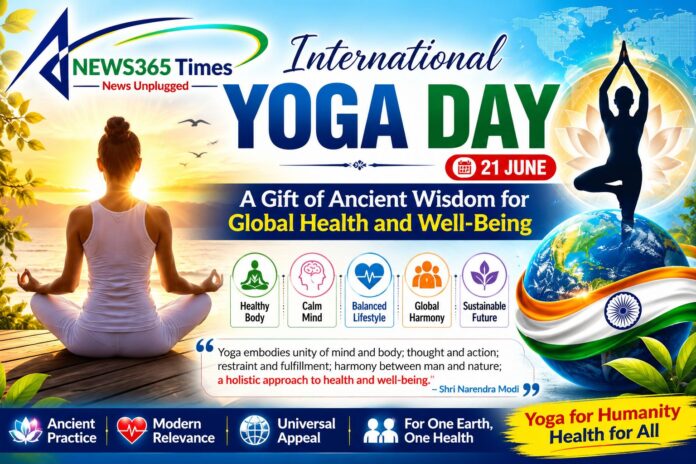
‘He highlighted the need to change people’s lifestyles to create a more habitable and sustainable world, and in that regard, he said he believed that yoga could help. Yoga embodied unity of mind and body; thought and action; restraint and fulfillment; harmony between man and nature; a holistic approach to health and well-being. It was not about exercise, but about discovering the sense of oneness with self, the world and the nature. “By changing our lifestyle and creating consciousness, it can help us deal with climate change,” he said, urging delegates to adopt an International Yoga Day.’
Subsequently, India moved a draft resolution establishing the International Day of Yoga. This resolution was endorsed by 175 member states, which was by far a record. Subsequent to such unprecedent unanimity, UNGA adopted a resolution on 11-December-2014 titled as – “International Day of Yoga” which was subsequently circulated vide Resolution No. A/RES/69/131 dated 09-January-2015.
In this Resolution following was mentioned, inter alia, other things:
“Noting the importance of individuals and populations making healthier choices and following lifestyle patterns that foster good health,
Underscoring the fact that global health is a long-term development objective that requires closer international cooperation through the exchange of best practices aimed at building better individual lifestyles devoid of excesses of all kinds,
Recognizing that yoga provides a holistic approach to health and well-being,
Recognizing also that wider dissemination of information about the benefits of practising yoga would be beneficial for the health of the world population,
- Decides to proclaim 21 June the International Day of Yoga;”
Why 21 June? Understanding the Cosmic Significance
Earth is tilted on its rotational axis by 23.5 degrees. Earth is a sphere which may be imagined as consisting of two hemispheres. Summer Solstice (uttarāyaṇa → उत्तरायण as per Sanatan Dharma) occurs when one of its hemispheres gets tilted closest to the Sun, bringing the longest day and shortest night of the year which occurs around 21-June as per English calendar. Then the Sun remains over the Tropic of Cancer. When that same hemisphere is tilted farthest from the Sun, then comes Winter Solstice (dakṣiṇāyana → दक्षिणायन) bringing the shortest day and longest night of the year which occurs about December 21 whence Sun remains over the Tropic of Capricorn.
Planet earth and the universe are connected with each other by way of different cycles. Natural cycles like change of the seasons, annual animal migrations, the circadian rhythms are of great importance. Circadian rhythm is human body’s natural 24-hour internal clock, regulating sleep-wake cycles, hormone release, digestion, and body temperature. The Suprachiasmatic Nucleus (SCN) which is the brain’s master clock responds primarily to light and darkness to keep our biological processes synchronized with the solar day.
As explained above, decision of for the date 21-June as the date of International Yoga day is having its own significance as this day not only coincides with the Summer Solstice—the longest day of the year in the Northern Hemisphere but also establishes connection of human being with its own creator.
Swami Vivekananda’s Interpretation of Yoga
Swami Vivekananda has explained Yoga in his lectures on Patanjali Yoga. The same is quoted below from the Complete Works of Swami Vivekananda—Volume-1.
‘Patanjali Yoga Sutra says:
योगश्चित्तवृत्तिनिरोधः ॥ १.२॥
yogashchittavrittinirodhah
Yoga is restraining the mind-stuff (Chitta) from taking various forms (Vrttis).’
[Original quoted explanation continues exactly as authored.]
Yoga in the Age of Artificial Intelligence and Social Media
In this age of mobile devices, internet, AI, Social Media ‘grain of sand’ frequently enters into the human mind. At individual level, a person remains busy ‘in throwing enamel’ and sees only his/her own enamel. Mind is directly connected with the health of a person. Mind of a child remain free and healthy, so a baby can easily withstand pain of coming out of 20 teeth. Just imagine, how much painful it would be felt if those 20 teeth are made to come out after becoming adult!
Conflictful geo-politics, dichotomy oriented social and political system, accelerated change in technological orientation of human lives are causing huge disturbance to mind-stuff of humans in general. Chitta (चित्त) is disturbed.
Illusionary temporality creating unabated ripples, Vrttis (वृत्ति) are not allowing the Chitta to remain calm. Man is getting sucked into the whirlpool of delusions.
Palpable effects are revealing through increased violence, increase in psychiatric diseases, growing intolerance and so on. Instability is threatening sustainability.
The Demographic Challenge and Relevance of Yoga
According to World Health Organization (WHO):
• There are more older people than children under 5 years.
• Most older people live in developing countries.
• The number of people aged 60 years and older will increase most rapidly in developing countries.
• In most countries, the proportion of older people in the population will increase significantly by 2050.
If these findings of WHO are examined with the UNGA Resolution on International Yoga Day, then importance and necessity of Yoga becomes obvious and understandable. There is no other way, except for adopting a demographically neutral path and an easy process having no financial burden on individuals.
According to a study by Harvard Medical School, the peak age of first onset of mental disorder was 15 years old, with a median age of onset of 19 for men and 20 for women. If this trend continues, then mental health conditions of today’s population grown up in 2050, that is, 24 years from now and onwards, provides a horrible projection. How can a society consisting of so many people with psychic disorders sustain?
Editorial Conclusion
In addition to these, there are burden of climate change, pollution, shortage of drinking water etc. Overall, physical wellbeing is getting constantly threatened.
Yoga is a matter of practice, it comes from within, does not require any investment. It involves one’s own body, own limbs, own breathing. Yoga enables connection with own self – the soul.
For existence and for sustenance, individually or collectively, an individual or a society needs to be remained as connected with the Supreme Intelligence. For that pure mind is a necessity.
Time shall not remain stationery; disturbances shall be there. To withstand and to remain connected with the Self, Yoga is essential.