

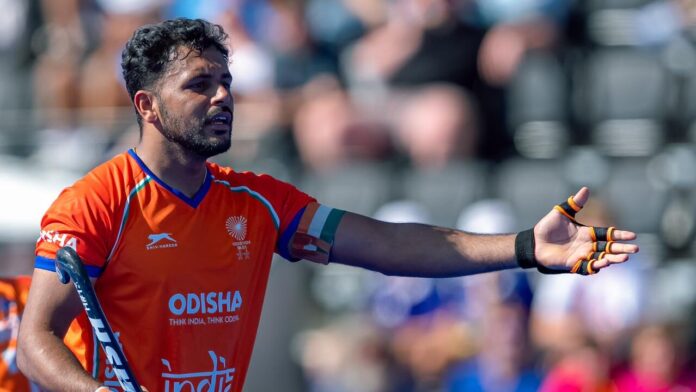
India’s men’s hockey team arrived at the 2026 World Cup with genuine hopes of going deep into the tournament. Instead, their campaign ended in the championship stage, leaving behind a familiar feeling of frustration. The quality was there, the experience was there, and the team had already shown during the Pro League that it could compete with the best. But when the World Cup demanded something different, India could not find the answers quickly enough.
The warning signs were visible from the beginning. India’s opening defeat to England put them under pressure early. They had led 2-1 but eventually lost 4-2, leaving little room for another slip-up. The win over Pakistan kept the campaign alive, but the bigger challenge was always going to come against teams such as the Netherlands and Argentina. Those matches exposed the areas India had struggled with throughout the tournament.
Craig Fulton’s team has been built around defensive organisation and quick attacks after winning the ball. It is a style that has worked for India. The problem was not the philosophy itself. The problem was what happened when opponents stopped giving India the space required to make that approach effective.
Against stronger teams, India struggled to take control through the middle of the pitch. Hardik Singh and Manpreet Singh were still important figures, but India often found it difficult to turn possession recoveries into sustained pressure. Too many attacks ended before they could properly develop, leaving the forwards with limited opportunities.
That also explains why it would be unfair to put the entire burden of criticism on the forward line. Players such as Abhishek, Sukhjeet Singh and Dilpreet Singh still have important roles to play, but forwards need service. When the ball does not reach the attacking third with enough quality or regularity, finishing becomes only part of the problem.
The other concern was tempo. India had looked sharper in transition during the Pro League. At the World Cup, particularly against the better sides, the movement of the ball was not always quick enough. For a team that relies heavily on turning defensive recoveries into attacking opportunities, even a small delay can allow the opposition to regroup.

There was also a tactical question. India needed another route when the counterattack was not available. Fulton has spoken about the team being capable of playing faster attacking hockey, but the tournament did not show India executing that alternative consistently enough. If that was the second plan, it needed to become a more familiar part of the team’s game before the pressure matches arrived.
The players cannot escape responsibility either. Experienced internationals are expected to recognise when a match is drifting away from the original plan. Against Argentina, India looked flat for periods despite having enough time to change the contest. Harmanpreet Singh eventually moved higher and tried to influence the game from another area, showing the kind of initiative that India needed more consistently.
The comparison with Paris 2024 is important. Many of these players were part of the Olympic bronze-winning side. The quality has not disappeared overnight. At Paris, India were able to rely on their defensive structure and showed remarkable resilience, including in the quarter-final against Great Britain after playing much of the match with ten men.
The World Cup offered a different challenge. The new format left less room for recovery, while the championship stage forced India to chase results. That exposed a weakness in their ability to dictate games when patience and counterattacking alone were not enough.
So where does India go from here?
The next major target is the Asian Games, where India will enter as defending champions. They have been placed in Pool A alongside Japan, South Korea, Bangladesh, Sri Lanka and Indonesia. Pakistan, Malaysia, China, Oman, Uzbekistan and Thailand are in the other group, meaning the traditional rivalry with Pakistan can only happen once the knockout rounds arrive.
For India, this tournament carries significance beyond another gold medal. Winning the Asian Games would secure direct qualification for the Los Angeles 2028 Olympics. Given India’s standing in Asian hockey, anything less will be viewed as a disappointment.

But the Asian Games should not simply become an opportunity to forget the World Cup. It should be used to address what went wrong. India need greater control in midfield, quicker ball movement and a more reliable attacking option when opponents sit deep. The balance between attacking numbers and defensive security also needs work.
The core of this team still has plenty to offer. Harmanpreet Singh, Manpreet Singh, Hardik Singh and Jarmanpreet Singh bring experience, while the younger players need to be given the responsibility to grow alongside them.
The World Cup has ended, but the road to Los Angeles is already beginning. India’s next challenge is not just to win the Asian Games. It is to make sure that when the next major tournament forces them outside their comfort zone, they have the answers ready.
For More Updates Follow RevSportz
The post India’s World Cup Exit: What Went Wrong and What Comes Next appeared first on Sports News Portal | Revsportz.