

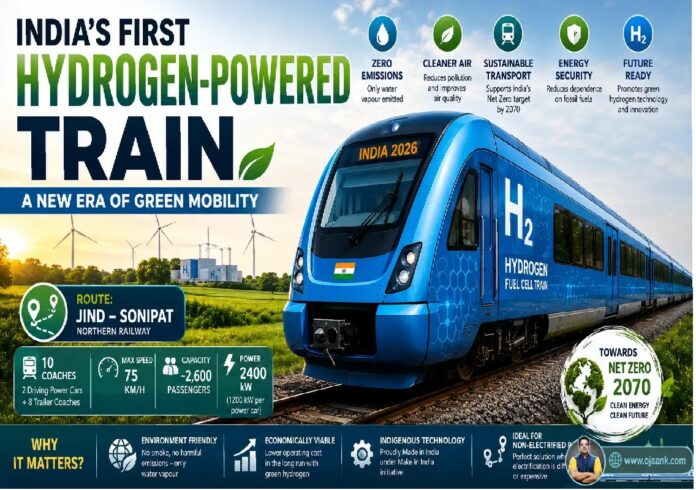
India’s first hydrogen-powered passenger train has completed around 6,000 kilometres since its launch, marking a significant early milestone for the country’s shift towards cleaner railway technology. Prime Minister Narendra Modi flagged off the train between Jind and Sonipat in Haryana on July 17.
India’s longest hydrogen train begins a new journey
The 10-coach train can accommodate around 2,600 passengers and operates at a maximum speed of 75 kmph, despite having a design speed of 110 kmph. With a propulsion capacity of 2,400 kW, it is described by Indian Railways as among the world’s longest and most powerful hydrogen-powered trains.
The train was designed and developed in India, with RDSO, Integral Coach Factory and Medha involved in its development and integration. A dedicated hydrogen storage and refuelling facility has also been established at Jind.
Hydrogen technology offers cleaner rail travel
The train uses hydrogen fuel cells to generate electricity by combining hydrogen and oxygen. The process produces water vapour and heat as by-products, with no direct tailpipe carbon emissions.
Indian Railways has estimated that the train’s operation has helped avoid around 36,444 kg, or nearly 36 tonnes, of carbon dioxide equivalent emissions.
The technology could prove particularly useful on railway sections where conventional electrification is difficult. Heritage and remote routes could potentially benefit from hydrogen-powered trains in the future, although wider deployment would depend on operational and infrastructure requirements.
A step towards greener railways
India has joined a select group of countries exploring or operating hydrogen-powered rail systems. The Jind-Sonipat service is currently serving as an important demonstration of the technology under regular passenger operations.
The milestone is significant not only for cleaner transportation but also for India’s growing ability to design and integrate advanced railway technologies domestically.